There were three guys at Mount Union who took me home on a regular basis. I called them “friends.” I’m not sure what they called me.
All three guys drank like I did.
It’s not my place to diagnose whether or not The Three were alcoholics. I can say that they had some things in common, and they had characteristics that I later identified as part of my own alcoholism.
For example, I never saw any of them outside of class when they weren’t drinking. If they went to class at all, they were hungover. Just like me.
They often walked around double-fisted at parties and bars – meaning with a drink in each hand. Just like me. (I found this to be an attractive trait.)
Also, when I ended up with one of these guys it was often because everyone else had gone home and we were still drinking. Sometimes the lights would suddenly blare, shocking us from darkness into florescence. The floor would be riddled with empty red cups and cigarette butts and sticky, chunky globs no one could identify.
But I didn’t want to quit drinking yet (meaning, I hadn’t yet passed out), so I would go with them to their rooms. And then – unlike with other guys – we would play music, dance, laugh, talk and … inevitably, we’d drink until we passed out.
If he passed out first, I would sit up, listening to music and continuing to drink. I didn’t realize then that I never purposefully “went to bed” anymore. I just passed out. I would walk home sometime after the sun came up, feeling like I’d accomplished something wonderful. This was never a “walk of shame;” it was a personal victory.
The other thing about these guys: I adored them. I thought they were funny and sweet and interesting. And they treated me with a respect I didn’t usually get from one-night-stands. We talked about our lives. I knew what their majors were, what they wanted from life, why they chose Mount Union. We laughed a lot.
I actually knew them. These little drunken friendships gave me hope. And hope was a revelation, since I was learning about people one person at a time. Men weren’t all Prince Charmings and they weren’t all idiots.
I didn’t know how much I could like a man without feeling like I needed to either detest or marry him. Drinking into the wee hours with the soundtrack of our lives forming in the background was not only pleasant, it was life-affirming.
I know that not all people learn things this haphazardly; I insisted on learning everything the hard way.
To be fair, if I’d looked around a bit more, I would have found other men that weren’t reprehensible. I just didn’t know to look for rational, level-headed humans, especially at the end of the night when my shoes were stuck to the beer-laden floor and I was holding my left hand over my eye so I could walk without bumping into anything.
I think about each of The Three from time to time, usually when a song plays that reminds me of one of our nights together. I wonder where they went, what happened to them. None of them are on Facebook – or if they are, they’re well hidden. For all I know, they could be dead.
But I hope they are alive. I hope they’re sober or, at least, clear-headed enough to have created an exquisite adulthood. I hope they found meaning in their lives and loving people with whom to hang, even after the lights came on and the party was over.
After meeting famous rock stars on our spring break in Chicago while all the other college students went to Florida and danced in the sun, Bonnie and I believed we’d reached a sort of holier-than-thou status. We’d touched greatness; our lives would never be the same.
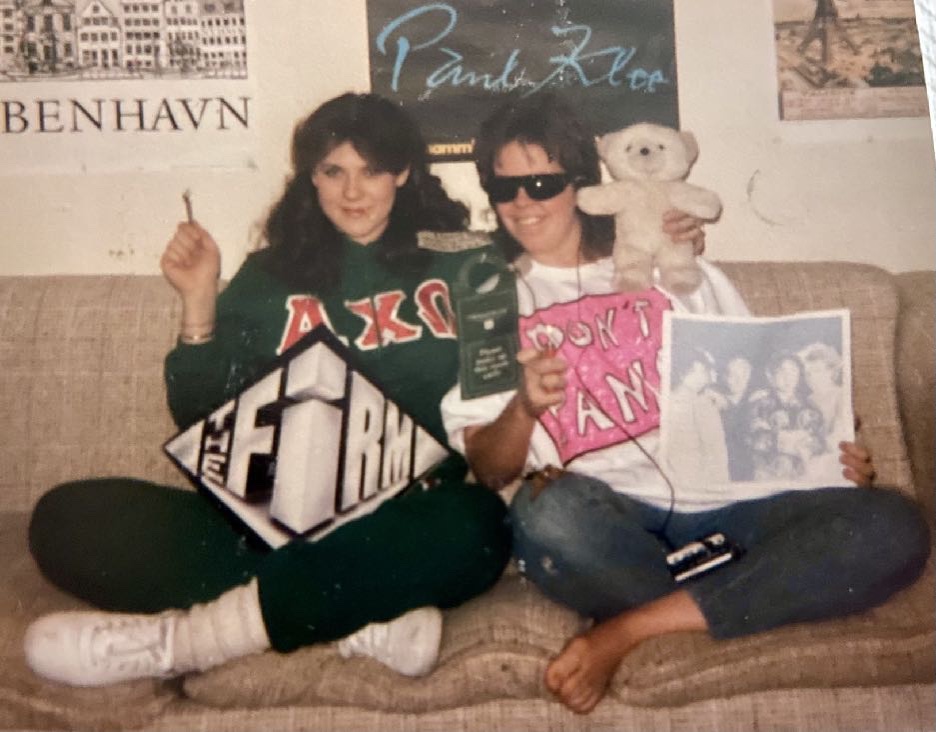
We spent the last few months of my junior year staring at The Firm poster on Bonnie’s dorm wall, listening to the album, crying and reliving the moments. We hung out at the sorority house where there was a TV, watching MTV from morning until night hoping for a glimpse of the band’s video for Radioactive. When the video came on – just a three-minute clip of the band playing – we would scream like they could hear us. We absorbed and memorized every note, facial expression and movement for the entire video.
When MTV announced the release of The Firm’s second video, Satisfaction Guaranteed, we were elated. We camped out at the sorority house waiting for it to play. (This wasn’t necessary, since MTV provided the exact hour it premiered.) When it finally started, Bonnie and I got deathly quiet, staring at the screen, waiting to see … something new.
The video was a huge disappointment: a mash of hot, sweaty people standing around and the band sweating along with them. The video showcased Jimmy’s ability to play his guitar with both a beer bottle and a violin bow, things he’d done in his Led Zeppelin years.
I suppose this is impressive if you’re not looking for the guys you met in some random bar in Chicago. But Tony – the bass player and Bonnie’s tryst – was barely featured and Phil, the road manager, was certainly nowhere to be seen.
Even Jimmy looked wrong. When we’d met him, Jimmy was sullen, eyes glazed over, no one inside. He was wasted, grumpy, almost mean, slumped and slurring his words. In the video Jimmy is fun, a legend, a bit of a trickster with a gleam in his eye.
Decades later, I saw Jimmy Page on TV. By then he only barely resembled the guy we met in the bar.
In 1985, Jimmy was drinking heavily and chain smoking. He looked like a puppy in a downpour waiting to drown. Jimmy has since given up all substances – alcohol and cigarettes included. Decades older now, being clean gives Jimmy a youthful countenance unlike anything we saw in 1985. He looks and sounds like a completely different person – upbeat and smiling and engaged in life.
But in 1985, he was just a guitar legend that had temporarily dropped down to earth and spent a few hours near Bonnie and me. We started to believe we weren’t ever going to be right again – although we didn’t know what it would entail to make our “new” lives whole. We felt like we’d experienced mind-blowing astral projection when all we did was party with strangers in Chicago.
College wasn’t the same. Parties on campus weren’t the same. Hanging with our friends wasn’t the same. We thought we might die of heartbreak, even though there was no love involved. We were starstruck teenagers on a mission to regroup with a rock band we randomly found in a bar.
So it was fortunate when, that very summer, Bonnie and I found them again. But first, I had to finish my junior year of college.
Bonnie wanted to sleep with Jimmy Page. It didn’t matter that he was just an old man (40), or that some woman in go-go boots was practically climbing on him, not allowing any of us to get closer to Jimmy Page than was absolutely necessary.
Bonnie held up a cigarette and asked Jimmy for a light. He obliged – and Bonnie pocketed his lighter.
The Firm’s lead singer, Paul Rogers, and drummer Chris Slade slipped out the door pretty quickly when they realized we were starstruck kids. Their darling British accents were enough to star-strike anyone, but Bonnie was out of her mind. She couldn’t believe she was talking to The Legend Himself.
Since Bonnie was suddenly overwhelmed with a need to follow Jimmy Page wherever he might go, I decided I would like to sleep with the guy with the big hair. Bass player Tony Franklin was very cute.
But Jimmy wasn’t interested in Bonnie; he already had his bizarre arm candy.
And Tony wasn’t interested in me, but Bonnie struck his fancy.
That left me completely ignored. So like a small child, I went into the bathroom and sobbed.
Bonnie, who hadn’t given up hope that she’d snag a night with her idol, quickly realized I was inconsolable. Not wanting to blow her chances with Jimmy, she left me alone in there – and sent the bartender to make sure I didn’t kill myself while she was hanging with the band.
The bartender – a nice young woman who’d probably seen this sort of thing a thousand times – tricked me into laughter with some kind of joke snot – yes, snot – that appeared to be coming out of her nose and hanging all the way to the floor. Drunk as I was, I actually fell for the rubbery trick. And while I am not normally a fan of gross humor, I admired her ability to make me forget why I was crying.
I rejoined the bar crowd. Shortly after I reappeared next to Bonnie, we all headed back to The Firm’s hotel.
There were at least two dozen people milling about in the suite. Alcohol was free for the taking in ice buckets around the room. People were smoking everywhere. Almost immediately, someone offered us cocaine.
That’s when I hunkered down near Phil, the guy with the rolled-up hundred dollar bill.
After even limited exposure to cocaine, I knew this was the drug for me. I don’t remember socializing anymore that evening, except when Bonnie and I went (together) to the bathroom in the adjoining hotel room. When I came out of the bathroom, she was holding a wallet taken from someone’s open suitcase.
“There’s a million fucking hundred-dollar bills in here,” she said.
“What are you doing?” I scream-whispered. “Put that down!”
She pulled one hundred-dollar bill out of the wallet. “They’re not going to miss one of these,” she said, tucking it into her jeans like a gum wrapper.
Eventually Bonnie and Tony disappeared together (Jimmy long gone) while I spent the night with Phil Carlo, The Firm’s (and Led Zeppelin’s … and Bad Company’s) road manager. What I remember best is Phil showing me pictures of his two adorable kids and both of us laughing all night long.
Sex isn’t necessary when you have cocaine.
Bonnie and I felt guilty taking Phil’s money for a cab in the morning – but not guilty enough to stop us from going shopping at Chicago’s luxurious Waterworks Plaza with the stolen hundred dollars.
Bonnie bought a stuffed bear. I bought my favorite-ever neon pink DON’T PANIC! shirt.
As Bonnie and I drank our way through downtown Chicago, we stumbled inside a bar called Mother’s.
Atop a set of steep stairs sat the bouncer. “IDs please,” he said, looking straight at me.
The drinking age in Chicago was 21; I was 20 and Bonnie was 18. Bonnie had a fake ID that she’d been using for years. It had her picture on it and her own birthday. I was using my friend Jodi’s fake ID – whose picture (not mine) was on the ID, along with a completely fabricated name, birthdate and New York address.
The bouncer watched me swaying and said, “What’s your address?”
I looked at Bonnie for support; I wanted to run.
“Why are you looking at her?” the bouncer said. “Don’t you know your own address?”
I spit out something that may or may not have been the right address. So he asked for “my” birthday – which I had memorized; I quickly spit out the digits from Jodi’s fake ID.
The bouncer rolled his eyes and handed back our IDs. He didn’t even quiz Bonnie who, at 18, looked at least 25 while I looked 16 until I was almost 30.
We made our way down the steep stairs and into the bar. We ordered very strong drinks to calm our nerves after the close encounter. Then we started to enjoy ourselves in the otherwise very empty bar.
Maybe half an hour later, a group of freaky people came in. They sat at the bar, too, a few stools away.
“Oh my god look at his hair!” I whispered, probably too loud for the very small space. My comment couldn’t have been new to the guy whose hair-sprayed ‘do resembled a bleach-blonde Everest. A cross between a mohawk and a pompadour, that guy’s hair was totally 80’s.
Bonnie looked where I was pointing. “I think that’s Jimmy Page,” she said.
I had no idea what Jimmy Page looked like. “He’s like 20!” I said about the hair-guy.
“Not him!” Bonnie hissed frantically. “The guy sitting next to him! That’s fucking Jimmy Page!”
Jimmy Page, the legendary Led Zeppelin guitarist, was one of Bonnie’s idols. Bonnie did her high school term paper on Stairway to Heaven.
“That can’t be Jimmy Page,” I said. To me, the guy she referenced looked old and tired. Plus there was a girl stuck to him who looked like she’d just stepped out of 1962 in her gold miniskirt and thigh-high boots.
“I’m going over there,” Bonnie said.
Of course I went with her, terrified to my core.
********************************
FLASHBACK to a day in an airport, when I was young. My family and I were walking through the airport, back when airport lounges were wide open, cigarette smoke pouring into the fray.
An old man with huge glasses and a cigar sat front and center at the airport lounge; everyone insisted he was George Burns. As “cute little kid,” someone gave me 50 cents to ask “George” if he was the person he appeared to be.
It took every ounce of courage in my tiny body, but I walked over and asked.
“George” (who sounded exactly like George Burns) laughed and said, “No, but I get that all the time.” To this day, I have no idea if I met George Burns.
But in Mother’s bar in Chicago on that cold day in 1985, I definitely met Jimmy Page.
I also met Bad Company’s Paul Rogers, drummer Chris Slade and bassist Tony Franklin, all members of Jimmy’s new band, The Firm.
While Bonnie and I were in Chicago, I proudly wore my wraparound black sunglasses everywhere we went. They were plastic and blindingly dark, especially in the dark bars we frequented.
But I didn’t want to take them off. I thought I looked cool. So when I walked into the bar, already drunk, I tripped over the threshold, nearly landing on my face.
Bonnie thought this was hysterical. “It’s like you’re blind!” she shrieked. “Ohmygod you should be blind! Let’s tell everyone you’re blind!”
“But I’m not …”
“No! Be blind! And I’ll lead you around by the arm, you know, like they do with blind people. Here, here, take my arm!”
I took her arm and pretended I couldn’t see. It was an interesting way to enter a bar.
I’m not sure who we were supposed to “tell” about my blindness. We were 400 miles from campus and didn’t know anyone in the place. But I continued to be “blind” with Bonnie helping me onto the bar stool, ordering drinks for me, sliding the drink into my hand every time I wanted a sip. Apparently being blind meant being entirely incapacitated.
It didn’t take long before we were approached by two guys, both our age and adorable. The ruse continued.
Bonnie told them, “She has to feel your face to see what you look like.” And she put my hand on one guy’s cheeks, so I explored his face from hair to chin. Then she moved my hand to the other guy’s face.
I had no idea what I was supposed to “see” from touching them; we had a tough time not laughing through this ridiculous form of greeting.
We chatted with the guys and continued to drink. And drink. And drink.
At one point, I fell completely off my stool. I was so wasted, I simply couldn’t stay upright. I started to laugh; I certainly couldn’t feel any pain.
Bonnie leaped to her feet screaming, “The blind girl’s hurt! The blind girl’s hurt! Get out of the way!”
She helped me to my feet and carefully and quietly led me to the bathroom. When the door shut behind us we fell onto the floor, sprawled in hysterics. We were laughing so hard, it became impossible to do anything but roll around into one another, tears of laughter pouring from our eyes.
I believe this is the moment when someone coined the term “rolling on the floor laughing.”
My black glasses fell off in the hoopla, leading Bonnie to reveal her next brilliant idea. “Ohmygod let’s say that when you hit your head, you regained your eyesight! This stuff happens all the time, right?”
I was crying and laughing too hard to even respond. I started to put my glasses back on.
“No no no no!” Bonnie grabbed the glasses. “Leave them off!”
We walked back into the very dark bar, Bonnie still holding my arm. “It’s a miracle!” she yelled as we made our way through the crowd. “The blind girl can see! Step aside! It’s a miracle!”
We got back to the bar, where we casually climbed back onto our stoools next to the guys, grabbed our drinks and took a few gulps while the guys stared, wide-eyed.
We said nothing.
Finally Bonnie swallowed and turned to the guys, stoic. Then suddenly she said, “When she hit her head, it must have knocked something back into place! She can see now! It’s a miracle! She can see!”
We both started to laugh so hard, I almost fell off my bar stool again.
When Spring Break rolled around during my junior year, Bonnie and I wanted to go somewhere and do something really cool.
“Let’s to South Beach!” she suggested – a hub for college kids seeking the kind of drinking extravagance only Miami in March can provide.
I didn’t know anything about Florida. “If we’re going somewhere warm, let’s go to Los Angeles!” I said. Obviously I didn’t know anything about Los Angeles either. I dreamed of wandering on Venice Beach like Jim Morrison, spouting poetry and dragging my toes through the sand. I had no idea that the Pacific Ocean was cold, and I sure didn’t know about the riff raff at Venice Beach.
We brainstormed ideas, imagining the entire world as a Spring Break option, until we finally decided to discuss our plans with our parents.
“How are you going to pay for this trip?” my parents asked me.
“Well I was hoping you would pay,” I said. I’d made some money at Kennywood and I got an allowance for college expenditures, but I didn’t have any savings.
After much discussion, my parents suggested that we consider going somewhere slightly less exotic. If we did, they said, they would help with costs. Bonnie’s parents said about the same thing. So we regrouped.
“Everybody goes to Florida for Spring Break,” Bonnie said. “We should go somewhere where nobody else goes.”
“I guess we could go to Delaware,” I said, trying to pick a place I’d never seen that wouldn’t be crowded.
“Delaware?!” Bonnie scoffed. Then she brightened. “Hey! My brother lives in Chicago! And he’s the coolest person in the whole world! They have tons of bars and restaurants and nightclubs that stay open all night long! Let’s go to Chicago!”
I didn’t know Bonnie’s brother, but she’d always said good things about him. Best of all, he was gay – so I didn’t have to worry about him ogling me. The drinking age in Illinois was 21, so we had to finagle a way around that. But otherwise, the bright lights and big city were suddenly calling me.
In 1985, while all the other college students flew south, Bonnie and I flew northfor Spring Break.
And it was cold. It was early March in Chicago – bitterly, brutally cold. The wind blew so hard, we literally helped an old woman cross the street. She was standing on the curb, hanging onto a lamp post, unable to step down for fear of having her 98-pound self blown over by the gusting wind.
She could not have crossed the street without us.
But we were helpful and happy and young and eager and excited and thrilled to be somewhere – anywhere – other than our little campus in Ohio.
I remember going to one bar at 3 a.m. – after the bar where we’d been drinking had closed – and it was like being transported into a movie. Lights and colors and sweaty dancers and deafening music filled the warehouse … and we wandered into the crowd, bouncing around but tired. When we wandered outside, it felt like we were in a different universe.
Chicago was different.
Little did we know what a huge effect our Spring Break would have on our psyches.
Drugs weren’t commonplace at college. Unlike today, when free-floating CBD oils and legalized THC gummies boast their own stores, Mount Union students didn’t readily espouse marijuana and cocaine as acceptable forms of recreation.
A big event instead would be a party that offered something in addition to kegs of beer – meaning, shots of tequila or some fancy mixed drink, like rum-and-coke.
To be honest, I preferred drinking beer to “fancy” stuff. There was something to be said for getting drunk at a slow and consistent pace, with an expected and often acquired result. Vomiting and head spins were still optional, but I knew what I was getting with beer.
By my junior year, I was an expert at having a few beers before the party, then deftly finding my way to the keg as soon as I arrived. I considered myself “impressive” because I could put away a ton of beer. (Very few others considered this feat impressive.)
But I realize now that drinking was almost the only thing I did in college. Sure, I went to classes and somehow graduated. But every day – especially after I hit the ripe old age of 20 – my efforts focused on how and when I could – and would – drink.
This is not to be confused with the Harley-Davidson motto “live to ride; ride to live,” which entered my life later.
Here’s a metaphor to explain what happened:
Imagine that you wake up and you have Cheerios for breakfast every day. You eat the Cheerios, then you go off to work. You have a sandwich or salad for lunch, then finish your day – you work, go home, go to the gym, have dinner, watch TV – whatever you do. Then you go to bed.
The next day, you wake up. You have Cheerios for breakfast as always, but you eat the last of the bag. Suddenly you panic because you remember you heard about a shortage of Cheerios. You go to work anyway, but you obsess all morning about cereal. You spend lunchtime hopping from store to store, looking for Cheerios, to no avail. Suddenly there are no more Cheerios anywhere.
You can’t think at work; you spend your entire afternoon looking online for Cheerios. There’s no rest. You can’t go home. There’s no time to relax or watch TV. There’s nothing but the inside of your brain screaming: I MUST HAVE CHEERIOS! And there are zero Cheerios. From this day forward, there will never, ever be enough Cheerios. Worse yet, there is no reasonable alternative.
Addiction is that simple, that stupid, and that incessant. It’s like a flip switched in my brain and I became irreparably obsessed.
During my junior year of college, my life quietly evolved from “collegiate fun” to “maniacally compulsive.” There was no prior thought, no decision made. I didn’t sit down and think, You know, I think I’d like to spend more time drinking and less time doing everything else.
I just … stopped caring about anything except Cheerios – oops, I mean alcohol.
It happened as quickly and as silently as a ball of dust rolling into a corner behind a desk.
I never saw it coming; I didn’t even know it happened. At the time, I didn’t care. My life was glorious, carefree and wonderful. I wanted nothing except … more beer.
I didn’t skip a beat without Scott. As I slunk further and further into my drunken ways, I continued to do whatever I wanted to do, believing I was more alive, more independent, and more free than I’d ever been before.
I didn’t feel the invisible chains. But things started happening that I didn’t want to happen.
Bonnie and I still had our pact that we would never leave a bar with a stranger – unless we left together with two strangers – but sometimes those strangers were not of my choosing.
I remember one night in particular when Bonnie and I were the only two people left in the bar at closing time, with the exception of two guys with really bushy facial hair and bad teeth. They were throwing gutter lines at us like, “Hey ladies, ya wanna get lucky?” They weren’t exploring our intellectual prowess.
At 2 a.m., Bonnie and I – who were broke as usual – had a choice. We could go back to our dorm without any beer, or we could go home with the bushy guys buying a six-pack. And we made the obscene choice to go home with the guys, because that meant more beer.
For the math-challenged, one six-pack for four people equals 1.5 beers per person.
For a beer-and-a-half, we followed two complete jerks to their filthy home where we rolled around on the floor doing things neither of us wanted to do. I was drunk out of my mind before I arrived but I remember very clearly thinking, Why am I doing this?
This was never, ever what I wanted.
To Bonnie’s credit, she grabbed the last two beers – which were warm by then – as we headed out. So technically we got two beers each for selling our souls.
The Big Book of Alcoholics Anonymous succinctly describes this kind of behavior as “pitiful and incomprehensible demoralization.” The pitiful, incomprehensible phase in my life began slowly, simply.
The book then says that over time “… we get worse, never better.”
But I didn’t learn this from a book; I lived it. The more I drank, the more I shifted my moral compass, the more I violated my personal convictions to ensure that I would get another drink.
One night (without Bonnie) I naively went home with Denny, a guy I’d befriended during weeks of drinking at The Hood. Denny wore thick-lensed glasses that made his eyes look much larger than they were, but not in a cute, stuffed-animal way. He looked deformed.
Denny was a teacher, so I deemed him “safe.” Plus he had a twelve-pack of Budweiser.
At his house, I scanned Denny’s album collection. From prior conversations about my childhood, Denny knew I grew up with the Carpenters. Very quickly, he threw on a Carpenters album. He was already half-naked and kissing me before I had a chance to tell him that the album was wildly inappropriate for his sudden and astonishingly brash intentions.
Inspired by a song I never liked and now detest – Touch Me When We’re Dancing – Denny morphed completely. With his bug-eyes three inches from my face, he whispered “touch me… touch me!” while staring into my face, practically drooling on me. Wasted, appalled, and utterly repulsed, I stayed and played Denny’s game.
That beer was never really free.
“Demoralization” is a simplification for what I did. “Degradation” is closer, but barely scratches the surface. Even after 30 years, jagged memories stick like a knife wedged in my gut, twisting and threatening my sanity.
And these relatively harmless incidents were only the beginning; I had years ahead to spiral downward.
After New Year’s Eve, Scott and I saw each other steadily for several more weeks. He still rarely spoke.
Everything we did involved music. We went to bars where bands were playing. We drove into Cleveland several times, hitting the nightclubs there. Everywhere we went, there was a ruckus so we didn’t need to talk.
In the car, we’d listen to tapes and Scott would drive wordlessly. I talked non-stop to make up for the silence between songs. I asked him questions about himself – his life before me – and he’d answer with grunts and two-word answers.
Sometimes I would talk and talk and talk and talk and talk and he wouldn’t even nod. I’m not sure if he cared that I rambled on, but I’m sure he knew I idolized his silence.
I didn’t need him to speak. Cool was my only concern.
Cigarettes, cocaine, and shiny silver beer cans were now a part of my life.
I was sure that my delusion of his coolness was seeping directly into me as I imitated his every move. What happened instead is that I developed two new addictions – cigarettes and cocaine – and believed this made me special.
To this day, it still amazes me that I believed I knew so much; I knew so very, very little.
Since Scott had no interest in hanging out with me on campus, and I had no interest in sleeping at his parents’ house, we stayed in hotels near whatever bar we frequented.
He didn’t talk at the hotels, either.
We’d zonk out at around 3 a.m. and sometime after sunrise, he’d wake me and drive me back to my dorm. There was no breakfast involved, just morning cigarettes to offend my hangover.
When Scott dropped me off, he’d say, “I’ll pick you up Friday at 7.” And that would be our next date.
We certainly did not talk on the phone.
After a couple of months of this deeply quiet relationship, it occurred to me that I might accidentally become pregnant. I hadn’t had a consistent sexual relationship before – not ever – so this was something I considered in depth.
Did I want to have Scott’s baby? No, I did not. As cool as he was, Scott didn’t strike me as great father material.
So one night in a hotel somewhere, I said to Scott: “I’m thinking we might need to start using some kind of birth control.”
He just stared at me. As usual, he said nothing. Then he went to sleep.
I thought this might require further discussion. So the next day as he was dropping me off at the dorm, I mentioned it again: “I really think we ought to start using birth control. I really, really don’t want to get pregnant.”
There may have been a slight sigh, or a grunt, but no words.
He was beautiful.
“Okay, see ya!” I said, hopping out of the car.
And I never saw Scott again.
**********************************************
Epilogue: years later, I found Scott on Facebook. The fingerless gloves were gone, replaced by North Face black fleece. His coal black hair is now silver. His grown daughter looks like a movie star.
Scott gave up leather in favor of patterned shirts and chino shorts. He’s completely obsessed with golf.
Golf!
There’s not a single picture of a raw potato anywhere on his Facebook page, which I don’t fully understand.
But I am sincerely glad he walked away when he did.
Like every family, mine was raised with some dysfunction, but we were raised to know the difference between what’s right and what’s destructive. My entire, enormous extended family comes from the same moral fiber.
There are people in my family who drink, but I’ve never seen any of them drink the way I did. I drank like my grandfather, who died of alcoholism. I have a couple of cousins who, at some point, got sober; I never saw either of them drink. Everyone has demons to battle – but in my gene pool, there just aren’t very many active drunks or drug addicts.
To say that I was raised believing drugs were “wrong” would be a drastic understatement. Not only did I grow up in a drug- and alcohol-free environment, but I took the required health class in school. I knew that heroin would kill me, LSD would make me jump off a bridge, cocaine would make my heart explode, and PCP would land me in an insane asylum.
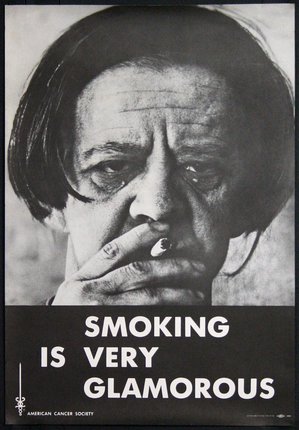
Even nicotine is hugely frowned upon throughout my extended family – about 115 people at last count, not including my cousins’ grandkids. Smoking and vaping are nearly non-existent. To this day, I can still visualize the poster of a cigarette-smoking old person that hung in the middle school locker room – a horrid creature whose skin was like a sun-dried tomato. “Smoking is glamorous,” said the poster.
I was always very attuned to sarcasm. I never planned to smoke.
But in late 1984, I stepped across a line that I’d drawn for myself in the sand. I didn’t know the line was there until I’d stepped onto the other side, and by then it was too late.
I smoked cigarettes for about six months before I started “trying” to quit. I hated what cigarettes did to my throat, to my lungs, to my soul. But I liked the feeling of having a cigarette in my hand. And if it was in my hand, I smoked it. As a result, I burned through a pack a day pretty easily, through two packs a day within a year, and three packs a day before I was done.
I knew that drugs would kill me. I knew that drinking would cause my liver to disintegrate and that marijuana would ensure that I never worked a full-time job. But by the time that famous commercial announced that my brain resembled a fried egg, I scoffed.
I laughed even. Because I knew better.
Once I started doing drugs, nothing could stop me from doing drugs.
Bonnie had explored drugs more than I had. Maybe a month before my first cocaine, Bonnie described an LSD trip to me: “You would look at a lamp and suddenly it would be the best fucking lamp,” she said. “And you would realize how much you fucking love lamps and then you would laugh because lamps are so fucking awesome.”
I didn’t understand; LSD still scared the crap out of me. I was raised to be terrified of all drugs – and rightfully so.
But on cocaine, I was floating on a cloud, a euphoria right inside my head. There was no pain; my usual feelings of anger and self-hatred disappeared. It was exhilarating.
That feeling lasted approximately 42 seconds.
Then it vanished and the only way to get it back was to do more cocaine, to feel that way for another 42 seconds.
Thank God I had no money to buy it. It was way out of my price range.
If no one had cocaine, I just drank. And smoked. A lot.