When the holidays rolled around, I invited Scott to visit me and my parents in Pittsburgh, but he declined. Instead, he suggested that I go with him to a New Year’s Eve party in Ohio – and I happily accepted.
New Year’s Eve has been notoriously lousy for me. When the days of banging pots and pans with my parents ended and I still wasn’t quite old enough to legally drink, New Year’s Eve celebrations went steadily downhill.
Except for New Year’s Eve With Scott.
When Scott picked me up for the party, he was dressed in different black attire – a black button-down shirt and a diamond in his ear. I wore my usual Forenza sweater and silver pants, and hoped I wasn’t underdressed, although I remember discovering that frat parties had a whole different dress code.
The party was a mass of strangers, all substantially older than me, but I tried to fit in. Scott’s friends were perfectly cordial, although he didn’t talk to them, either. I wondered where he found these friends. They were serious partiers, too, particularly on this wild, celebratory night.
Scott drank Coors, so I drank Coors Light. His can was gold; mine was silver.
Scott smoked Salems, so I smoked Salem Lights. It seemed like the feminine thing to do.
So when Scott pulled me into a side room and whipped out a tiny vial of white powder, I knew instantly I would be trying my first-ever cocaine. It was New Year’s Eve – the biggest night of the year. I was not going to mess up this one!
Scott dispensed the powder onto a little mirror and used a razor blade to swipe it into lines. Where did he find these things? I wondered. Did he pull them out of his pocket?
As he worked, I panicked a little. This is a real drug. What’s going to happen to me?
Then he rolled up a twenty-dollar bill so it became a little tube, and he handed the rolled-up money to me.
“How do I do it?” I asked Scott, completely baffled.
“Want me to show you?”
I nodded – and watched carefully. One end of the bill went in the nose while, somehow, I was expected to inhale a line of powder through the little tube.
“Just don’t breathe through your mouth,” Scott said.
I tried. I got most of it into my nose. It was a learned skill – getting the entire line in one inhaling motion – but I learned quickly.
Immediately my head felt delightful.
Many studies have been done about the effects of cocaine on the brain – particularly about its extremely addictive component. Because cocaine’s “rush” hits so quickly then dissipates at the same rate, it’s a drug that needs to be done over and over and over and over to maintain a “high.”
In rehab years later, I watched a film where monkeys were given cocaine. They chose cocaine over both food and rest … until they dropped dead.
And at that moment, I already understood.
I was hooked instantly. From that night on, if cocaine appeared, I chased it like a cat chasing a laser, a panther chasing a deer, a dog chasing a squirrel. If someone had cocaine, I was interested. Once I knew about it, I never took my eyes off it. I got myself into many, many bad situations by following the cocaine.
But that was ages away.
First, I spent a beautiful champagne- and cocaine-filled evening with Scott until the sun rose and 1985 officially began.
Scott and I became exclusive – I thought – immediately. I had no interest in seeing anyone else, since this guy with the black leather was all I’d ever want or need in life.
It never occurred to me to wonder why Scott never spoke. He just didn’t. He was too cool.
Scott would pick me up in his car. I thought we would always go to The Hood, but Scott wasn’t a one-bar kind of guy.
In spite of his attire, he didn’t drive a motorcycle, or even a particularly cool car. But because he had a vehicle, we could go places.
So that’s what we did. We went places. We saw bands and drank at nightclubs and ate at diners and delis. We drove to Akron and Cleveland and Kent and Canton, just because we could. I thought Kent was particularly exotic, because of the massacre.
Scott could go wherever he wanted, and I felt fortunate to be included. I thought Scott was worldly.
Scott spoke through music – sharing obscure Lou Reed songs with me, which I swallowed whole, then reevaluated for weeks, listening to Street Hasslelike it was the word of God. Later Scott introduced me to Trio, a band that wowed me with its brilliant lyrics (“Uh huh uh huh uh huh” and “Da Da Da”) interspersed with real German. Scott’s musical choices made me believe Scott was brilliant, too.
Scott worked nights at the local grocery store, stocking shelves while the store was closed. This, to me, seemed like the coolest job in the world. He got to stay up all night and get paid for it!
Scott smoked clove cigarettes, which smelled like spicy candy. When he ran out, he smoked Salems.
After a few dates with Scott, I started smoking Salem Lights, so I could smell the way Scott did. I lacked leather and cloves, but I definitely smelled.
Scott had formerly lived on a beach in Florida, eating raw potatoes to survive. I believed this was the ultimate freedom, and aspired to do exactly the same thing.
“You think eating raw potatoes is cool?” Scott said.
“Yes!” I screamed. “You could eat whatever you wanted! Do whatever you wanted! Go wherever you wanted! And you got to sleep on the beach!”
Scott shook his head slowly. He didn’t talk enough to argue with me.
I never considered the fact that Scott had left those Florida beaches to return to Ohio to live with his parents and work night shifts in a grocery store.
One night, Scott took me to his house for dinner so that I could meet his parents. I was scared. The coolest man in the world probably had the coolest parents – and I was not cool. Would they like me?
They did like me.
In fact, they seemed to be just regular parents. We ate regular food at a regular table in a regular house.
Scott didn’t talk at dinner either, so I got to know his parents really well. But I only met them once.
Most of the time we were having our worldly adventures in eastern Ohio.
I dreamed of riding with Scott to a beach, a sack of raw potatoes in the trunk, a case of Coors for him and a case of Coors Light for me, and a whole carton of menthol cigarettes in the glove compartment.
College seemed distant and unimportant.
But as I finished my first semester of my junior year, I had to leave both Bonnie and Scott to go home for Christmas.
The beach and its potatoes seemed far away indeed.
While I spent evening after evening and night after night at The Hood, I remember very little about being inside the bar. I remember the smell of stale beer and the drab, darkened decor, but my memories of what happened there are … foggy.
Mostly I sat at the bar, if crowds were low, and drank beer. On really special occasions, I would get a Hood Burger, but mostly I sat and drank beer. If the bar was crowded, my activities consisted of making my way through the crowd to get another beer, then finding a less crowded place to stand and drink … and then making my way back to the bar to get another beer.
Then one night, when crowds were low, I saw a guy walk in dressed all in black: leather jacket, black leather pants, and black fingerless gloves that he didn’t remove, even when drinking his can of Coors.
I’d never seen fingerless gloves before, so I decided that he was the coolest person ever to walk into that bar. His eyes were as black as his clothes. He sat at the darkest corner table, right next to the door.
Once in awhile, if he turned his head just so, I could see the glint of gold in his left ear. Like the incomparable George Michael, David Bowie and Boy George, this guy had an earring, too.
He was mysterious.
He lit a cigarette which made him even cooler. After only one beer he left, never speaking to anyone, not even looking around. Just sitting quietly and then disappearing.
For weeks afterward, I went to the bar looking for the black-clad man. I wanted to know this guy.
Finally, one night, he returned: same black leather, same fingerless gloves, new can of Coors. I stared from across the bar. He sat at the table next to the door, spoke to no one, and then he was gone again.
I nearly followed him outside – but instead, I just watched him go. Again.
This happened four times over several weeks before my nerve – and my alcohol level – sufficiently pushed me to speak to him. Or maybe it was Bonnie and a dare. I don’t actually recall.
Suddenly I was at his dark table, plopped down next to him, introducing myself and shaking the hand with the fingerless gloves.
“Scott,” he said, his voice low, nearly nonexistent. I was terrified and could barely form a sentence, so I raced into the bathroom to make sure I looked okay.
When I came out, he was gone again.
The next time he walked in, I nearly threw myself into his lap. “Where did you go?” I yakked – then kept yakking until somehow I got his number – before the days of cell phones, so I had to call him. Having this incredibly cool guy call the dorm floor payphone seemed ridiculous.
I waited a couple of days and then I called.
“Hey,” he said. And then I talked for half an hour.
Drinking excessive alcohol started to cause weird, unexpected occurrences in my life.
For one thing, people started asking me about parties. Like everyone else, I picked up printed flyers for frat parties and house parties, and those flyers told me where to go.
But strangers would ask, “Hey! Are there any parties this weekend?” And I would have to think: What flyer do I have? And why the heck are they asking me?
Most of the time, I would mumble, “I think there’s one at ATO…” and trail off, hoping they would be able to figure it out on their own.
One time, I was called into the Dean’s Office for planning a party.
Dean Davis – who already knew me as a “problem drinker” – said, “I want you to rethink whatever you are planning this weekend.”
“I don’t know what you mean,” I said. I literally had no idea what she was talking about.
“There are to be no parties in any dorm,” she said.
“Okay,” I said. “Why are you telling me this?”
“Because I believe you are planning a very big event on your floor,” she said.
“I’m not,” I said, completely truthfully. “I don’t know anything about any very big event!”
The dean did not believe me.
Sometimes there were parties on my floor. I remember a kamikaze party where I got very, very sick from an overload of whatever alcohol is in a kamikaze. I never drank kamikazes again.
But the dean blamed me for some figment of her imagination. And mostly the parties happened elsewhere.
Another interesting development happened as college progressed: people started asking me – and Bonnie – if we had any drugs to sell.
At that point, both of us had given up whatever drugs we’d done in high school. We just drank a lot.
“I don’t do drugs,” I would say – meaning it.
“Right,” they’d laugh. “Well if you get any, find me.”
Get any what? I’d wonder. I don’t even know what I’m supposed to be selling.
One semester, I was put on something called Social Probation.
“You will remain on Social Probation for one semester,” the letter said. “If there are any infractions during the upcoming semester, you could be suspended or expelled from college.”
“… expelled from college.”
Really?
Sure, there were rules about visitation – but I thought everyone agreed that those rules were stupid. So when someone actually turned me in for having a man in my dorm room, I was appalled. I was an adult! Why was I being treated like a child?
It didn’t matter that I couldn’t tell you the name of the guy who was in my room because, between the parties and the impromptu overnights, there were too many names to consider.
Why couldn’t people just accept my new persona and leave me alone? I’d have to spend an entire semester adhering to the rules … and hoping not to be too drunk to forget.
Right after receiving my threatening Social Probation letter, I received another letter from Mount Union.
“Congratulations!” it said. “Your exemplary GPA and outstanding academic performance have placed you on the Mount Union College Dean’s List!”
I’d made Dean’s List and been put on Social Probation in exactly the same semester.
Two years later, I was back on Social Probation for the same offense. I never made Dean’s List again.
I’ve said that Bonnie gave me “permission” to do things that I wouldn’t otherwise have normally done. But I need to clarify.
Bonnie didn’t sit around determining what I could and couldn’t do. She simply showed by example that things could be done differently than I’d been doing them. Before meeting Bonnie, I tried harder to play by the rules.
When I got a speeding ticket, I sat and listened to the police officer and shook, worried about the legal ramifications and the possibility of jail. Then I drove home and immediately mailed in the fine so I wouldn’t somehow forget.
When Bonnie got a speeding ticket, she swore at the officer under her breath, blasted music in her own car while he was writing out the ticket, and as soon as he was out of eyesight she shredded the ticket and tossed the scraps into the backseat.
I thought this was cool. In fact, I thought everything Bonnie did was cool. So I tried to be like her.
One thing I learned from Bonnie involved going home from parties and bars with men: sometimes Bonnie said no. If she didn’t like the guy, she just said, “No thanks!” and kept chatting and drinking.
Until I saw what Bonnie did, I hadn’t known there was a choice. I thought if a guy asked you, you went. My motto: guys are more important than me, so I have to do what they say.
I wonder how much of my “motto” was due to my age, and how much was due to my overwhelming insecurities.
I asked Bonnie about this the very first time she told a guy “no thanks.”
“Fuck him!” Bonnie said. There was no other explanation. She chose the person with whom she’d depart – they didn’t choose her.
I didn’t really get the concept, though. From that point on, I turned into a predator. I started “choosing” as soon as I walked into a place.
Making a conscious choice to go home with someone specific provided me a delusional feeling of control. With my life slowly spiraling out of control because of my drinking, I thought this was an important step in the right direction.
But both Bonnie and I were putting ourselves in dangerous situations based on our choices.
After one harrowing incident when Bonnie almost didn’t make it home from her 2 a.m. excursion, we made a pact: from now on, we choose two guys, so that whatever we do, we do it in the same place. We made sure they understood that we would not be separated, whether they liked it or not.
We wanted to be safe from being lost in the middle of the night and unable to find our way home, and we wanted to be safe from unwanted advances. Having each other within arm’s reach meant that we wouldn’t be alone, ever.
Of course, we were obliterated by alcohol most of the time, so I’m not sure this rule made a bit of difference. But we felt safer because of it.
A lot of alcoholics forego food in favor of alcohol. In college, with my meals “free” (thanks Mom and Dad!), I didn’t need to forego anything. The cafeteria was a social hub and I didn’t want to miss anything – least of all the cute guys building towers out of their mashed potatoes and meatloaf, only to drop an apple on their creation to see the spray.
But Bonnie didn’t see the cafeteria in the same light; she wanted to eat better food – meaning, something from the snack bar after the cafeteria had closed. It didn’t matter that I had no money for such frivolities. Bonnie had a checkbook.
I didn’t even know how a checkbook worked, but Bonnie would say, “Let’s get malts!” and I would leap from the chair and head over to the snack bar for a malt.
One day I asked, “How can you afford malts every night?”
She shrugged. “I’ll just bounce a check!” And in we’d go, for malts and whatever else we might want.
For the first semester, Bonnie also often had a car. This was rare, as a freshman, so we made the most of it. We’d walk to the bar and back – then hop in the car and drive to Denny’s, because it was open all night.
The entire campus – and many people we didn’t know – would be at Denny’s, wasted, inhaling thick pancakes and greasy bacon. Denny’s was the place to be at 3 a.m. We’d be there for hours, stuffing ourselves silly and laughing like we’d never laughed before.
Sometimes we’d go to Bonnie’s parents’ house for the weekend. We’d wait for them to go to sleep and then we’d raid the refrigerator. One night we dined on cold peas in a jar. We considered this a delicacy, and laughed about it for weeks.
Since we rarely had dinners at the cafeteria, we also had pizza delivered. There was no Door Dash – pizza was the only thing we could have delivered. Everyone had pizza all the time. And always Dominos.
Then we found a place that would deliver subs. We’d ask: “Can we get two steak-and-cheese subs?” And that would be lunch. We’d get pizza for dinner.
We ate subs for quite awhile before we discovered that they also sold beer at the sub place. It was like getting soda, we reasoned, so it didn’t hurt to ask if they’d deliver it.
“Can we get two steak-and-cheese subs? And can you maybe also add a six-pack of Natural Light?”
They would.
Suddenly subs were our favorite food.
“Can we get two steak-and-cheese subs and a six-pack of Natural Light?” we’d say – every single day.
One day Bonnie looked at me in all seriousness and said, “We should get more beer.”
So we did: “Two steak-and-cheese subs and a twelve-pack of Natural Light, please.”
This made us temporarily happy. And then one day, it happened.
“Can you just deliver us a twelve-pack of Natural Light?” I don’t know what we ate that day.
I know that within a week, we were ordering two twelve-packs at a time, because as any alcoholic knows: more is always better.
Some days we got subs, too. Some days we got pizza, too. Some days we even got malts at the snack bar.
But not leaving the room and having infinite beer delivered … and living across the hall from the bathroom and the water fountain … ? Well, that was truly heaven on earth.
Bonnie gave me permission to do all the things I’d been trying not to do.
Breaking rules was big on Bonnie’s list of favorite things to do. She refused to set an alarm for class, so skipping classes became a regular occurrence. Stealing things from the snack bar, the bar, the store … that wasn’t “really” breaking the law. Driving drunk was okay when she borrowed her parents’ car. And to think, I’d been afraid to go more than a week without doing laundry.
As a freshman, I was enamored with all the opportunities at Mount Union: parties, sports, clubs, games, orientation. Bonnie was a freshman when I was a junior, but she rebelled against college-sponsored activities. She even suggested we go to bars other than The Hood – which was very new for me. By the time I graduated, Bonnie was adamant that Mount Union was beneath her; she transferred to a larger college.
In spite of her rebellion, Bonnie always wanted to look good. In this way, we were complete opposites. Her dedication to appearance felt like the opposite of rebellion, like she was trying overwhelmingly hard to conform.
It didn’t matter where we were going or what we were doing, Bonnie’s main loyalty was to her hair and makeup. This is very natural for many females – but Bonnie’s routine seemed extreme.
I woke up on the floor of her room in last night’s clothes, brushed my teeth and hair, rubbed off any eyeliner smudges, then plopped back down on Bonnie’s floor to wait.
Bonnie’s rule was to wash her hair once every three days. On wash day, she put her hair in enormous curlers, then sat under a hair dryer attached to the wall for three hours, unable to do much of anything but sit. I grabbed things for her from across the room, changed the album when it ended, and generally served her for those three hours. Every three days. For two years.
When her hair was finally properly dried and her natural curls entirely negated, Bonnie moved to her desk to do her makeup. There was no schoolwork on the desk; it was just cosmetics. She had foundation and powder, 27 shades of eye shadow, eyeliners and sharpeners and eyelash curlers, varying brands and colors of lip liner, gloss and lipstick, and separate rouges for each area of cheekbone. She worked meticulously to apply colors that provided the illusion of perfection.
Then Bonnie removed the giant curlers and started fixing her hair before considering what she would wear. Choosing clothes was an ordeal that either took two minutes or two hours – with unchosen clothes piled unceremoniously all over the floor.
Sometimes getting ready to go out took eight hours.
Years later, Bonnie and I were exploring Pittsburgh when a couple of guys offered to take us midnight motorcycle riding. This sounded like great fun to me – racing through the night, wind blowing through our hair, gawking at the stars.
Bonnie refused to go.
“But why not?” I asked, genuinely perplexed. Bonnie was usually up for anything.
It took a long time for her to answer. Finally, she pulled me aside so the guys couldn’t hear her and whispered: “My face. It’s all I have. If anything happens to my face….”
She trailed off.
I stared at her, dumbfounded. Her face?
Although I’d never heard her say anything even remotely similar, she sounded sincere. In fact, it may have been the most sincere thing I ever heard her say.
And it’s the only time I ever saw fear in Bonnie’s eyes.
College dances were substantially better than high school dances.
At my high school prom, I shared one bottle of wine with three other people before the dance. For an alcoholic, having a tiny bit of alcohol is like standing half-naked in the snow.
Since we weren’t allowed to drink at the prom or after-prom party, I spent 12 hours feeling cold and … off. This was followed by my not-drunk date falling asleep at the wheel and sliding the car into the median barrier. We all woke up quickly.
So the prom was not fun.
In college, my first dance was also very … uncomfortable. I went to Homecoming with someone who didn’t drink – so I figured I couldn’t drink either. I was miserable.
The most important factor for a fun evening became drinking freely before going out.
I drank just to prep for walking out of my room. Dances were especially uncomfortable because I never wanted to wear a dress. This was long before the gender-non-conforming ability to wear whatever you want. I hated “formal” attire.
But … there were formals. I had fun at every formal, and I attended both sorority and fraternity formals. We would rent out a hotel ballroom with blocks of rooms for everyone in attendance – so we could drink safely and pass out safely at the end of the night.
I proudly did this every time.
I went to formal one year with a guy named Joe who was a flat-out jerk. He was chauvinistic and just generally unkind, but everyone said I should go with him because it would still be fun. I drank and drank and danced and drank and danced, and it was indeed fun. (I still detest Jimmy Buffet’s song Come Monday because Joe loved it.)
The best dance ever, though, was my AXO formal with Jim. Jim was a legendarily fun guy who had graduated years before me. I think. He was always around. Jim always smiled, made everyone feel liked, and drank obscene amounts without falling over. We danced and laughed and danced some more. He was the perfect date for a formal.
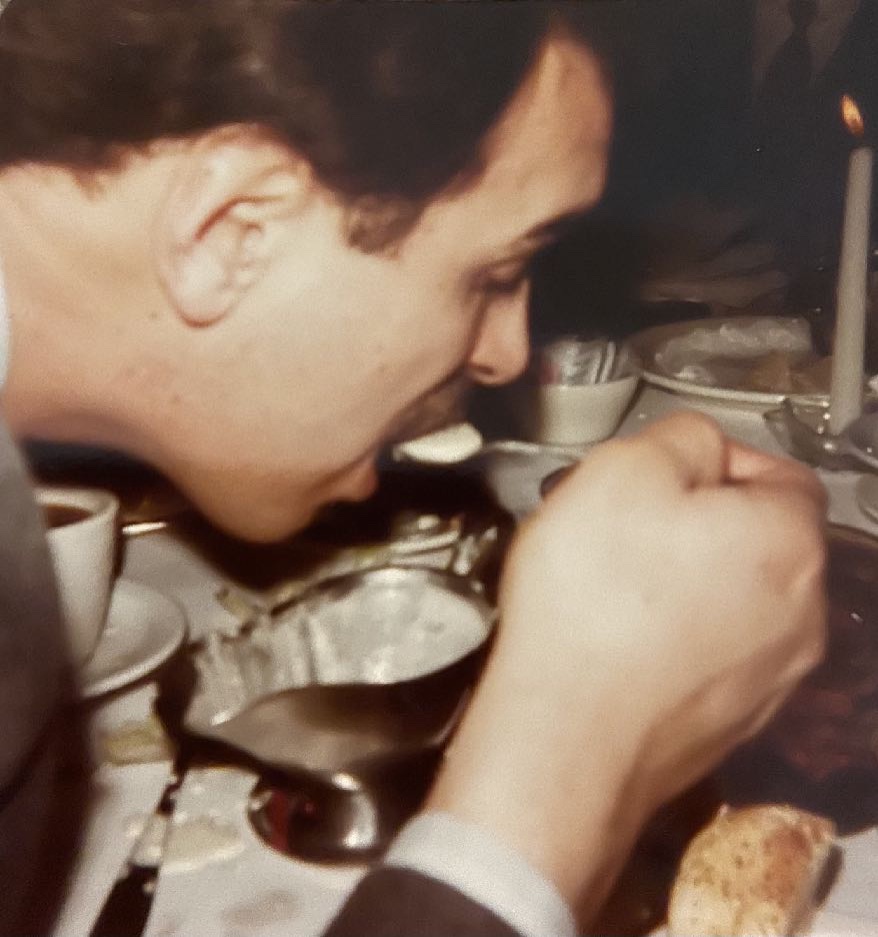
At dinner, already drunk, Jim picked up the table’s bowl of Italian salad dressing. He was chatting away and he must have forgotten what he was doing. He looked down, saw the spoon in the bowl, and scooped Italian salad dressing directly into his mouth, smearing it onto his mustache.
“Oh my god did you guys try this soup?” he asked. “It’s the best soup I’ve ever had!”
We told him it wasn’t soup but he continued scooping, entranced. We couldn’t stop laughing long enough to stop him. Jim finished it off, straight from the bowl, then burped up salad dressing for hours: while dancing, while drinking, even in his sleep.
When I got sober – years after formals – I attended sober dances. They played music I loved and I wanted to dance, but I couldn’t figure out how to make my body move correctly. I wiggled my arms and legs but I felt stilted and confused.
I loved line dances; I’d learned how to do the Electric Slide in rehab. I appreciate detailed instructions about exactly what moves to make.
I stood on the sidelines a lot.
Then one night, I just hit the floor and started dancing. What I Like About You is very danceable. I closed my eyes and moved to the music and finally remembered that dancing is about the music, not about me.
Since then, I can dance. Maybe I suck, but I don’t care – and I don’t have to drink to enjoy myself.
Possibly the best thing Bonnie did for me was to introduce me to a whole world of new music.
When I visualize Bonnie now, I see a girl bouncing wildly on her dorm room bed. Bonnie was so lost in the blaring music, she barely noticed she was dancing. Head shaking, arms flailing, scream-singing every word of the song, she became one with the song – whatever song was playing on the record player.
Before the song ended, she’d leap from the bed – three feet into the air and landing on the floor – yelling: “Oh my god you have to hear this!”
In one practiced, fluid motion, she’d scrape the needle across the spinning record and toss her beloved album on the floor, while pulling a new record from its cover and dropping it on the turntable. Then she’d be back on the bed bouncing, beer in hand.
Whatever music Bonnie liked became my favorite music, too. Bonnie would point out a specific guitar riff in a song which I would then never un-hear. Or she’d sing specific lyrics louder than others, staring at me knowingly, begging me to recognize the significance of those specific words.
Some of the classic rock bands had completely eluded me in high school. I knew the Doors and Jimi Hendrix; she knew the Stones, Pink Floyd and David Bowie. She’d done her high school term paper on Stairway to Heaven, and I didn’t even know how to spell Led Zeppelin. (Her knowledge came in handy when Jimmy Page walked into a bar one day, months later, but that’s a different story.)
The Cure, U2, The Smiths, Yaz, REM, Violent Femmes – these bands provided Bonnie’s soundtrack at Mount Union. So they became my soundtrack, too.
I adored these bands, but I honestly hated The Smiths. When we went to see The Smiths in concert, Bonnie and I spent the entire evening in the bathroom. Morrissey bored me. We listened to The Smiths more than anything else, possibly because she was trying to sway my opinion, and eventually I liked a couple of their songs. But I never admitted this to Bonnie; in my eyes, her opinion was the right one.
Several years later when I introduced Bonnie to Edie Brickell and the New Bohemians, she snubbed them without more than a minute of listening. I loved my new cassette, bought with my own money after college when I was very poor.
“That fucking sucks,” she said.
I still like Edie, although she didn’t go very far beyond her one hit wonder status. Still, I always tried to like whatever music Bonnie shared, and she never really listened to mine.
In spite of all those hours of Smiths – and my real adoration of bands like Yaz – I eventually learned that what Bonnie thinks about music is all that matters to Bonnie.
She was never swayed by my opinion. And since I didn’t hold much stock in myself, Bonnie’s “rightness” never much bothered me when we were hanging out. I believed that Bonnie knew best, Bonnie knew more, Bonnie loved more deeply and passionately, and therefore Bonnie was always right.
I was nearly 50 years old before I realized that Bonnie never actually cared about me at all.
But this didn’t stop us from spending every waking moment together for my final two years of college.
During fall break, my junior year, I met Bonnie: a freshman with an attitude-and-a-half. No one else was on campus during break, so we hung out together and drank ourselves silly. We laughed and hooted and hollered and ruled the very empty school. We yelled down the echoing hallways, screaming with freedom, getting to know each other with every bold new move.
Bonnie was everything I wasn’t: loud, confident, brash, calm, wild and cool. Oh my, Bonnie was cool. Nothing phased her. She could stand in the eye of the hurricane with her arms outstretched, laughing at the wind, her long black hair electric around her. Bonnie was everything I wanted to be.
After fall break, I didn’t want to hang out with anyone else.
Bonnie challenged everything I’d ever believed. She took great pride in never being embarrassed or afraid, so I decided to be unafraid, too. To Bonnie, my naivety wasn’t cute; it was stifling. She ignored my god-given tendencies and taught me how to be strong.
Or so I thought.
My entire life, I’d tried to follow the rules: parents’ rules, Bible’s rules, school’s rules, society’s rules. Bonnie broke all of them.
I followed her lead and broke them all, too.
Bonnie validated all the mistakes I’d made and showed me that they weren’t anywhere near as bad as I’d believed. Candy for breakfast? Yeah! Leftover pizza off the floor? Sure! Drinking every day? Why not! Skipping class to sleep? WhatEVER! Premarital sex? Of course! Impromptu road trip? Anytime! Concerts instead of exams? Absolutely!
Bonnie was against authority – all authority – and wild beyond my wildest imagination. She bounced checks to buy chocolate malts. She drove drunk. She chose – and tossed aside – every man in her wake. She slept through entire weeks of class. She swore like a sailor. Bonnie was my idol.
While I technically lived with a roommate down the hall, I spent most nights sleeping on the floor in Bonnie’s single room. She lived directly across the hall from the water fountain, which was exceptionally important in the mornings. And I didn’t want to miss spending a single a moment with her.
I started to evolve. I went from trying so hard to be good … and failing … to purposefully going off the rails. At the time, I decided I was becoming tough, rugged, smart and strong. But really, I was finally letting go of my self-imposed restrictions, allowing myself to do whatever felt good in the moment.
I had no idea that this choice was the first step toward the end of everything I’d ever known.
With Bonnie, I felt spectacularly liberated. For the first time in my life, I had a friend who didn’t worry about who I was; she just modeled who I wanted to be. She lived her life and I followed along, believing every word she said about every subject, fascinated by the many things I didn’t know about the world.
Best of all, and most essentially, Bonnie drank exactly like I did.