Larry came to pick me up on his motorcycle (hereinafter often referred to as “bike”). The motorcycle was so loud that we couldn’t possibly have held a conversation over its roar.
I remember thinking that it was nice that we didn’t have to talk. I didn’t have anything to say to him.
Eventually he pulled into the parking lot of a bar. We got off, took off our helmets, and started toward the door. I cringed a little.
“I’m not 21 yet,” I said.
“Fuck that,” he said. “Nobody’s gonna bother you if you’re with me.”
Larry grabbed my hand and we walked inside. No one even looked at us. We sat down in a booth.
This bar was fancy – first, there were booths. At college we were lucky to have a place to sit. And there was an actual band playing – or at least, whining. It wasn’t the kind of band I would normally enjoy.
A monstrous dance floor stood empty between the bar and where we sat. I watched Larry walk all the way across that empty floor. His hair was stringy and brown – stringy like thread, with a bald area in front that wasn’t quite combed over, and long enough in the back that it bounced when he walked. What he lacked on his head grew on his face – a bushy beard and mustache which, I recalled, scratched when he kissed me.
He wore blue jeans with a chain hanging out of his pocket on one side; it jangled with every step. His boots were black and bulky – “motorcycle boots” he called them – and they clunked loudly on the dance floor.
I was appalled. He made noise when he walked. I’d spent my entire life trying to go unnoticed.
Larry didn’t notice the clunks or the jangling. He had absolutely no inhibitions. As he walked across the floor he seemed to remember I was there. He held up two drafts in a sort of salute, and smiled that goofy smile. His teeth were yellow and crooked but he didn’t notice that, either.
“Here ya go, Baby,” he said, sliding into the booth across from me, the chain impetuously rattling against the wood as he slid the beer to me. He’d called me “Baby” a sickening amount of times in just a few hours.
“Thanks, Baby,” I mocked.
He blinked for a second and then regrouped. “Here ya go, Kris,” he said, trying to impress me.
I sipped my beer and considered this. Did I care that he didn’t know my name? No, I did not.
And yet: “It’s Kirsten,” I said, emphasizing the first syllable. “My name is actually Kirsten. I tell people ‘Kris’ because it’s easier.”
“Kristen?” he asked.
“No, it’s keer-stin.”
“Say it one more time,” he said.
“Keeeeer-stin,” I repeated.
Larry smiled. “Keer-stin!” he said, proud of his accomplishment. “That’s a pretty name! Pretty name for a pretty girl!”
“Thanks,” I mumbled. I was used to ridiculous, sexist comments like this, but I didn’t think my name was particularly pretty, so I just drank.
Larry got me a second beer, and a third, and then I lost count. I have no idea what we discussed.
When the bar closed, we rode back to his place – the place where the junkie had sold their stereo – and we screwed around on the floor until just before dawn.
“I’ve got to get back before my parents wake up,” I said.
Larry laughed. “Let’s go!”
When he revved up the motorcycle I realized: my parents would be awake the instant we roared into the neighborhood.
There was something inside me screaming to get out in the summer of ’85. I didn’t know what it was; I just knew that something was desperately, horribly uncomfortable.
My youth was one long recognition that I was different. I was weird and I was unliked and I was never going to fit into the world the way I saw it. Everyone else seemed to know what they were doing. Everyone else seemed to get along with each other. Everyone else seemed to have a ton of friends and an understanding of how the world worked. Everyone else seemed to fit societal ideals. Everyone else seemed to have a grasp on what they wanted and needed in life. Everyone else seemed to reach out and grab what they wanted while I floundered in a ditch, watching.
I always felt like I was on the outside looking in. My whole life. And for this, I blamed my parents.
I was almost 21 years old and I believed my parents were to blame for absolutely everything that was wrong with me. Nature, nurture – doesn’t matter. It was my parents’ fault.
I saw my parents the way I saw the world: they knew what they were doing, understood how the world worked. They fit societal ideals; they knew what they wanted and needed in life and were able to get it. They were the epitome of the way I saw society.
And I didn’t belong in their world. Something was desperately wrong with me; I never, ever fit.
But I didn’t know what was wrong. There was no label for it, no name to identify what was causing my problems. It never – not once – occurred to me that nothing was wrong with me.
If I didn’t fit into the world the way it was, then I had to be the problem.
And of course, people told me I was a problem – particularly my parents. I didn’t feel like this because of the alcohol. I drank because I felt like this my whole life. Alcohol was just an accelerant.
And the rage building up inside me inevitably sparked and spit every time I walked into my parents’ house.
My parents responded the only way they knew how: by buckling down, trying to allow me some independence while also trying to enforce rules so they didn’t lose their own sanity. And I responded by breaking every rule, as often as I could, trying to break free of societal expectations, all while trying to find a place for myself in a world I didn’t really understand.
One particularly bad evening, the phone rang and no one was around. Normally I would have let it ring and ignored it, but I was bored so I answered it.
“Hello?”
“Is Kris there?” The voice on the other end of the line was low and growly and I was really, really bored.
I knew exactly who it was. It had been a few days and I had given him the wrong name and number – or so I thought – but here was the guy from the gas station, somehow calling me.
Nobody named Kris lived at my house; I reserved that name specifically for people who were too stupid to learn my real name. Part of me really wanted to claim “wrong number” and hang up.
I don’t remember much about the ride from the gas station, or about the guy who drove the motorcycle on the night that I erroneously believed I would embrace my independence.
I remember that there was beer at his apartment, so we ended up there: a dirty room with a couch and table, no chairs and nowhere to sleep.
“Turn on the tunes!” I said enthusiastically, wired by the wind in my hair.
“Can’t,” the guy said. “My roommate sold the stereo! Fuckin’ heroin. He sold everything that used to be in here. Sold my amp, too, but not my guitar. I’ve gotta get out of here before he gets my guitar.”
I took another sip of my beer. “Heroin?” I asked, a little afraid.
“Fuckin’ junkie,” he said. “I don’t do that shit. That shit’ll kill ya.”
He stared at me, smiling again.
This guy wasn’t the brightest bulb and I couldn’t imagine continuing to hold a conversation.
Somehow I found him oddly attractive. He was rough and gravelly and swore constantly, wearing Levi’s and leather – my kind of guy. So I decided it would be easier to kiss him than to talk. We messed around until eventually I passed out on the floor.
When I woke up, he was walking into the one-room apartment with two coffees and an already opened pack of Winston cigarettes.
“Thought you’d need this,” he rumbled, trying to hand me a coffee. This guy didn’t know me at all; I couldn’t stand coffee.
And in the light of day, oh my god he was unattractive.
And old. Really old. I needed to get out of there.
“No thanks,” I said, lighting a cigarette.
“Wanna get some breakfast?” he asked cheerily.
“No thanks,” I repeated. “Can you take me back to my car?”
“Only if you give me your phone number first,” he said, laughing that gravelly laugh again.
Dear Lord, I thought. I am not giving this guy my phone number. I don’t even know his name.
“Okay,” I said.
He found a napkin on the table and a pen near the ashtray, and handed them to me. Fully intending to write a fake number but too hungover to think of a good one, I scrawled down some digits.
I laughed nervously. “Okay,” I said. “Let’s go.”
We walked outside directly into an ancient city block I’d never seen before. I could hear cars nearby; the sun was blazing. My head was pounding and I was dying of thirst. As usual.
I didn’t know how far away the car might be, but I realized that I’d have to ride – sober – on the motorcycle to get there. This wasn’t quite as free-feeling as the night before. The guy had to help me with my helmet again. I climbed on carefully and held onto him, although morning made this feel slimy.
“Ya ready?”
“Yep,” I said, lighting another cigarette. The motorcycle was so loud, we could have woken every sleeping person within a 12-block radius. But apparently he heard me, because he revved the engine and off we went.
We drove down a hill and stopped at a red light. We turned right, drove maybe a hundred yards, then turned left into the gas station where I’d left my car. I was thrilled to be back so quickly but also amazed that I’d had no idea where we were. I could have walked to my car.
I hopped off quickly and handed the helmet to the guy, who started tying it to the back of the bike.
At 3 o’clock in the morning, I pulled into a gas station and sat for a moment, staring at the guy in front of me. He was pumping gas into his motorcycle, facing away from me. All I could see was long, brown hair sticking out from under his helmet.
I almost stayed in the car, a little afraid that I wasn’t alone at the station at that ungodly hour. But I needed gas, the stereo was still blasting, and Van Halen made me feel brave. I clicked off the car but turned the key backwards, the “music only” gear.
Wearing my typical attire – cutoff jean shorts and a t-shirt that went well past the shorts – I hopped out in bare feet and went straight to the pump. I kept my head down and avoided eye contact, also typical.
This did not deter the motorcyclist. “Hey Baby,” he said, in a gruff, growly tone.
I looked up. He had bright green eyes, a very full beard, and a wide smile in spite of his truly awful tooth alignment.
“Hey,” I said, way too quiet for anyone to hear over Eddie Van Halen’s guitar riffs. I looked down again.
He took two steps closer, but didn’t quite reach my car. “What’s your name?”
After one look at his teeth, I decided he was too stupid to properly pronounce “Kirsten,” which is Keer-stin. It would have taken 10 minutes for me to give him the tutorial about my name.
“Kris,” I said, using my standard name for stupid people.
“Okay Kris,” he smiled again, his voice growly enough to be almost creepy. But it was happy-creepy. “Ya wanna go for a ride?”
I looked at him again. He could probably see the wheels turning in my brain.
Do I want to go for a ride? YES I want to go for a ride! A motorcycle ride in the middle of the night? YES, YES, YES! But this guy is a moron.
I made this judgment after he’d spoken only 13 words.
Then I remembered: I have literally nothing to do and nowhere to go and a whole night to kill.
“I could do that.” The words came out of my mouth almost without my permission and certainly without any forethought about danger.
“I’ve gotta get another helmet,” he said. “Ya wanna wait here while I grab one? I only live right over there.”
“Okay,” I said.
And here’s the really, really stupid part: That’s what I did.
I finished filling up the car with gas, pulled over to the empty space by the tire pump, and sat there for 10 minutes while he went and got another helmet for me to wear.
He came back with a cigarette hanging out of his mouth. He smiled when he saw me sitting there. This guy smiled all the time. It was gross.
He pulled up next to my car. “Ya ready, Kris?”
“Yep,” I said, trying to be cool. I wanted the ride, but I did not want to be with this guy.
He helped me strap on my helmet, told me where to put my feet on his very old Harley, and pulled my arms around his waist.
“Ya don’t wanna fall off!” he said, and laughed a gravelly laugh.
I grabbed my left wrist with my right hand and hung on. I didn’t want to actually touch the guy.
I didn’t get back to my parents’ car until almost noon the next day.
When summer rolled around, I decided to have a party. My parents were out and all three “kids” were old enough to stay at home alone, so we had a bash. We stocked the fridge with a ton of beer and invited all of our – meaning my sisters’ – friends to a party. I don’t remember any of my own friends being there.
I was so happy sitting on my parents’ deck, drinking beer and smoking cigarettes. Music blasted, people laughed loudly; I felt like I was in a John Hughes movie.
But the party wasn’t pleasing to my parents.
Another long meeting ensued about how I needed to follow their rules, blah blah blah. There was some mention made about my younger sisters who, at this point, were 14 and 17 years old. Blah blah “role model” blah blah “rules” blah blah “set a good example” blah blah blah….
So many things I didn’t want to hear, so little space to do what I wanted to do.
A few days later, I told my parents I was going to my friend Cherie’s house to spend the night. I hadn’t yet been invited, but Cherie always offered me the opportunity to spend the night. I just didn’t want to be home anymore.
So I went to Cherie’s and we drank. Only on this particular night, for whatever reason, for the first time in many years, the words “you can spend the night” never came out of Cherie’s mouth. If I had asked, I could have stayed, but I didn’t ask.
It was 3 a.m. I had an opportunity to be alone, to do whatever I wanted to do, wherever I wanted to do it. I even had a car!
I felt … independent. I felt free.
I decided to drive around, sleep in the car, watch the sunrise in a park somewhere. I could do whatever I wanted because nobody was going to stop me.
I blasted the stereo at top volume, forging a solid path so that I didn’t get lost. There were no GPS trackers and no cell phones and I never know my way around, so I just drove up and down Route 30, the road that passed directly in front of my parents’ neighborhood. I figured if I just drove for a couple of hours one way, then drove back a couple of hours the other way, I would be home at a reasonable time.
Route 30 runs the entire width of Pennsylvania. I could have driven back and forth for a month without getting lost.
I spent a lot of my drinking career – before and after this moment – wishing desperately for this kind of freedom. I wanted the stability of shelter and transportation, but ultimately I just wanted to be left alone. I wanted to create my own fun alcoholic life.
I imagined myself as a hippie stuck in the wrong generation, flowing freely from place to place, following my dreams of freedom and the road.
In reality, because I had no money, I ended up immediately dependent on the first guy I saw, especially if he had an extra 50 cents to buy me a beer. But I didn’t recognize this pattern for decades.
So tonight was my chance. No friends, no family holding me back: middle of the night, stereo blasting in my parents’ car, I launched myself into the wild black yonder.
I made it as far as North Versailles, maybe 15 minutes from home, where I stopped for gas. And that’s where my plans for independence vanished into thin air.
Bonnie and I watched The Firm’s tour bus drive away from the parking lot. The band members may have been in the back – we never quite knew – and our buddy Phil was long gone – no idea to where.
Decades passed before it occurred to me that I’d had no money, no food, no way to get home after Massachusetts, no plan for what came next. But at 20, I never thought beyond another backstage concert.
Bonnie and I were despondent; our dream of groupie life had been unceremoniously dumped into the crapper.
We were also wired on some very high quality cocaine, so we drank more beer to tamper the effects of the stimulant. We hung with Mack and wondered aloud about the life of a driver for a famous rock band.
Mack said he drove all night and slept all day, which was cool – to us. If Mack had been subsisting on raw potatoes, I might have never left that cab.
The little cocaine mirror went around and around and around. Eventually the sun started to rise.
And I still had my parents’ car.
My parents had no idea if I would ever be home. Probably they didn’t sleep at all, but I thought I could get home before they woke.
We thanked Mack profusely for letting us hang with him, as if we were mere peasants, then raced home. When we got to my bedroom, I opened the window wide. There was no screen and I leaned my head out.
“I can’t breathe,” I told Bonnie. “I feel like my heart’s beating out of my chest.”
I could feel the pounding – rapid-fire boomboomboomboomboom – all the way from my core to my brain. I could hear it in my ears and it was much, much too fast.
I hung the entire top half of my body out of the window, trying to suck in whatever air the morning offered. Breathing was getting harder, not easier. I was nearly hyperventilating.
“What’s going on?” Bonnie asked. She seemed fine. Of course, she was on the tour bus while I was snorting nonstop lines off that little mirror.
“Maybe I did too much coke?” I actually looked to the 18-year-old for verification.
“I don’t think you can do too much coke,” she said. “Just leave your head out the window and keep breathing, but try to breathe slower.”
Bonnie went into the bathroom.
Hanging out the window, desperate for air, desperate for an end to the pounding, my brain was screaming with boomboomboomboom. I couldn’t breathe any slower. My heart was racing; my eyes were watering; my lungs felt like they might explode.
I knew this was an overdose. I knew I needed a hospital. I knew I was going to die.
But I didn’t want to tell my parents; I didn’t want to get into more trouble.
So I just hung there, trying to breathe while my heart beat like the drum solo in Wipe Out. There was no calming it, no controlling it.
My heart was not under my control.
I pulled myself upright and sat on the window sill. I tried to breathe more slowly, but I could barely breathe at all. I sat that way for a long, long, long time.
Eventually, I rolled onto my bed and closed my eyes: boomboombooomboomboom. I just listened to the rhythm, and I breathed.
I knew closing my eyes was dangerous. I had overdosed on cocaine and I was alone.
Bonnie and I quibbled all the way back to the Civic Arena, wondering how to get to Massachusetts without getting me thrown out of the house.
“We can’t not go!” Bonnie said. “Your parents’ll take you back.”
“They won’t,” I said. “And anyway I can’t just leave their car in Pittsburgh.”
“But it’s The Fucking Firm!” Bonnie countered.
“I can’t,” I said again as we pulled into the parking lot. The fans’ cars were mostly gone but the tour bus and tractor trailers were still where we’d left them an hour before.
We didn’t see Phil or the band so we explained our predicament to the first person we found. He happened to be smoking a cigarette out the window of a Mack truck.
The guy’s name was – really – Mack.
Mack pointed at the tour bus. “I’d check in there,” he said.
We slunk over to the tour bus to say our goodbyes but Phil and the band were nowhere to be found; it was just a bus full of strangers.
We went back to Mack and his truck for more ideas. He handed us two cold beers through the window. We had to reach way up to get them; Mack was very short, toothless, and about 105 years old.
“That’s the bus everybody rides,” he said. “Wanna do a line while you wait?”
Cocaine.
Suddenly we became eight-year-olds chasing puppies. We forgot The Firm, climbed into the cab, plopped ourselves down next to the old man, and obediently did lines. Then we did more lines. We drank our beers, still moaning about the Massachusetts dilemma.
“I’ll get you there,” Mack said, passing the mirror again. “Sleep the whole way if ya want!” He motioned to the bed behind the seat.
“That’s really cool,” I said. “But I can’t go.”
Suddenly Bonnie lit up. “Ohmygod!” she said. “You can’t go, but I can! And I’m fucking going!”
With that, Bonnie hopped out of the truck leaving me, Mack, and the cocaine. She ran directly onto the tour bus not even looking back.
Bonnie was going to Massachusetts without me.
Her parents weren’t stopping her from following her dreams.
My parents were so cruel.
Mack and I continued to do lines. We drank and talked about trucking, which convinced me to be a truck driver someday; it seemed like the perfect life. Do drugs, drive, sleep….
But I was sad. “I’m going to say goodbye to Bonnie,” I told Mack, and I walked over to the bus.
Climbing on board, I saw Bonnie in the third row. Immediately she leapt out of her seat screaming: “You’re going with us! I knew you’d go!”
“I just came to say goodbye.”
“I love you!” Bonnie said, hugging me hard. I started to cry and stepped off the bus. I waved to Mack, who held up the coke mirror. How could I refuse?
I drank and whined and did lines with Mack until the tour bus started its engine, lighting up the lot like Christmas.
But the bus didn’t move. Suddenly, Bonnie appeared in front of the bus’ headlights.
Arms outstretched, she ran straight for the Mack truck. “I can’t go without you!” she cried, climbing back into the tiny cab. “I thought I would be fine but when you came to say goodbye, I just couldn’t do it!”
The reunion was intensely emotional, the drama almost unbearable. We thought we’d nearly lost each other forever.
“This will help,” Mack said, and we both snorted a bit more cocaine.
We never saw Phil, The Firm, or even the roadies ever again.
When Phil asked Bonnie and me to go to Worcester, Massachusetts with them, we nearly spontaneously combusted.
“Okay!” we shrieked. “Let’s go!”
But I had a nagging suspicion that I should be doing something first.
“We need to grab our stuff!” I said. “How long can you wait?”
“We’ve got to tear down,” Phil said. “Just hop on the bus when you’re ready.”
I don’t think he understood: I needed to drive to my parents’ house – a good 30 minutes from downtown – and pack for an indefinite stay, and Bonnie needed to condense her stuff from Ohio.
We needed to move fast.
Driving at breakneck speed (only slightly buzzed since we’d had nothing since before the concert) we pulled up outside my parents’ house in record time, thundered inside and up the stairs.
As always, my mom was awake. I think. Maybe the thundering assisted her awake-ness.
“The Firm invited us to go to Massachusetts!” I screamed. “We’re going to Massachusetts!” I could not pronounce “Worcester” for the life of me.
Mom nearly combusted, too. “What? You can’t do that.”
“Yes we can!” I said. “We just came home to get our stuff! Can you drive us back downtown?”
“No,” she said. “You cannot go to Massachusetts with a rock band.”
The conversation may have been a bit more heated, but my mother appeared substantially calmer than me. In my view, this was the opportunity of a lifetime. We were going to party with world-famous rock stars, travel the world, and leave the doldrums of college behind.
“We have to go!” I screamed. “We just came home for our stuff! We’re going! They invited us!”
Bonnie – who generally stayed quiet when my parents spoke – nodded. “They want us to go!”
My mother went to discuss the situation with my dad while Bonnie and I started piling shirts and makeup into bags. We were generally spinning in circles around the room, not knowing what was important and what wasn’t.
“She has to fucking let us go,” I said. “They have to let us go!”
Bonnie agreed. “They will. This is our life! And we’re adults! They have to know how fucking huge this is.”
My parents knocked on the door, which I’d closed so we could swear freely.
Very carefully my mom spoke: “If you go to Massachusetts, you would be going against our advice. We think it’s a terrible idea. If you decide to go anyway, we don’t want you coming back here. You won’t live here anymore.”
I dropped all the stuff in my hands, along with my jaw.
“WHAT?!? You’ve got to be kidding! We will never get this chance again!”
“That’s our decision. If you go, don’t come back here.”
My parents went back into their room and closed the door.
I started to cry. I sobbed, in fact. I didn’t want to move out. I didn’t want to lose the comfort of home. I didn’t want to lose my parents, my family, my whole life.
But more than anything in the world, I wanted to travel with The Firm.
“I can’t go,” I said. “I can’t fucking go.”
“Let’s go anyway,” Bonnie said. “They’re not really going to throw you out!”
“They will.” I said. My parents had never threatened anything so serious.
“Well let’s at least go back and tell the band we’re not going,” Bonnie said. I knew she thought I’d change my mind if I stepped foot on that tour bus.
So we got back in my parents’ car and drove back to the Civic Arena.
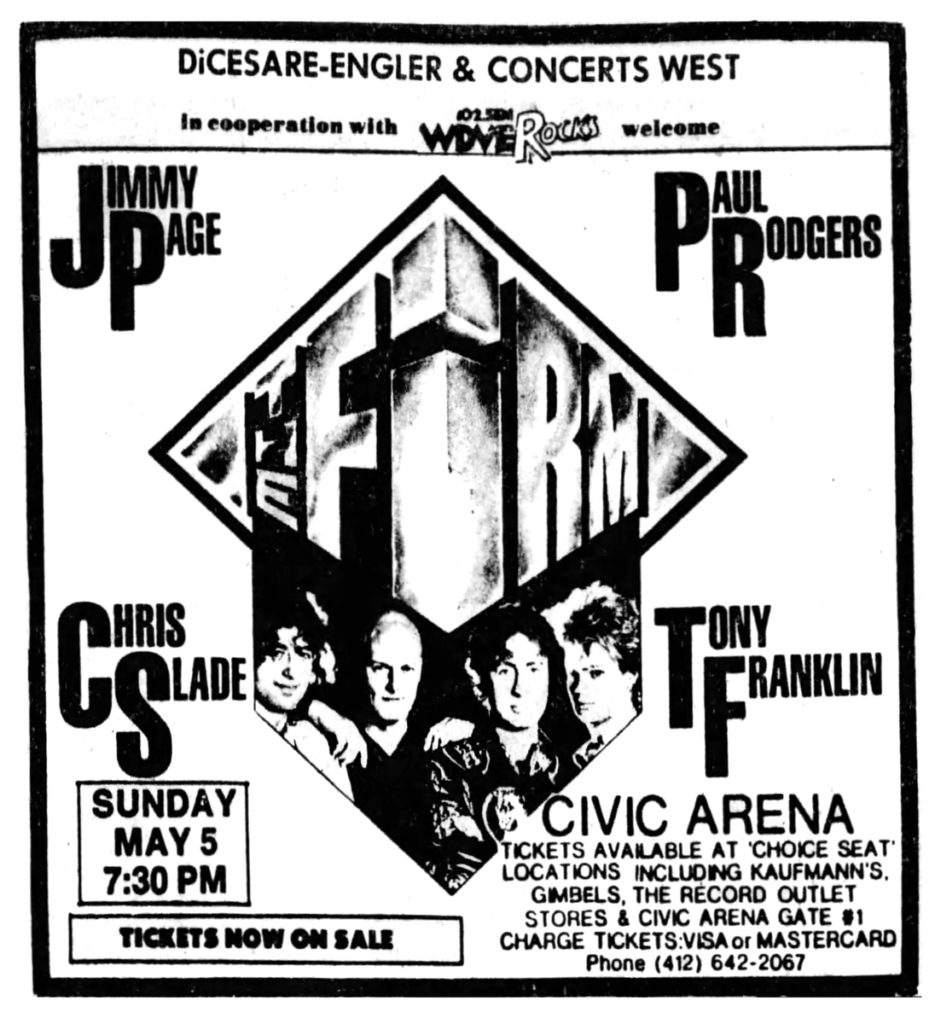
The Firm was playing in Pittsburgh, and we wouldn’t have missed it for the world.
Bonnie and I prepped for the concert at my parents’ house, and drove their car to the show. We were so certain of our kinship with the band that we showed up with no tickets. We walked around the building until we found the backstage entrance, and started looking for people we knew.
We didn’t know anyone.
Pittsburgh’s Civic Arena staff was not thrilled to have us milling about, either. They tossed us out twice while we tried to sneak in through the heavily guarded gate, so we regrouped.
“Let’s buy tickets,” Bonnie said. “We’ve got to get in there!”
“I can’t afford tickets,” I said.
“I have my mom’s credit card!” she said. And just like that – we were in.
Back in the eighties, things were not quite so secure as they are now. We got into the building and high-tailed it to the stage area. We went up some stairs and walked around in the second tier, looking down at the stage while trying to figure a way to drop down into the backstage area without killing ourselves.
We paced back and forth through the rows of empty seats like lions waiting for a chance to strike. It was a long way down, but we were pretty sure we could make the jump without breaking any bones.
And then, quite suddenly, there was my buddy, Phil the tour manager, supervising stage set-up about a hundred feet below us.
“PHIL!” we screamed in unison. “PHIL! PHIL! Up here!”
Once he found us, he stared for a moment – and then he smiled. “Hello Loves!” he yelled in beautiful British. “What ya doing up there?”
“The backstage guys wouldn’t let us in!” Someone started playing a guitar and drowned us out.
“What?”
“They wouldn’t let us in!”
“Who wouldn’t let you in?”
“NOBODY will let us in!”
“Those focking ass-o’s!” he yelled, then pointed. “I’ll meet you at the back!”
Phil hopped off the stage and headed to the other end of the arena – while we raced to the same spot (through masses of waiting fans) a hundred feet above his head. We saw him talking to a security guard and pointing in our direction. When we finally reached him, the security guard moved to the side we walked right down to the floor – no problem.
Phil grabbed my hand and led us through the crowd. “Those focking ass-o’s!” he said repeatedly. Phil turned swearing into the most beautiful language we’d ever heard.
We followed him through the crowd, Phil with his VIP badge swinging around his neck. He took us straight backstage and told us to make ourselves at home.
“I’ve got to do some work,” he said, “but I’ll see you after.”
“Backstage” was really just a cement tunnel with little rooms here and there. Phil showed us to a room with free alcohol, so we grabbed a couple of beers and walked around a bit, then went back into the room and sat down.
It was quite boring backstage.
Eventually we saw the show from waaaay off to the side – which was great. When the band ran off, we yelled our hellos and they all smiled like they remembered us.
I am sure they did not.
But Phil did, and he treated us like royalty. After the show, on his way to the tour bus, he said, “Come with us!”
And that’s when the next part of our adventure began.
Before summer started, we had to finish the school year which, for me, meant drinking more.
Bonnie and I had joined the same sorority. She was very much anti-establishment, and she didn’t want to join, but I told her that she had to join because our sorority – Alpha Chi – did the most drinking.
I have no idea if this was true.
Many Greeks drink a lot. Still, when it came time for sorority events, we liked to include as much alcohol as possible. This was one of the great things about Alpha Chi.
Bonnie became my sorority Little Sister – a convenience of her being younger than me. We did all the Big Sis/Little Sis activities in line with tradition. We got pins and paddles and shirts and sweats. I loved feeling part of a group of girls, this group of girls, and having Bonnie by my side made that even more wonderful.
I remember strategizing for the Greek Sing event – a competition that required all of the fraternities and sororities to perform on stage. (Click here to see a fine example of Greek Sing from 2015.)
Our strategy: let’s be the drunkest. Rather than trying to win the competition, we wanted to be so wasted, we’d guarantee ourselves last place.
Our performance starred an “on-the-street reporter” asking questions of sorority sisters, who answered the reporter by singing something. For my part, I sang the line “our house in the middle of our street” – my own funny one-hit wonder experience.
After singing that one line, I understood why we’d chosen to be drunk. Getting the appropriate laughter was awesome but singing on stage was terrifying. Being drunk together, as a team, made it bearable.
When the judges announced last place – the losers – they called out “Alpha Chi Omega.”
We jumped and hooted and screeched and hollered like we’d won the Powerball. I remember the other sororities trying to calm us: “No, no, you didn’t win…” as if trying to explain to a small child that their pet had just died. We yelled and jumped around just the same, confusing everyone but ourselves. We’d reached our goal!
One night, at a sorority-fraternity bash, I got drunk and punched a guy named Tom right in the face. I don’t have any idea why I did it, or what angered me so greatly that I felt the need to lash out physically. Apparently I had no rational adult way to handle my internal rage, so I punched Tom.
Back in 7th grade, I also punched a guy named Donald and knocked out a filling. Donald had just come from the dentist. He wouldn’t stop talking to me, so I clobbered him.
Like Donald, Tom probably did nothing at all. Thirty years later I messaged him an apology on Facebook but I’ve no idea if he ever received it. I have no recollection of the actual incident; I was obliterated.
What I remember, though, is the emergency meeting called for me to meet with my sorority board. I didn’t even know the sorority had a board. My sorority sisters (“the board”) suddenly looked solemn and professional. No one laughed.
I sat and listened as they announced that because I’d punched someone during a sorority event, I would be deactivated. I didn’t know what “deactivated” meant either.
My drunken behavior had gotten me thrown out of my own sorority.