I am not crafty. I admit this to anyone who will listen.
So when I realized that my relatively new, cream-colored hoodie was comfortable but stained, I was at a loss. I’d bought a neutral color because it would go with everything – but it only “went with” the food I spilled on it – starting with red lentils and ending with grape juice.
That grape-juice dot on the sleeve was my sign: I could dye this shirt with grape juice. I’d just bought a bucketload of grape juice at Costco and then discovered I hate grape juice. So: two problems solved.
I researched and googled until I could google no more. Finally, I jumped up and threw my shirt into a bucket and drowned it in grape juice.
As suggested by many crafty bloggers, I let it sit for 12-24 hours. In fact, I let it sit for 36 hours, just to be sure. Frequently I pushed it around, stirred it, turned it over. It was definitely purple!
My crafty friend suggested that I find out how to set the dye. So, again thanks to googling, I transferred the shirt into vinegar-enhanced water and let it soak like a giant purple Easter egg.
It was gorgeous. I wish I had a photo of that brilliant purple color! I’d created a shirt I would be excited to wear.
But it was really, really wet.
That’s where I got stuck. After it had soaked and set, the crafty internet people disagreed. Should it be washed in cold and hung to dry? Or should it be washed in hot and dried in the dryer? No one seemed to know – or rather, everyone seemed to know, and they all contradicted each other.
My logic determined that if cold water with vinegar had already set the dye, then washing it with hot water – which sets a blood stain – was a good idea. So that’s what I did.
I wrung out the shirt to eliminate excess water, then I tossed it into the washer, set it on hot, and pushed “start.” Soon it was officially washed; I pulled it out to admire it.
Hm.
That gorgeous purple had turned into lavender. It was a nice lavender, but it wasn’t that gorgeous bright purple anymore. Still – it was nice. It was better than cream-colored and stained.
The internet gods said that I needed to wash it three times, so I did. After the second washing, I examined it again. This time, it was gray. Not puke-gray, but a solid, sporty gray.
After the third wash, it was a very light, definitely-not-purple gray. In fact, after three washes, it was most certainly puke-gray, the unmistakable color of an inmate’s jumper.
I tossed the shirt into the dryer. When it emerged with its vinegar-set, heat-set professional dye by Kirsten, there wasn’t one smidgeon of purple.
And while I couldn’t find evidence of red lentils or the purple spot of grape juice on the sleeve, the shirt now has teeny little pinprick-sized blue dots, making it look like I bought a gray shirt and stained it at least a dozen times with my leaky blue pen.
I don’t know what to think of this “new” shirt. I’m a little afraid that it’s somehow still going to bleed purple. Or maybe it will bleed gray.
I think I will do what I do with most of my craft projects. I will throw it into the garbage. Then I will buy a brand new, bright purple hoodie – created by someone else.
Let me say that again, with emphasis in the proper place: my baby just turned 18.
When I look at Shane, I can still see an infant with saucer-sized eyes. I can hear his toddler twang, a Southern accent he developed without living in the South. And I am still surprised that his hair is brown, as it’s been for a decade, because it was so blond when he was young.
I have heard that this happens with the youngest child – that moms can never quite allow that child to grow up. In Shane’s case, he’s been mature for so long, it would have been impossible for me to hold him back. He’s always made me wonder: how can he be so wise at such a young age?
But watching him grow has been like watching a slow-motion movie. He waltzed through middle school; the typical social scares simply didn’t apply to him. He went off to high school orientation without much of a thought: “How was it, Son?” “It was school,” he said. And while I took him driving for at least half of his required 60 hours, it was more like a hobby than a rite of passage – something to do during the pandemic, really. He tried it; he passed; he drives now.
I’ve been taking Shane on college road trips since he tagged along with Dylan to see campuses, and we stopped at a few indoor water parks on the way. College trips with Shane have been long and quiet but wonderfully compelling, keeping me on my best behavior and teaching me repeatedly that Shane is usually right. The colleges were never the highlights of these trips; I just treasured our time together.
Now, with only a handful of trips ahead and dozens behind, Shane’s birthday hit me like a thud, a brick against my head. Alice Cooper’s raw roar “I’m EIGHTEEN“ keeps echoing in my head, even though the character in the song bears little resemblance to my son.
Shane has reached adulthood. He hasn’t become stoic or stolid or any less fun. Shane hasn’t changed in any way; he’s still the incredible young man he’s been for so many years. But now …
He’s going to leave. He’s going to walk out that door; he’s really going. And he’s not going to be at camp for a week, which was tough enough for me to handle. He’ll be at college – likely hours if not days away – and he won’t be in his bedroom or playing the guitar or blasting his music behind closed doors. Shane won’t be home.
Shane will have a new home. He will call his college “home” and I will be happy that he is happy there. But secretly I will also be lonely and sad, because Shane’s home has always been here, with me. And my home will be dreadfully empty (sorry Bill) without him.
Now that he’s 18, Shane will be trekking forth to make his life elsewhere.
This is tough to know, to recognize, to believe, when I still see a child in front of me. My toddler-twangy baby boy is officially a man.
I only know how to handle this one way, and it the only thing I know to get through the unthinkable: I will take it one day at a time. I can survive anything in tiny chunks.
There aren’t too many celebrity deaths that actually bring me to the point of tears. But today Meat Loaf died, and I couldn’t contain myself. His death took a part of my youth with him.
Silly, I know, that someone who names themselves after a hunk of ground beef with ketchup would mean so much to me. I never understood the name. Perhaps his size – substantially reduced in recent decades – was the reason for calling himself Meat. Honestly, none of that mattered to my 14-year-old self; I just adored him.
It was the iconic Bat Out of Hell that resonated with me, the album purchased by more than 40 million consumers. Even after the rest of the world had tossed its albums in a corner, I bought the CD and blasted it in my car, my throat sore after every attempt to hold those power notes at the end of the title track. I never could hold them quite as long as Meat Loaf did.
Later Paradise By The Dashboard Light would play at frat parties so that the guys could watch the girls throw their drinks on the floor and swarm to the middle of the room, dancing and screaming lyrics at top volume. When the duet part started, some would sing the female part, some the male part, before we regrouped for the finale.
I always sang the male part: me and Meat.
I was a Rocky Horror fanatic for many years; Meat Loaf roared onto the screen every weekend on his motorcycle, with comically short hair and singing Hot Patootie. And every weekend, I was saddened when he was viciously murdered and eaten like the Loaf he claimed himself to be.
Meat Loaf showed up randomly over the years on some of my favorite TV shows, like House and Elementary. My husband and I started watching Monk during the pandemic and, wouldn’t you know, Meat Loaf showed up there, too.
Meat Loaf is one of the few artists my husband and I both loved. Bill had the “other” CDs; he enjoyed the sequels as much as the original. So when Meat Loaf came to Constitution Hall – a small venue in Washington, D.C., we immediately got tickets.
The concert was acoustic – his Unplugged tour for MTV’s series – and Bill and I had tickets in the seventh row. Powerful and compelling in song, Meat Loaf told hysterical stories, too.
Bill went to the restroom mid-show. He came back sheepishly trying to make his way to his seat there in the seventh row, and Meat Loaf stopped the show.
“Do you need a minute, Sir? We can wait.” The audience sang with laughter along with us. It was a great moment to be recognized by a great man, in spite of the reason.
We all knew Meat Loaf had health issues, that his heyday was well in the past. But I loved that he would appear randomly on the screen. And I still know every word to every song on that first album.
I only taught myself to play one of his songs on the guitar – and it’s the one that’s now stuck in my head, burning through my tears, wishing it were still true:
“Heaven can wait, and all I’ve got is time until the end of time….”
I am not a big fan of video games, but I am also not a big fan of dementia. So when I started losing track of words – like really, really simple words – I decided that I might need to start doing some brain work.
Since I’ve started eating better, my brain is actually responding better – but it is still not to the level I would like. So I googled “memory games” and found Luminosity.
Luminosity is tailor-made for folks like me: those of us who want to sharpen our brain skills, but don’t want to get out of our chair to do it. It offers three free games a day, each game geared toward a specific skill: attention, memory, speed, vocabulary, etc. (There is a “premium” package available if you really want to get in depth, but I prefer “free.” And three games a day is enough!)
I was playing Luminosity games when I was presented with a penguin character. The penguin needed to traverse a maze to get to a fish. It was the simplest task I’d ever been given – just push the arrow keys and guide the penguin to the fish.
There was another penguin in the maze, also trying for that fish. Whichever penguin got to the fish first could eat the fish. I couldn’t believe this was even a game; it was stupidly easy.
Then the maze spun. With the maze on its side, the arrow keys didn’t work right. Suddenly the up arrow didn’t make the penguin go up. The left arrow rammed the penguin into a wall. The down arrow made the penguin go backwards. And by the time I figured out which arrow to push, the maze spun again.
My penguin starved to death. The other penguin ate all the fish. For most of the game, my penguin was smashing his little penguin head into a wall. I absolutely could not get him to move in the correct direction.
Luminosity says this game tests and supposedly improves my “spatial orientation.” It reminded me of the pre-GPS days when I tried to read a road map to ascertain directions. I would turn the road map upside down, then tilt my head to the side, trying to figure out whether I needed to turn right or left at the next intersection.
I would stare at the map, completely baffled. Often, even after several minutes of study, I got lost anyway. Apparently I have zero spatial orientation ability. The penguin game confirmed this.
After the penguin debacle, I played a game that is akin to being an air traffic controller for trains. My job was to direct trains into their appropriate station houses by switching the train tracks as the trains chugged along.
At first, you get three station houses. The trains arrive, faster and faster, until your time is up. If you do well, you get another station house. After playing only three times, I was up to nine station houses. I rocked at the train game.
The train game supposedly tests and improves “divided attention” – the ability to simultaneously respond to multiple demands. This might be my very best thing in the whole wide world.
But I can’t make the penguin stop smashing itself into a wall.
I enjoy Luminosity; it helps me to learn about my strengths and weaknesses. And I will continue to play the penguin game when it pops up. But wow, I feel really sorry for that hungry little penguin.
We planted our little Christmas tree just as soon as Christmas ended. My job was to water the tree.
With the hose set directly under the tree, I was to run water daily at a slow trickle. This gives the tree deep, strong roots.
The hose, unfortunately, was six feet too short to reach the tree.
I whined to Bill: “The hose won’t reach! The tree will die!”
So Bill went outside and made a contraption – two long hoses together and some kind of new-fangled spout thing on the end.
“Now it will reach,” he said.
I ran the contraption through the garage to the tree. I watered the tree, then closed the garage doors and went inside.
Bill came home from work. “Why did you take the hose through the garage?” he asked.
“It wasn’t as muddy,” I said. “And I left the doors open while the water was running. You said I could drive over the hose with a car as long as the water wasn’t running.”
“That’s not the same,” he said. “You can’t leave it pinched under a heavy garage door.” Bill pulled the contraption out of the garage and wound it around the house to the tree.
For days, I watered that tree: turned on the spigot, set the timer, turned off the spigot two hours later. Then one day, I walked out to the tree to see how the new-fangled spout thing worked.
The hose was under the tree, but no water was coming out of the new-fangled spout thing. For days, I’d “watered” nothing.
This was Bill’s fault. “Why would you set up this whole contraption and not turn it ON?”
“Why would I turn it on?” he asked. “You were the one watering it.”
He had a point, but I didn’t admit this.
The next day, water was trickling down our driveway when I watered the tree. I whined to Bill: “Why is there a puddle on the driveway?”
“Because you put the garage door down on the hose,” he said. As Bill had predicted, I’d ruined one of the two hoses. At my request, he taped it – but duct tape doesn’t work on everything.
About that time, snow hit. The ground was too frozen for watering. At some point during the freeze, the leaky hose disappeared.
When the weather warmed, I looked at the tree. The hose was still underneath, waiting to provide those strong roots.
So I went out to the spigot, turned the water on trickle – and I remembered, for the first time, to check the new-fangled spout thing. I walked out to the tree.
The new-fangled spout thing was turned on, but no water was trickling. I turned it off, then on again. (It works for my computer.) But no water came out. Frustrated, I removed the spout thing – still no water.
Then I saw a kink in the hose – a big kink. I walked over, bent down, and untwisted the hose, sure that the tree would be blasted with water. But not a single drop emerged.
I threw down the spout thing, frustrated, and examined the hose. I looked for more kinks, untwisting even the smallest ones. Still no water! Finally I gave up.
I walked back to the spigot to turn the water off. That’s when I noticed: the hose was no longer attached to the spigot. The water was pouring straight onto the ground, making a puddle in the bushes.
To be fair, those bushes blocked my view.
I turned off the water. I reconnected the hose to the spigot. Then I turned the water on – again – and went to make sure the water was finally coming out of the end of the hose.
It was!
Unfortunately the hose is six feet too short to reach the tree.
I got a note from Cozy Earth’s president. Cozy Earth sells some very fine, all-natural bedding. It looks awesome and its products get great reviews, but it costs a fortune.
Apparently my new friend Tyler, founder and CEO, has personally noticed that I have been frequenting their site for a couple of weeks, nearly every day, hoping the price of their bamboo mattress pad will drop.
I wanted to send you a quick note to thank you for your interest in Cozy Earth. … Each day, I try to reach out to as many “first time” visitors as I can. I know buying something for the first time comes with skepticism, especially if you’ve never experienced it before….
It’s our mission to deliver personal luxury for the master suite. That means enhancing your rest and at-home lifestyle with products that are surprisingly better.
You mean everything to us here at Cozy and serving you with life-changing products is why we get out of our Cozy beds every morning:) Stay cozy!
So I wrote a note back to Tyler (whose email is surprisingly the same as “customer service”) to let him how reality feels.
Thanks, Tyler, for your interest in whether or not I make a decision on buying your product. To be honest, I am not interested in luxury living. I just desperately need a mattress pad that is not made of synthetic material, since I have a ridiculous number of sensitivities. I am not looking for ‘personal luxury for the master suite,’ although it sounds nice. I am just looking for one night of rest on my 21-year-old mattress with its disgusting, torn-up, polyester mattress pad.
Unfortunately, the mattress pad I want – yours – costs $171.75 on sale. For a mattress company president, maybe that doesn’t sound like much. But for me, whose second child is headed to college in the fall while the other is not yet graduated, it is a lot of money.
So every day, I look at the $171.75 mattress pad and think, “I could get six mattress pads or ONE new mattress.” And every night, I go to sleep on my 21-year-old mattress with its flattened mattress pad and torn synthetic pad covering. And every night I wake up – uncomfortable and unhappy – in the middle of the night, wishing I had either the “luxury” mattress pad or a new mattress.
So yes, I am still looking at your mattress pad. But unless the price drops by about half, I will never buy it. I will just suffer through, as is usually the case, until the mattress breaks or disintegrates and forces me to buy a new one.
Thanks for your offer of coziness for me. Alas, it is probably not meant to be.
Someone named Jenn responded to my email to “Tyler,” and sent me a coupon for 40% off. Plus she offered me a full refund if I didn’t absolutely love my new mattress pad.
My new friend Jenn said this would bring the cost down to $147.
I did a quick calculation: 40% off the sale price? Wait, that’s not $147! It’s only $103! And sure enough: Jenn was wrong.
The gambling addict inside me grumbled and took over where common sense once reigned.
Forty percent off! said the gambler. Get it before she figures it out!
Knowing deep down that Jenn probably miscalculated on purpose, I grabbed the deal and bought the mattress pad. I will continue to sleep on my 21-year-old mattress until it crumbles beneath me.
I am in the car, and I am talking. Shane is in the car, and rarely says anything. I just keep talking, waiting for him to say something, but he doesn’t.
As I am talking, I frantically discover the traffic. Suddenly we are surrounded.
I’m supposed to turn left into the mall, but everyone is turning left, because everyone is going to the mall. What made me think I should get Shane’s booster shot two weeks before Christmas on a Saturday … at the mall? This is crazy. Traffic is nuts out here; look at this traffic.
I don’t turn left. Instead I drive to the next street and make a U-turn, try to sneak in that way. Now I’m in the right lane with 497 cars. The whole time I am considering my options, making my driving decisions, I am pointing out to Shane: look at this traffic!
I tell Shane, in as many different ways as possible: the traffic is completely out of control.
I am in the lane to turn right – but the line to turn right is ten times longer than the line was to turn left. How did I not see this? I am 50 yards from the stoplight and we sit through that light six times. We can’t make a right.
The people who are turning left – making the turn I didn’t make – are blocking the people who are turning right! I will never get to make my turn! No one will ever get to the mall!
See this, Shane? Look at this traffic! These people are all crazy!
Just then, a white SUV zooms past all of the waiting cars. He’s flying – maybe 40 mph – and then SCREEECH! – he hits the brakes and the turn signal. He has just zipped past every single one of the 497 cars who are waiting to turn right, and he wants to turn right, too. But he wants to do it in front of everyone else. And he thinks that by politely using his turn signal two feet from the intersection, someone will believe that he simply didn’t notice the 497 cars who were waiting – “oops!” – and that he just suddenly remembered he needed to buy a pair of mittens.
I gripe about this white SUV for five minutes. Shane hasn’t spoken in as long as I can remember. Sure enough, someone either kindly or idiotically lets the white SUV into the line four cars ahead of me. I talk about this for another few minutes before I realize that I no longer know what Shane’s voice sounds like.
“I feel like I’m talking to myself again!” I wail, dumbfounded that he has said absolutely nothing in response to my detailing everything that is happening with the traffic. “Why aren’t you saying anything?”
“I was just listening,” Shane says. “You are just talking about the traffic.”
“Don’t you have anything to say about all this?” I say, grandly waving my arms at the four million cars surrounding us. “I mean, you should have something to say by now!”
“It’s just traffic,” he says. “I can’t figure out how you have so much to say about it. We’re moving along and we’re going to get there. What else do you want me to say?”
And that’s when I realize, again, that in spite of my technical job title as “teacher” and full-time position as “mother,” Shane is always going to teach me how to live.
On this New Year’s Eve, these are the kinds of things I’m pondering.
During the pandemic, we bought new tiles and carpet for the whole house. We’d learned along the way that Dylan is allergic to the chemicals found in new carpet so we got wall-to-wall wool carpeting. Wool carpet is untreated and all natural – so Dylan can breathe in his own house.
After the carpet was installed, Dylan said, “There’s a hole in the new carpet.”
“What happened?”
“Dirt spilled out of my plant and I was cleaning it up and now there’s a hole in the carpet.”
That’s how we learned that you can’t rub wool carpeting like you do with Berber. Rubbing causes a hole.
We placed the plant over the hole and bought some Woolite. I’d always wondered what Woolite did. I thought it was laundry detergent. Now I know.
A year went by and Shane said, “How do you clean up spills on the new carpet?”
I looked at him, trying hard not to explode. “What did you spill?”
“Just a little bit of coffee.” Sigh. Grape juice might be worse, but not much else.
So I told Shane how to clean up the spill. I didn’t even follow him upstairs to make sure he did it right. After all, these are the things we should expect with adult children. Just because they’re not toddlers anymore doesn’t mean they won’t spill things.
I think often about when the kids were little, and the house was still new. I think about Shane driving his battery-powered motorcycle on the hardwood floors and Bill yelling, “He’s going to ruin the hardwood floors!”
I didn’t care about the hardwood floors. I cared about my kid having fun.
But Bill cared about the floors and he didn’t ask for much. So even though he loved riding it around our house, little Shane didn’t ride that motorcycle anymore. It broke my heart to put it in the cold, crowded garage where he ignored it.
Our hardwood floors are trashed now anyway.
In the mornings, my tiny boys would come into my room and wake me up by jumping on the bed. They loved this game. Bill was worried about the mattress but I said, “They’re only going to be young once. Let them jump on the bed!”
So they jumped. The mattress is still fine.
I have a mirror by my bed, and I was afraid they’d knock that mirror off the wall and onto my head. It’s a huge, heavy decorative thing and it would have broken bones if it had landed on someone. But I let them jump anyway.
One day I noticed a dozen tiny handprints on the mirror. The boys were getting bigger and those handprints were only going to get bigger, but I couldn’t imagine washing those handprints off of that mirror. I adored them.
After years of my not cleaning, Bill got frustrated with the mess. So we hired cleaners to come and do a deep clean. Afterward, those tiny handprints were gone from my mirror. By then, the kids had stopped jumping so my mirror stayed clean.
I hate the clean mirror.
So when Dylan tore the wool carpet and Shane spilled coffee on it, I thought: It’s just carpet.
The toddler motorcycle is gone. The handprints are gone. Soon the kids will be gone forever, too. And if the carpet is torn or stained, so be it.
At least I’ll know they were once there – that youth and joy once ran rampant in my home. That’s how it should be.
COVID has struck again where I live. It started a few weeks before school let out, when Shane’s friend’s vaccinated brother got it. I pondered whether or not to test Shane; he’d eaten lunch with his friend. But the friend never got it – just the brother.
Then my friend called and said her son had been exposed at school. They wouldn’t tell her where or how he’d been exposed: which class, which activity, what time of day. She didn’t know if he’d been exposed randomly or close-up and unmasked. Eventually – after exposing countless other people – the vaccinated and boosted friend’s son also got it. As did most of his friends.
Before Christmas, more people I knew had it – and more got it – over the holidays. These people were all over the country, and all of them had been vaccinated. Some had already had their booster shots. “Breakthrough” seems to be inaccurate in the case of Omicron. It’s getting everyone, everywhere, and fast.
I hold on to hope from the science: everyone who was vaccinated is getting well. They are not being hospitalized for weeks, and they aren’t dying. They are fighting it off – something we did not know how to do only a year ago.
I keep thinking of a video I saw in 2020, showing how exactly the virus worked. Knowing how it works is the key to figuring out how to stop it – so I was interested in that video. The viral cells started in the nose and what made it dangerous is that it replicated itself, like most viruses do. But after a few days, it moved into the lungs and replicated itself so freely there that it didn’t allow any room for air in those lungs. That’s how people with COVID die so quickly.
The people who made the vaccines knew this, and they acted accordingly. They may not have known how to kill the virus, but they knew how to stop it from replicating so wildly. So Pfizer and Moderna made vaccines that stop the replication of the viral cells in the respiratory system.
Even though the virus is spreading like wildfire right now, many people’s bodies are already fighting it off as quick as it comes, thanks to two vaccines and a booster. And the people who have these vaccines have the added bonus of stopping the cell replication in the lungs – so even if they get a “breakthrough” infection, and the virus makes them sick, they will fight it off.
I am not saying I am no longer afraid. There are people who are sick, who have serious illnesses who could still die because their bodies are not able to fight COVID. I feel for those people, and I want so badly for this to be over – for COVID to be defeated and not deadly to anyone anymore.
But for right now, since I can do nothing except my own part, I want to beg my 3.2 loyal readers to get vaccinated, to get boosted, to make sure that everyone they know is vaccinated – before COVID reaches anyone they love.
It’s hard to fight this disease; it’s harder still to watch the multitudes die. The vaccine does make a difference. It’s how we stop the virus. It’s the only way. And a year after vaccines became available, I’m still begging for people to do this, so they don’t die from a virus that didn’t need to kill them.
For about 50 years, I have gone out with my family to cut down a tree. For a few years, I bought a cut tree, but for the most part, we have always chopped down our annual Christmas tree.
One year, Dylan objected to the chopping. He said, “This tree is alive and we are killing it.”
Still, every Christmas, we would happily choose a tree from our favorite tree farm. We’d bring it home and decorate it and watch Rudolph and sing Christmas carols. Then, for weeks, I would stare at the tree and watch it dying.
“We are killing it.”
After the holiday, we would throw the dying tree into the woods. I justified the whole experience by pretending it was compost. But mostly I remembered the dying tree, suffering because of me. Last year, with the pandemic in full swing, I just stared at that tree and thought about what I’d done.
I couldn’t do it again.
This year, I thought: cut tree? artificial? used artificial? But nothing felt right. I was leaning toward “no tree.”
Then I thought: we could get a live tree with a root ball, and plant the tree after Christmas! Since our yard had been destroyed by a “licensed arborist,” planting a tree now has a special significance.
So, I researched like crazy. And after much forethought and consideration, we went out and bought a live tree.
Here is why this was a stupid idea:
Unlike most years, the kids didn’t go with us. The root ball weighs substantially more than the tree. You can’t tie a 300-pound tree on top of an SUV. So the kids didn’t fit in the car.
The tree couldn’t immediately come into the house. A live tree can only be inside for 10 days – max – so we left our tree outside for two weeks.
The root ball required a giant bucket. No one sells heavy duty buckets like Grandma used to have. Thankfully one had been sitting untouched on our neighbor’s lawn for years. The neighbor let us have it for free.
Moving a 300-pound tree requires oomph. Without Dylan and Shane moving it from the car to the yard, to the garage (to help it acclimate), and eventually into the house, we would have failed miserably.
The tree branches – which haven’t been pruned for optimal ornament-hanging – are too thin for ornaments. We put on 1/3 of the ornaments we usually use, so it’s a bit sparse.
Planting the tree requires digging a ginormous hole, cutting through rock and roots, and then just hoping it will live. It took Dylan more than two hours of solid digging before the 56″ x 19″ hole was complete. This was a huge hassle.
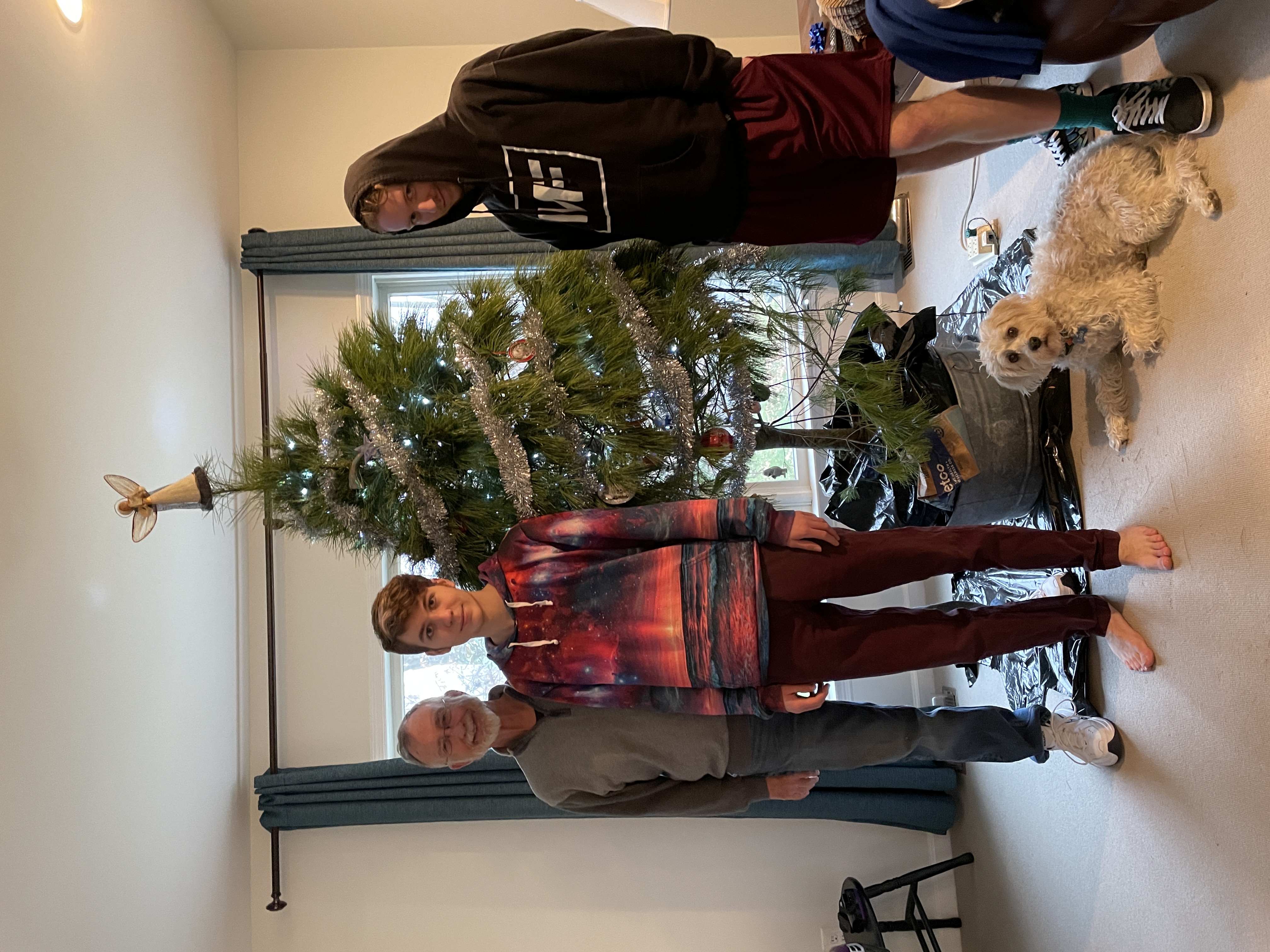
And now, with the tree indoors, it’s a little crooked. The root ball isn’t quite balanced in the neighbor’s bucket. The trunk leans a lot. And it looks a little silly with all that empty space at the bottom, so few ornaments, and a dirty burlap sack and squashed cardboard holding it upright.
But hey: we did not kill a tree this year. We have done our best to care for it, to do the right thing for the tree. It will only be indoors for six days, and we expect it to live a long, happy life in our yard, growing to its full height of 175 feet.
And yet, there are no guarantees that it will survive the first week in the ground.
We will pray. Prayer is more Christian than Christmas trees are anyway.