I have a real issue with college rankings. If this sounds like a rant, so be it. But before anyone complains that I don’t know what I’m talking about, please read Where You Go Is Not Who You’ll Be. It’s got way more factual backup than I could ever provide in this blog.
Many parents – and students – are driven only by college rankings. People are obsessed with attending one of the “best” colleges in the country. What’s ironic is that there is no “best” college.
Back in 1983 – coincidentally while I was attending college – U.S. News and World Report published a report called America’s Best Colleges. They didn’t have any special training in determining what made a good college; they just selected some random criteria. They asked around, did some research. They contacted colleges and used data supplied by staff. No one is sure if their data was (or is) accurate; they just used whatever they got.
And if a college didn’t respond to their request for data, it didn’t get ranked, simple as that. In fact, more than 35 years later, U.S. News is still making that annual list with virtually the same criteria. Of the nearly 4,000 institutions of higher education in the United States, only 1,466 have been ranked. U.S. News hasn’t even compiled data on more than 2,000 colleges in this country.
I won’t delve into the statistics used to determine the “best” colleges because they are random and useless. (If you really need to know, click here.) U.S. News gathers random data, just like they did in 1983, and sometimes they ask “experts” for their opinions.
Then they make a list. They could just as easily be listing the “best” candy.
After that, the insane American public takes over. If it’s ranked, it must be good! Princeton is #1? My kid must go there!
And the longer this goes on, the worse the situation becomes.
Case in point: a college with a low acceptance rate must be a good college, right? Well… no. A low acceptance rate literally means that the college rejects a ton of highly qualified students.
But thanks to U.S. News, and the crazed folks who believe that “quality” and “ranking” mean the same thing, the colleges that are ranked highly get even more applications, which means they reject even more students. So their acceptance rates go down, while the quality of the college doesn’t change even a tiny bit.
There’s nothing “better” about ranked colleges. But by being ranked, the college name becomes synonymous with quality (even if quality was never determined) – which leads to name recognition – and name recognition will supposedly provide a better future to the college graduate.
It doesn’t really work that way, but that’s what people believe.
I’m not saying that the 1,466 colleges that have been ranked aren’t good schools – or that some aren’t better than others. I’m just saying that U.S. News is not qualified to decide. Their claim to fame is that they are “a recognized leader” in rankings – and they rank everything now, including high schools – but who recognizes them as a leader?
Well, anyone who reads their lists and believes their hooey considers them a leader. So they are certainly “recognized.”
But U.S. News has absolutely no idea how to analyze a college, nor do they care. They’re making a fortune by sitting around, compiling data and opinions, and turning those things into lists.
But there is currently no uniform, accepted definition of what constitutes a quality college. And until there is, there simply can’t be any accurate college rankings.
It’s been a few weeks since my trip, so I feel confident talking about this now. When I went to Tennessee to visit Dylan, I spent three days not wearing a mask.
In early February, Omicron was raging, so this was an incredibly dangerous thing for me to do. It wasn’t dangerous in the I-might-get-COVID-and-die way; I have survived it once already and I am hopeful that I would survive the milder Omicron if I got it. It was dangerous because I was supposed to hop on a plane to California with Shane as soon as I got home. I didn’t want to get sick in Tennessee and miss taking Shane to California.
My first stop in Nashville was at a concert venue where my beloved son would be playing music. When I first arrived, I wore my mask everywhere. I ducked into the venue and pushed quickly through all of the people indoors – none of whom were masked – and shoved straight through to the back patio where the bands were playing outdoors.
I didn’t see a single mask in the crowd. They were young and believed they were invincible, I reasoned. Their brains don’t even fully develop until the age of 25.
It felt like there was a sniper lurking and I was the only one who knew about it. I covered my face and stood in the back of the room away from the tiny mosh pit. I hid from people as much as possible, even though I was outside.
Then I found Dylan, and stood near him. Like everyone else, he was not wearing a mask. We were at the sound board together, so I felt safely away from the crowd. I took off my mask and drank my ice water and tried not to worry.
When it came time to get another glass of water, I was troubled. No one inside was wearing a mask; no one outside was wearing a mask. If I put on my mask to go inside, like I did at home, I would look even more out of place than I did by being old.
So I held my breath and just … walked inside. I went through the people quickly, stood away from the other customers at the bar, and asked for my drink.
That’s when I realized: the bartender could hear me.
I am quiet and it’s been challenging for people to hear me through my mask for the past two years. But in Tennessee, everyone was able to hear me – even above the din of the bands and the drunken customers.
Suddenly I felt energized. I got my water and I felt like I was 22. I was walking around in a bar without protection! I was wild! I was free! I was invincible!
This went on for three days.
I took my mask everywhere – in my pocket. Dylan and I went to restaurants and a museum and a car wash and a grocery store and another store and … we went wherever we wanted, and nobody anywhere was wearing a mask. For those days, I worried a little: Does the waitress have COVID? Do the other shoppers have COVID? I scurried a bit, trying to stay six feet away.
But most of the time, I felt like I was flying. It was like diving off the top of a building. Of course, I had no idea if I was going to crash land in the street below. But I dove and dove and dove … and did not crash.
Since I am allowed to just rant about whatever I want in this blog, I would like to take issue with three words that really, really bother me:
Rest In Power.
When someone dies, this is often posted on the web next to an obituary. From what I can gather, this is supposed to be a term of honor, something that sends the deceased into a place among the angels with an extra gold star on the halo.
But when I hear it, the words reflect some kind of anger and, to me, the term does nothing to elevate the person who has died. In fact, I think: What a load of hooey.
Everyone gets one life. Then, at the end of it, we finally get to rest. This world is over and we get to move on to whatever comes next. We finally get to leave the Human Condition. It’s probably the only thing good about death: some form of rest is practically guaranteed. If there’s nothing after this life, at least there’s no more human angst. And if there is an afterlife, even if Heaven isn’t the correct term, it has to be a more stress-free existence than the life we’ve completed.
No matter what happens next, it’s just got to be peaceful. Even if we’re reincarnated and have to go through that, there is probably a bit of time between death and the next life. So: Rest In Peace. It fits. It’s suitable. It gives the person who has died a sense of dignity and calm.
Rest In Power implies that the person – who is dead and can do nothing – still has to fight. They have to be powerful, in charge of something, representing some valid cause. They have to be strong. Why would anyone in their right mind want to ooze strength and power even after death?
What do people expect from the dead if they are sending them to rest in power? Are the deceased warriors who should be in charge of something on the Other Side? Are they going to be leading a group of protestors, a fight against the establishment, an army of do-gooders? And how are they supposed to rest if they have all that responsibility thrust upon them?
I am not terribly active in fighting for my favorite causes in life. Maybe I just need the energy of the dead to start standing up for the rights of the oppressed. But wait … do the dead have energy? Do I even want the dead to have that kind of energy?
I don’t plan on getting a rush of energy when I die. I plan to be dead. I want to rest. I don’t want any extra responsibility and I sure don’t want to have to be in charge of anything. I don’t want even the tiniest bit of power.
So while I have no idea – truly I don’t – what happens after one is dead, I would like to plead with anyone who might post my death on social media: please, allow me to Rest In Peace.
Netflix is raising their monthly fee. Only Shane watches Netflix, for the most part, so I’m not thrilled at paying extra and getting nothing new. So I sent this question via chat to the Netflix customer service representative, Jessica Mae.
*****
Hi Jessica Mae – Can you please let me know why my plan fee is being raised when I am getting nothing new?
Hi! I got your concern and I would be happy to assist you today.
By the way, here are some tips so we don’t get disconnected: Please don’t use the back button or close this chat window. Also, please reply within 2 minutes so the system knows we’re still chatting.
As we continue to add more TV shows and movies and introduce new product features, our plans and prices may change. We also may adjust plans and pricing to respond to local market changes, such as changes to local taxes or inflation.
I will also send you an email on how you can request a movie.
I don’t need an email on how to request a movie!
If I read this correctly, you are telling me that after being a dedicated customer since the time when Netflix was still sending out DVDs in the mail… you are really going to change nothing, but I am still going to pay more?
The Price change is actually Global.
Right. So ALL of us are going to pay for nothing.
When we change plans or prices, we’re always working to improve the Netflix experience and invest in quality content for our subscribers around the world.
So I am paying for someone in Zimbabwe. Got it. That is why I’ll be paying more?
We have promotions from T-Mobile and Xfinity where Netflix is included in their package.
WHAT? Why do I care about that? Are you a real person or am I talking to a bot?
I will take note of your concern regarding the price change, thank you so much for that.
I will be canceling my plan unless you can give me a really good reason to stay. I mean, what’s to keep you from raising the price every month?
We have different shows every month and also our price changed to respond to local market changes.
Local market changes. Subscribers around the world. Which one is it exactly?
Not only Netflix is changing the price, some merchants also, company and etc.
Okay, no really. Do you speak English? OMG you are a bot.
******
I can’t imagine that there was a real person on the other end of the line – except that obviously someone trained something to respond with completely benign answers to real questions. After 20 minutes of “chatting” with whatever-it-was, I signed off. No need to delay the inevitable.
For what it’s worth, I will indeed be canceling my Netflix plan – just as soon as Shane goes to college. That was the plan from the beginning. I guess I will pay an additional $6 total until then.
We went to see Licorice Pizza at the theatre. It was Shane’s choice although really, it was more my kind of movie than Shane’s.
Bill tagged along. Bill’s idea of a good movie is one with barely any plot, non-stop fighting and car chases, and extraordinary special effects. Still, Bill was able to find the value in Licorice Pizza.
On our way home Bill said, “It wasn’t the kind of movie I normally watch but it was well-done and I can appreciate that.”
I asked Shane what he thought. He said, “I really, really, really did not like it.”
This came as a complete shock to me, since it was a very long movie and Shane sat right next to me, silently, the entire time. So I pressed for details.
“Nothing happened the entire time,” Shane said. “And I didn’t care about the people in this movie and I feel like they left a ton of loose ends and no one knows what even happened with most of the storylines. Stuff just kind of randomly happened for no reason.”
Without giving up too much, I will say that Licorice Pizza is the story of two people who encounter a variety of small adventures during their friendship. So technically, Shane was right.
“That’s the way it was made,” I told him. “They were focusing more on the feelings of the characters than the things that happened. One of the ways they used film to do that is to only show the parts of the story where they were included. They let the audience determine, in their imaginations, what happened after the main characters were no longer around.”
I went into a detailed example of the camera angle in one particular scene, where three people were involved but only one character was shown full-on. It was an amazing feat of camera work and direction that pulled off more in two minutes than some books can accomplish in 1,300 pages.
Shane was still miffed. “I feel like a movie didn’t do it’s job at telling a story if it lets you decide what happens. That’s what those little choose your own adventure books are for.”
Hm, I thought. I always liked those “Choose Your Own Adventure” books, except they always finished the story for me. I prefer imagination above all else.
Shane sees things so differently than I do. He wants to watch a movie that has a definitive story and everything wrapped neatly in a bow by the end. I didn’t realize this until we watched Licorice Pizza.
To be honest, I would have rather seen American Underdog. I absolutely love sports movies. If I had known that Shane wasn’t going to like the movie that he suggested, I would have gone to see the reality-based football movie by myself. Shane’s least favorite type of movie is one based on real-life sports, so if I wanted to see a movie with him, it had to be one he wanted to see.
Now that I’ve seen Licorice Pizza, I would like to recommend it to anyone who likes artsy, independent films. I haven’t seen anything I liked so much since Little Miss Sunshine, many years ago. To be fair, Little Miss Sunshine won a whole bunch of Academy Awards and had some serious laugh-out-loud moments.
Licorice Pizza is more of a tilt-your-head-to-the-side-and-wonder movie. If you like that kind, go see it.
Dylan’s metal band was headlining at a very loud venue on a rowdy Friday night. It was 67 degrees after sunset, and the outdoor space was hopping. Twentysomethings danced and sang and bounced around in a blob, stopping only when the bands stopped playing.
I found Dylan running the sound board, melded into the scene. Both of us were wearing our musician-inspired, very expensive ear plugs and talking was at a premium.
Between bands, we stood up near the side wall, away from the crazed fans. People kept bopping up to Dylan, who leaned down to hear whatever they yelled into his ear. Then he yelled something back and they bopped away.
As the only old lady on the premises, I suddenly realized that I might be intruding on Dylan’s time.
“You can go hang out with your friends,” I yelled into his ear, quite sincerely. “You’ve hung out with me long enough.”
“I’m okay,” he yelled back. “I’m right where I want to be.”
This sentiment warmed my heart. In fact, it is still warming my heart more than a week later.
Dylan – who is nearly a full foot taller than me – stood overlooking the people, listening, watching. He was in his element – content, confident. I watched him with pride and a touch of envy, but mostly with an intense recognition that he’d grown into a fine young man.
I tapped Dylan’s shoulder, begging him down to my level so I could yell into his ear again. “You have a lot of friends here,” I said. “All these people seem to know you.”
“Yeah,” he said, “I guess.” He stared for a minute into the distance, then leaned down again. “It happened when I made the decision to stop beating myself up. I guess people like positivity.”
I smiled and nodded, unable to respond over the music. He was quiet for a full minute, watching the band and the people.
Then he leaned down and told me something that most people don’t learn. Ever.
“You become what you think you are,” Dylan said.
Then he went back to supervising the night. I stood awestruck and amazed. The band finished, and Dylan’s band got up on stage. I watched the entire performance, practically hovering above the scene I was so far removed, yet I was completely immersed.
I thought about what he said the next day. I love that he has such wisdom, that it’s helped him.
But I thought about what he said the day after that, too. And the next day. In fact, I kept thinking about it to the point of, possibly, slight obsession.
One day I randomly thought, as I often do: I am a fat old lady.
And then I heard Dylan’s voice again: You become what you think you are.
I don’t know if I will suddenly stop being a fat old lady, but I can say this: I might (and I do mean might, because I’m not sure I have the wisdom to carry this to fruition) – I might stop thinking of myself as a fat old lady.
I might instead start recognizing and appreciating the soul that resides inside this aging body.
I might start thinking of myself in a different way, a different light, so that I can become something more than just the exterior piece of myself, a piece that’s been letting me down for decades. I might become something more substantial, because I might think of myself as something more substantial.
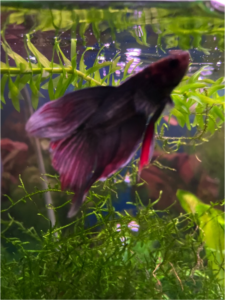
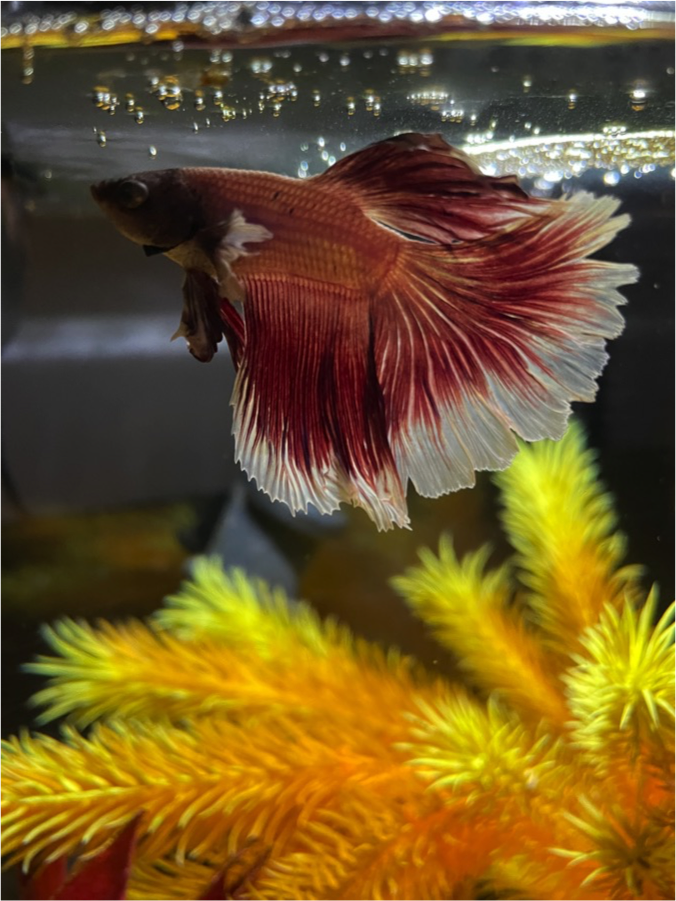
Dylan rescued some Betta fish from our local aquarium before the end of summer. They live in separate tanks, because otherwise Bettas will kill each other. Dylan rescued the fish, and then he went back to college. So we have these two fish.
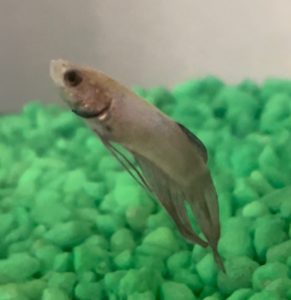
Tidbit was a tiny little thing, completely white – drained both of color and energy. White is the color of despair in Bettas. When they have no reason left to live, their color leaves their body and they begin to die. Tidbit was completely lethargic when we got him. But Dylan changed all that. Tidbit regained a ton of color and now charges around his ten-gallon tank, attacking his food with vigor – a completely different fish.
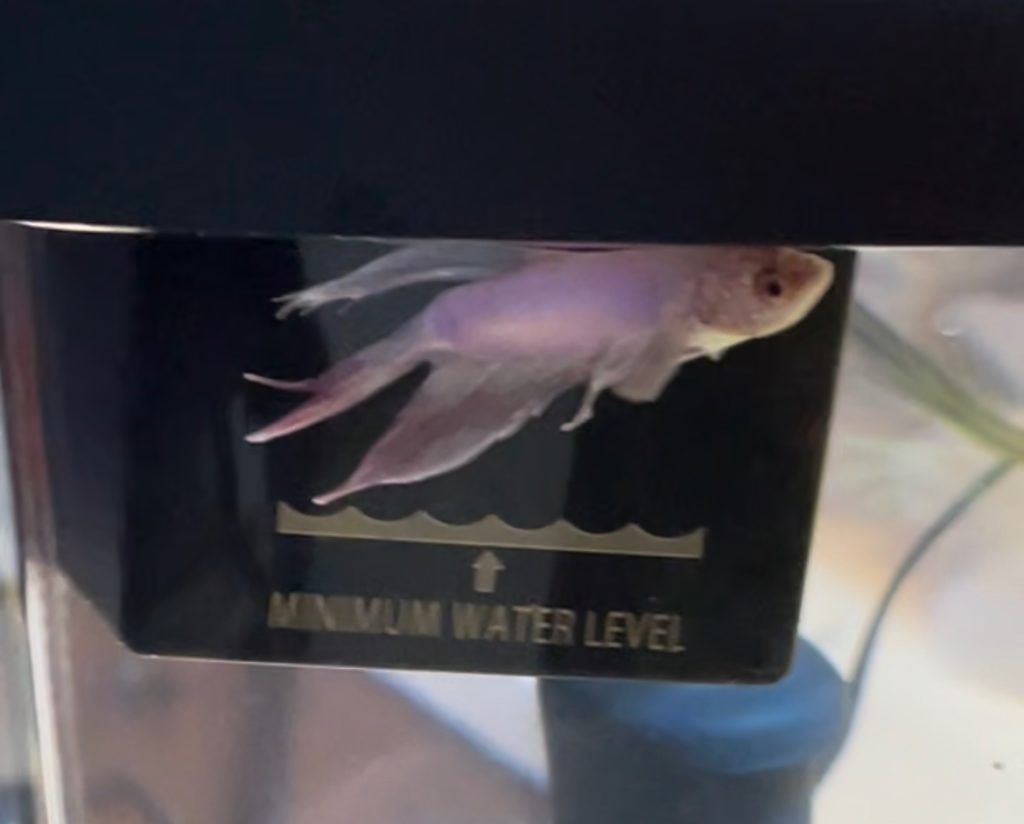
Hambone was a mystery. Pinkish-white in color, his eyes were enormous, glaring defects on the sides of his head. His ailment is called “pop-eye,” because his eye sockets literally pop out of his head. It didn’t heal with traditional treatments, so Dylan decided that he’s had a serious head injury. No one expected him to live.
We named him Hambone when Shane jokingly suggested it; the fish was responding stupidly to everything. He spent his days smashed between the filter and the side of the tank. Feeding him required waiting for him to find the top of the tank, then dropping the food directly on his face. In spite of everything, Hambone regained his color and – in spite of his disability – he is now thriving.
Over the last six months, feeding Hambone has gotten more challenging. His right eye is now as bad as his left, and he finds his food by following shadows, responding to the movement of the tank’s light when I lift the lid.
It’s sad, and Hambone often seems sad. He’s not zipping around like Tidbit.
When Dylan came home over Christmas break, he spent a lot of time on the piano which, coincidentally, is right next to Hambone’s tank. Dylan played for hours. His piano playing offers glorious music to a house that is otherwise pretty quiet.
So when he went back to college, everyone noticed – even Hambone.
Hambone was moping in his cage, and I realized quite suddenly that Hambone had been peppier with Dylan home. I wondered: was it the constant influx of music?
I raced to my 1968 Wurlitzer, which is in the same room, and played three songs for the fish, watching carefully. Hambone didn’t respond. So I sat down at the piano and played my one-finger version of Heart and Soul.
Hambone sprung to life. I played Heart and Soul for five straight minutes and Hambone swam around his cage excitedly. When I stopped playing, he stopped swimming.
I can’t play the same song with one finger all day long – but Hambone had been so excited….
So I rigged Alexa to play piano for him, which works until a commercial blasts at Volume 10. Then I tried Elton John and Billy Joel CDs – but Hambone freezes or hides during guitar riffs and blaring saxaphones.
Hambone only likes the piano. So Shane found an old bluetooth speaker, and I found piano music on YouTube that allows the music to play for hours without interruption. For hours each day, I play piano music for a legally blind fish.
Hambone has found a new life. He can’t see a thing, and feeding him is nearly impossible. But he’s happy – so obviously, swimmingly happy – that nothing else matters.
The longer the pandemic goes, the more likely I am to stay in my cocoon here at home. It’s very cold outside – and nowhere near as cold here as it is in other places – but I am happy to hibernate.
Every morning I wake up with nowhere to go and nothing to do, and I think, I don’t want to get out of this bed. I wonder about any upcoming activities and realize: I have to feed the fish. If Dylan hadn’t rescued two fish and left them with us, I wouldn’t even have this. But one of our fish is all-but blind now, and feeding him takes a minute. Plus I play piano music for him; he likes that.
So I consider getting out of the nice, warm bed (with it’s new mattress pad, which is lovely). I remember: I have to walk the dog. Loki gets walked twice a day no matter what the weather. When I finally roll out of bed, it’s usually because Wordle is waiting. Some days, this is a 12-second game, and some days it takes 20 minutes. The worst days are when I play after midnight, leaving me with no Wordle in the morning. Fortunately, then, I have Jeopardy questions and Luminosity. These are supposed to keep me mentally fit.
But lately I have been thinking: I don’t care if I’m mentally fit. Why do I bother? I still can’t remember why I jumped up and raced into the kitchen. I still don’t know the word for that thing that does the thing for the whatchamacallit.
I am virtually friendless, for good reason. I don’t talk to anyone, mostly for fear of putting them off, having them dislike me. I’ve been hurt a lot so I push people away rather than get to know them.
As has been the case since I had my very first friend, there are a couple of people I’ve let in. But I don’t make friendships a priority. Occasionally sports venture into my daily routine – softball sometimes, pickleball lately – and dealing with people is necessary for sports. It reminds me that people are my biggest fear.
Dealing with people feels like a lot of work. I worry all the time. I question every word I say: Did that sound weird? This thought is followed immediately by a horribly disturbing thought – the force that drives me in the world of people: Did I hurt her feelings; does she not like me now?
I am so consumed by this thought, so overwhelmed by it, that I can barely function.
So prioritizing people doesn’t make a lot of sense; I have decided to prioritize dogs.
When talking to my dog, I don’t ever think: Does he like me? Because he always likes me, and it doesn’t matter what I say or do. Even if I explode because he tore up the paper towels again, two minutes later he’s on my lap.
Dogs give so much and require so little; it makes sense that I should get a ton of dogs, spend my time with them, be an old dog lady. Maybe I’ll trade in this suburban lifestyle for a small place in the woods with a doggy door.
With the kids gone, if I weren’t married, this would be the path I would take. As a married person, I am required to compromise. I am required to deal with at least one person. So far, I can’t even get Bill to agree to get a second dog.
Yet the animals are literally the only reason I get out of bed.
I’ve figured out the problem with the world. As always, the problem starts with me.
I grew up believing I was smart. My parents – both college-educated, intelligent people – told me I was smart. I took some kind of test in elementary school that verified it. I got better grades than many of my classmates, and I graduated from college. So I believed I was a pretty smart cookie.
Then I met Bill. I’d met other people who, I knew, were smarter than me – lots of them. But I didn’t marry those people.
Getting to know Bill put my intelligence into perspective. Bill sees things differently than I do; he has a broader scope. He can figure things out that completely baffle me. He intuitively knows things that most people will just never understand.
And he is the most humble person I’ve ever met.
Lest I think that Bill is simply “differently abled,” Bill is also knowledgable in every single field, which makes him a trivia whiz. He knows science, geography, math, outer space, history, and government. He can fix a car or a computer, or anything in between. Before Google existed, if I really wanted to know something, Bill was the first place I’d turn.
Bill even explains his answers to questions, although I prefer less detailed responses because really, it’s a bit confusing for me.
Over the years, I determined that Bill is just plain smarter than me. And that’s okay, especially since he gave those good-brain genes to our kids.
I reason that my intelligence must be of some worth, since he decided to marry me. I try not to think too hard about this, since this may not have been his best decision.
Still, he stuck with me, so I must be smart enough for him. We have friends who are absolutely brilliant as well, and they put up with me. That has to count for something – but who knows?
A woman once told me a story about her first grandchild.
“She cut her finger and it was bleeding. You know what she did? She asked me for a ‘boo-boo sticker!’ She didn’t know the word ‘Band-Aid’ so she called it a boo-boo sticker! She’s a genius!”
I determined that that Grandma must be dumb as a post to think “boo-boo sticker” was genius. But what do I know?
Maybe none of us are as smart as we think. After all, of the wealthiest countries in the world, the U.S. has the lowest COVID vaccination rate. The 36% of adults who are still unvaccinated believe that they are smart, too. And they’re literally dying, just to prove it.
Today I was watching Judge Judy(which should tell you something about my intelligence right there). The episode was about a woman who had been suckered into working for a scammer. She’d given the guy $3,500 in cash and $4,000 in jewelry with zero evidence that the scam was even remotely legit.
After the show, the camera crews interviewed the woman outside the court room. She’d just been snookered for nearly $10K and here’s what she told the world: “I’m a Consumer Advocate for the State of Idaho,” she said. “And I thought I was pretty smart!”
That’s when it hit me: we are all idiots who think we’re smart.
And that, in a nutshell, is the problem with the world.
It started when Magic Kingdom began offering alcohol. I remember thinking: Wait, this isn’t right. This isn’t a Disney-like thing to do. But in 2018, Magic Kingdom started selling alcohol.
Walt Disney never wanted alcohol in The Happiest Place on Earth. It just doesn’t fit. Disney was headed down a slippery slope.
But Disney World has been my favorite vacation spot since we visited in 2009. So when I realized that Shane and I were going be five minutes from Disneyland – the original most magical place on Earth – I started planning our trip.
What I’ve learned is: sure enough, Walt Disney’s vision is no longer in charge.
On our prior trips, we enjoyed many of the biggest attractions with something called a Fastpass – a free paper ticket – free! – that would allow us to skip most of the wait. I would race from one side of the park to the other, grabbing Fastpasses for the whole family. I logged about 20 miles per day. But we rode a ton of rides and had very short waits in spite of overwhelming crowds.
Unlike Six Flags and Cedar Fair, who gouge customers by charging a fortune for Disney’s Fastpass service, Disney World included the Fastpass option in every ticket. Yes, Disney World tickets cost more – but it was worth it since everyone could ride virtually everything without much wait.
Later the Fastpass system went online: no more paper tickets! We could just log into our app and get our reservation times for each ride. We rode a gazillion times on the rides we liked. I only logged 10 miles per day on those trips. And Fastpasses were still free!
But during the pandemic, they discontinued the Fastpass system.
Now they’ve decided that – like Six Flags – they are going to charge a fortune for the pleasure of riding without waiting in line.
And for the pleasure of getting substantially less and paying substantially more, you can ride your favorite rides exactly one time without the wait. So if you want to ride Space Mountain twice, you are stuck in the standby line for three hours. The ride itself takes less than three minutes.
At Disneyland, even if you want to pay $20 per person, per day for the once-free service, the three most popular rides in the parks aren’t even included. You have to pay extra for those: up to $20 per ride for the biggest, best rides in the park.
But you’re only allowed to pick two of them. You will have to wait in the three-hour line for the other one. You literally can’t even buy your way out of the standby lines – which are obscene.
So for Disneyland, you pay $104-$164 per person, per day – yes, REALLY – just to enter the park. If you want the previously free option of skipping the line (only once per day!) that’s an additional $20 per person, per day. And if you want to ride two of the three biggest rides without waiting all day, add another $40 per person.
And if you’re going to Disneyland specifically, and you only have one day to see two parks like we do, you have to pay for the Park Hopper option – an option we never used at Disney World. This is another $60 per person for the privilege of walking out of one gate, crossing the sidewalk, and walking in through another gate.
All told, we will pay about $600 for two people to spend one day at Disneyland.