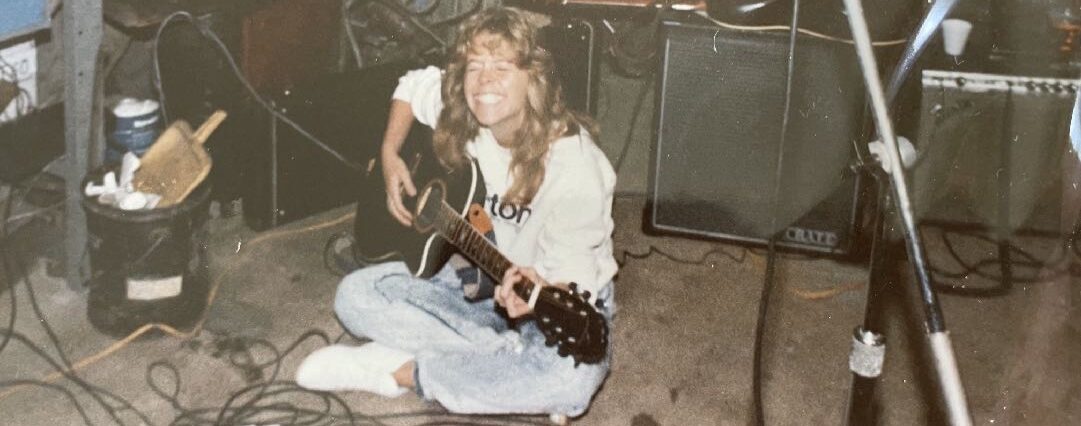
Decades ago, when I was very young – or at least, felt very much younger – I used to frequent some weekend dances at a local rec center. In the early 90’s, the dances were a big part of my social scene. I’d given up the bars and the wild life, and settled into a more easy-going lifestyle.
And I was still young enough to really dance. I loved the music of the day – whatever it was – and flailed around on the dance floor with the other dancers to the best of my ability. When the Electric Boogie played, I screamed with excitement and raced out to electrically slide and spin until I was nearly crying with glee. I had the time of my life dancing to that song.
The only thing that made my dancing experience better happened around 1993, when this guy I knew started appearing regularly at the dances. He hung around in the kitchen, helping the folks who ran the dance, and he spent a lot of time talking to people who needed a dancing break. When I talked to him, he always laughed at my jokes – and most people didn’t really understand my humor. But this guy did.
Eventually, he danced with me. He didn’t slide or do the line dances. In fact, he was a swing dancer. I had no idea what swing dancing was, but I would wander out onto the floor with him and laugh until my sides hurt. Long before the days of “So You Think You Can Dance,” he would spin me around and dip me like a pro. I just tried to remain upright as I was beaming and flying across the floor.
I danced with this guy every week and, eventually, I spent more time hanging out in the kitchen with him than I spent dancing with anyone else. After a couple of years, the dances kind of faded out – but it was okay. I married the guy.
Bill and I fell in love at that rec center; at least, I fell in love with him. My visions of him – those memories – are still so sharp that when I pass by that rec center, where those dances are now a thing of the past, I can still see Bill standing there, smiling.
This past weekend, I walked into that rec center for the first time in years, along with my 18-year-old son. This weekend, it was the site of my son’s After Prom Party – a thought I simply could not have imagined 20 years ago as I was sliding across that dance floor in 1993.
Dylan had a wonderful time, and the venue was perfect for the party. But I find it hard to believe that the After Prom Party was as perfect for Dylan as it was for his dad and me, all those years ago.
Tonight, Dylan goes to prom.
My little, tiny baby Dylan is going to shave and put on a tuxedo. He’s going to take his girlfriend to a fancy dinner and dance. If it were up to him (it’s not), he would drive his own limo. Maybe one of those Hummer limos. And he will be out all night, enjoying the last dance of his school career.
My little, tiny baby Dylan is all grown up.
No one believes me when I tell them something is up with Shane.
But something is up with Shane.
Since no one has come up with any kind of new “disorder” or “learning ailment,” I have been on my own, trying to figure it out. I have taken the Asperger’s quizzes online about two dozen times, because Shane’s “issue” so closely mimics Asperger’s – in some ways.
Asperger’s is high-functioning autism, and ADHD is on the autism spectrum. And I know the “spectrum” runs in the family. So when I hear Shane talking or thinking in such a literal manner, I think, it MUST be Asperger’s.
And he’s a synaesthete – he experiences letters as colors. This is a trait that is much more prevalent in people with autism-spectrum disorders.
In other ways, it seems impossible for Shane to have any “disorder.” He’s functioning beautifully – except when he’s utterly baffled by something that is so obvious to other people.
Did I just not teach him well enough when he was younger?
I thought I’d nailed it with “Nonverbal Learning Disorder.” But there are symptoms of NVL that he doesn’t have – just enough to make me wonder.
Meanwhile, I’ve noticed that he’s got very serious challenges understanding subtext, or body language, or reading between the lines. For years, he identified people by the color of their hair – and didn’t realize they had different faces. More than anywhere else, this is going to hurt him socially.
So since no one believes me, and no one else (except his kindergarten teacher who helped to diagnose him with a vision processing disorder) seems to notice the issue, I am always on my own.
Then I got an email from Shane’s English teacher. Shane had gotten a C – which is a very low grade for Shane – on his quarterly assessment. When I asked why, this is what his English teacher had to say:
I went back and analyzed Shane’s test response and identified two areas of weakness:
1.) Apply knowledge of language to understand how language functions in different context, to make effective choices for meaning or style, and to comprehend more fully when reading.
2.) Cite strong and thorough textual evidence to support analysis of what the text says explicitly as well as inferences drawn from the text.
Simply put, Shane needs to first and foremost understand figurative language. From both his test and my classroom observations, Shane gets the overall picture of what the text is about, but can’t quite explain clearly how he came to the conclusion. … Inferencing is also an important skill to work on and he can accomplish this with the more he reads and THINKS about the reading.
Inferences, figurative language – this all relates back to Shane’s overwhelming ability to be literal. Whatever it is, he needs to work on it.
So I’m trying to “train” him through – of all things – YouTube. I’m finding videos related to each little piece of what might ail him.
But it’s incredibly frustrating. For the first time in my life, I find myself without any ideas on how to help my child. Maybe this is why I spent so much time concentrating on how to help Dylan – because ADHD is so well-studied and documented.
I ran into an old friend one day who said that she’d just found out that her son has Asperger’s – at the age of 32. Asperger’s wasn’t a “thing” when her son was younger, but now that he’s 32, he’s finally able to be diagnosed and properly treated.
I sure hope I don’t have to wait until Shane is 32 to figure out how to help.
I am not a huge fan of tradition, so Mother’s Day is not bright on my radar. It’s nice having a day, but we don’t spend the whole day buying purses or eating at some high-priced, lavender-infused bistro.
As a result, my sons can almost forget about it beforehand. They don’t fret over cards or gifts – although this year Shane spontaneously presented me with a hidden word puzzle book, which I love.
Mostly, I just enjoy spending time with the boys. We played several games of Racko this year, after playing Apples to Apples and Big Boggle. We watched “Ferb TV,” my favorite Phineas and Ferb episode, and I got to pick anything I wanted to eat for lunch and dinner. (Bill cooked, thank goodness.)
For health reasons, I am on a very restricted diet. NO gluten, dairy, soy, rice, potatoes, corn or sugar. My blood sugar skyrocketed, probably because I consumed a ton of fruit.
So I am now fighting extra hard to avoid even trace amounts of sugar. For lunch, I asked for hot dogs and baked beans, a treasured staple from my childhood.
We had one, soup-sized can of baked beans in the cupboard: 16 grams of sugar in 1/2 cup. The entire can was 42 grams of sugar. Previously, I would have eaten it anyway. But my health is in danger, so even on Mother’s Day, I knew better.
Since it was my special day, Dylan and Shane went to the grocery store to find me some sugar-free or reduced-sugar baked beans.
They were gone mere minutes when Shane sent the first photo: Dylan crouched in front of a wall of baked beans, scouring labels. Then the texting began.
No sugar free beans sorry
This is the only can that doesn’t say “made with brown sugar” or “made with extra brown sugar” on it
We can’t find reduced sugar either
I’m looking at all the beans they have mom
They all have sugar
I called Dylan to tell him to forget it. He answered without saying hello: “After reading the labels absolutely every can of baked beans, I am now certain that there are no baked beans without sugar.”
“Don’t worry about … ” I started to say.
“Oh wait! This one has 10 grams of sugar. Ten is the lowest I can find.”
That’s more than 30 grams per can. “Forget it, Dylan, really. I just won’t have baked beans.”
“It’s Mother’s Day,” Dylan said. “Let me get one can. You can have ten grams of sugar on Mother’s Day.”
I was about to agree – or maybe I wasn’t – when Dylan found a can with only seven grams of sugar per serving. “It’s pork and beans, though,” he said. “It doesn’t say ‘baked beans.'”
“That would be great; thank you,” I said, then hung up the phone, ecstatic that I’d limited my sugar intake to something almost reasonable.
I’d told the kids they could get some ice cream while they were at the store, even though it is 99% made from ingredients I can’t eat. Before they checked out, Shane sent me a photo of the ice cream they’d selected. Three half-gallons of Breyer’s and Turkey Hill, and two additional pints of Ben & Jerry’s. It seemed a bit much, so I texted back.
Is anything on sale?
I don’t think so.
Put the Ben & Jerry’s back if it’s not on sale.
Somehow, my struggle with sugar hasn’t affected them in the slightest.
Still, it was a glorious gift, having my well-educated children reading labels, scouring details, and successfully finding me a can of beans. My Mother’s Day could not have been any better.
When I was pregnant with Dylan, things didn’t always go well.
First, very early in my pregnancy, I passed a blood clot – a horrible glob of something fell into the toilet. Bill and I cried for two hours, thinking I’d miscarried, until we finally saw the doctor.
I got an ultrasound. “I don’t know what you passed,” said the doctor, staring at the black and white screen. “But your baby is just fine.”
Then we really cried. The baby was fine!
A few months later, after we’d finally decided on Dylan’s name, the doctor saw something on baby Dylan’s brain – “a spot” – whatever that meant.
“It’s a marker for Down’s Syndrome,” the doctor told me. “It doesn’t guarantee that your baby has it, but it is a marker. Because of your advanced age (35), I would recommend getting an amniocentesis, just so you can be prepared.”
During the amnio, baby Dylan seemed to be reaching for the needle – even then always active, wanting to touch whatever was nearby.
We had to wait several days for the results. Those were hard, hard days.
Finally, we got the results. “We can’t guarantee that your baby is fine,” they said, “but the amnio showed no signs of Down’s, spina bifida or cystic fibrosis.”
Again, we cried. This time, they were tears of relief.
My water broke a full 24 hours before Dylan was born. He was eight days late, but never fully dropped. Someone guessed that his foot might be stuck in the umbilical cord.
My “all natural” childbirth became the “try anything” approach. Eventually, an emergency C-section gave us our a surprisingly perfect baby boy.
I had no idea that Dylan wasn’t “typical.” I didn’t know that zipping around like a Tasmanian Devil was unusual for a toddler. I thought all babies did that.
And I didn’t know that by the age of 2, most kids could say “white” and “yellow” instead of “ye” and “yo.”
I also didn’t know that most toddlers can’t spell their own names or count past a hundred. And I didn’t know that empathy was reserved for ages 8 and up; Dylan had true empathy before he ever got into preschool – at two.
During preschool, I blamed Dylan’s little friend, Nicholas, when Dylan got into trouble. By kindergarten, I knew I’d blamed the wrong child.
By first grade, Dylan was so bored, he could have slept through school and still been passed along to the next grade. Truthfully, he could have started school in 3rd grade.
The gifted program was Dylan’s first truly wonderful school year. For the first time, he was interested in learning.
There were some suspicions that Dylan had ADHD – but no one ever really “diagnoses” ADHD. Instead, everyone weighs in – teachers, parents, friends. Then the doctor writes a note to the school to “help” with “problem areas.”
Dylan carries that rather haphazard diagnosis with him to this day. In a way, it was helpful. But being gifted – and bored – caused him far more difficulty than ADHD ever could.
And now, finally, Dylan is graduating. He survived everything, and is leaving school with a real sense of himself and who he is – which is way more than I can say for myself at that age.
I wonder sometimes, still, about that spot on his brain – that “marker.” Did it make him gifted? Is it also a marker for autism-spectrum disorders? Maybe that spot is a “marker” for something that no one will discover for a hundred years.
However it happened, I am just proud of the man Dylan has become.
Dylan is nearing the end of school – forever. He’s legally an adult, he knows how to drive, and he doesn’t need me to sign any of his forms. Prom and the last day of school are around the corner, and graduation day is going to be promptly followed by college orientation.
So I am starting to focus on Shane.
I don’t mean that I’m paying more attention to Shane – because really, I am not. In fact, I might be paying less attention to Shane than ever before. Instead, my worries are focused on Shane. I’m starting to notice that he’s not as concerned as he should be about things – like grades, cleanliness, and chores around the house.
I’m starting to worry about his sugar intake, his overindulgence in dairy items, his dry skin. I’m overly concerned that his room looks like a pig sty. I’m wondering if I can still trust him, the way I always have – not because he’s done anything wrong, but because I’ve just noticed that Shane is 15.
Shane is an amazing young man, and I could count his flaws – when he has them – on one hand. But I am getting a little sick with worry about him.
Because Dylan is stepping out of the spotlight. He’s very carefully and deliberately allowing me to let him go.
Even if I don’t want to. And I really, really, really don’t want to.
Over the weekend, Shane went on a church retreat. In an idyllic setting with just enough rain to make it cool, and 30 people peacefully exploring nature, he had a wonderful time.
When he came home, Shane answered all of my questions. He told me about the group activities, the Bible verses they discussed, the team trust exercises, sitting on rocks in the water, his fun roommates, the woods in darkness, and s’mores by the campfire.
I absorbed every word. I love listening to Shane.
“It sounds like you made some new friends, too,” I said, referring to his roommates and hoping to encourage more discussion.
“Yeah,” he said. “But mostly I talked to the group leaders. They kept coming over to me like, ‘hey, I’d better go talk to the shy kid.'”
This peaked my interest. I was always the shy kid, so Shane appearing shy intrigued me. I remember feeling completely left out all the time – school, church, Girl Scouts, dance class, team sports – all the time.
I didn’t want Shane to feel that. Listening to him talk, it didn’t seem like he felt left out. He is always quiet, never disruptive, but I haven’t considered him “shy” since the great dollhouse debacle back in ’08.
“Did you tell the group leaders that you just don’t talk much, and you don’t smile much, but that you are usually perfectly content?”
“No, I didn’t mind,” Shane said. “They were cool. I even found out that one of them is ranked higher than me in the ping pong league!”
Ah, a fellow pong player. Maybe he was 20 years old, but at least he plays ping pong.
So Shane made friends, and he became friends with the college-aged group leaders, too. I’d say it was a good weekend.
Dylan’s summer plans have been in flux since last summer. Now, not surprisingly, he wants a summer job.
For a year, Dylan has been considering a gap year. He’s gone to gap year fairs, job fairs, and been accepted into AmeriCorps. He turned it down, in favor of … well, nothing. He thought he’d be going to the beach for the summer, living there rent-free and making a ton of money, while having his girlfriend visit him frequently.
None of that happened. So, with summer on the immediate horizon, Dylan wants to work.
Dylan loves to work. I would be thrilled with him working. But he should have secured a summer job back in January, when I told him to start looking. Instead, he’s filling out applications just as fast as he can fill them.
Today, one company – a place he’d adore working – emailed him and asked him to send them his summer schedule. “This will help us to determine,” said the company, “whether or not it will be a good fit.”
I texted Dylan his schedule. He’s got high school, then the prom, a night at the theater, and graduation. This is followed by a week-long trip for a two-day college orientation, which is followed by a week-long mission trip. After that, he’s taking a week of vacation – and then heading to college less than two weeks after that.
Dylan sent all of that information to the company.
The email response was almost immediate, but not automated. “Thank you!” it said. “We would like to have you join us for an in-park interview!”
I couldn’t believe it. Who looks at the schedule he provided and interviews him anyway?
But they did – and how wonderful it would be if he could get that job and enjoy his summer, too. It might just be the perfect thing for him.
While Dylan was finalizing his college decision, Shane and I got started on our college search.
Yes, it’s too soon. No, I don’t care.
For Shane, since he doesn’t require the amount of “inspiration” that Dylan required, we started at the end of 9th grade – and we invited Shane’s friend along, to make it more of a vacation and less of a hard-core search.
Still, we started with Princeton. We (briefly) saw Rutgers, then drove up through Connecticut and Rhode Island, stopping at a bunch of schools – including Brown and Yale. Shane’s favorite was Fairfield University.
Shane is not headed for the Ivy League. He could, certainly, go that direction, if he so desired. But he has no interest in those schools. After one quick trip, I know that what Shane seeks is a small, quiet school – preferably with therapy dogs roaming around campus.
I think the dogs put him right over the edge at Fairfield.
We’re going to keep looking, of course, since I love to travel with Shane. It will be a different kind of search, and one that will be every bit as enjoyable as my trips with Dylan.
Shane has been saying that he wants to work on film – which means he’ll need to do something other than the “film program” that doesn’t actually exist at his school. We’ve already got some options on that end.
Unfortunately, there are only a handful of colleges with good film programs on this side of the country – a couple in Connecticut and Rhode Island, and a handful in upstate New York.
The good news: I already had a trip planned for upstate New York, but Dylan and I never took that trip. So it’s ready for Shane!
And the other good news is, Shane isn’t 100% married to the idea of working only in film. During this first excursion, he latched onto another major that he thinks he might enjoy: business and economics.
And that opens up a whole new world for Shane.
I’ve been making Dylan’s breakfast for 18 years. Since he started eating solid foods, I’ve done a lot of research on healthy breakfasts for babies – and then for toddlers, preschoolers, young children, and finally for kids with ADHD.
What I learned would make any parent’s head spin, but I figured it out to the best of my ability. He needs L-Tyrosine, Focus Factor and animal protein – either eggs or meat – to assist the way the amino acids function in his body. Omega 3 can also assist his brain.
So the logical breakfast: organic, cage-free eggs with Omega 3. I started feeding eggs to Dylan in eggnog, but the eggs were raw and the sugar content was high. He said he could eat scrambled eggs with lots of cheese – so I started making mini-omelets. And then, when he couldn’t quite get downstairs in time to eat a leisurely breakfast, I started putting those scrambled eggs with cheese onto buns so he could eat them on his way to school. For a few years, he’s been eating egg sandwiches two or three times a week.
With only a month left of high school, Dylan said – for possibly the tenth time – “I really don’t want to eat egg sandwiches anymore. They actually make me sick when I eat them in the morning.”
He said this very calmly and rationally. But I blew up.
For two days, I blew up. I raged and sputtered and screeched and hissed. “What else do you want me to do?!?” I squealed in my agony. “You won’t eat anything else!”
While he read me a list of things he would eat – pancakes, waffles, hash browns, croissants, fried potatoes – I screamed over him that none of those things have animal protein! I was driving them to school – for Dylan’s very last month of school – and I still thought he didn’t understand how his vitamins worked: “You need animal protein!”
But in the back of mind, something was stirring – something deep under the surface of my angst.
The kids got out of the car and I couldn’t even say, “Have a nice day.” I didn’t even put the front window down so the kids could pet Loki. In fact, I couldn’t say or do anything at all.
And then, halfway home, I suddenly could do only one thing: I could cry. A dam of tears burst from my eyes and deep, choking sobs erupted from my gut. Sitting at a red light, I was crying so hard, I couldn’t even breathe.
Loki looked up and instantly pulled toward me, nearly breaking his little seatbelt. He climbed into my lap at the red light and stuck his head under my chin, desperately trying to comfort me.
It was the sweetest, most touching thing my new dog has ever done for me.
I don’t know how Loki even knew that those sounds required comforting. But I think I know now how I’m going to survive Dylan’s move to college.