Six months after my original request for a meeting to discuss Shane’s OCD accommodations, we met again – this time to determine what we could put on the 504, since Shane really only had one issue.
His issue was reading.
Over the summer, Shane was agonizingly stuck so often while trying to read – a fiction book of his choosing – that I’d volunteered to read to him, or to singlehandedly excuse him from the summer homework. Shane simply couldn’t read. The OCD was making it impossible.
Fortunately, though, with a new therapist and Shane’s hard work in therapy, Shane was having way less trouble in November than he’d had in July. In fact, he was hardly having any trouble at all.
“Sometimes I get distracted,” he said. “But I don’t really get stuck anymore.”
“Let’s see what your teachers have to say,” Shane’s counselor said, and she picked up teacher referrals from every one of his teachers. Then she read aloud:
Shane is a great student. He puts 100% effort into all of his work. He has maintained an A for the entire quarter. Shane is polite, hardworking, and cooperative. His writing is very creative and his reading comprehension is excellent.
He sits in the front row with strong students and diligently stays on task. He is not very chatty and will proactively ask for help.
Shane is always attentive in class. He does not get distracted by other students.
Shane does not need any of the accommodations listed in his plan. He is fully independent and can perform wonderfully without them.
Shane’s counselor finally put down the pile of papers and looked up.
“You’re a rock star, Shane,” she said.
Shane, who regularly shows no emotion whatsoever, had just a tiny eye flinch – something that I have come to recognize as pride. His mouth even twitched, and I swear he almost smiled.
And deservingly so. For page after page, teachers had raved about Shane’s incredible ability to do exactly what was expected of him, and to excel both creatively and intellectually. With the quarter ending, we also knew that Shane got six A’s – including an A in his first-ever AP class – and one very high B.
My worries about OCD were over.
The counselor, whose job it is to make sure that Shane stays successful, told both of us that we would reconvene in a year to reevaluate Shane’s 504.
“Is there anything you think you’ll need then?” she asked him.
“Not really,” Shane said. “Sometimes I get distracted when I’m reading but I think I’m doing okay.”
He’s doing okay.
“How about a flash pass?” I suggested. “If you are ever too distracted to read, and you just need to get up and move around, you can walk to the counseling office and just sit until you’re ready to go back to class.”
“We don’t even need to put that on the 504 plan,” said the counselor. “We can just give him one. Do you think that would help you?”
“I could try it,” Shane said.
So Shane got a flash pass which, most likely, he’ll never use. The meeting was over in 15 minutes. And I got the feeling that we really weren’t going to need another meeting in the future.
But I sure did enjoy this one.
After questioning the therapist about the connection between hoarding and OCD, he called me into his office at the end of Shane’s session.
“There are different reasons for hoarding,” he said. “Sometimes it’s about needing to hang onto things just in case they’re needed later. Other times it’s more about a sentimental attachment. And sometimes it’s just about things being where they are, and feeling like that’s just where they go.”
He said that he thought Shane might have a few of those things going on, but not all of them, and that he thought Shane was willing to work on them. Then he gave Shane some homework to do.
“Maybe you could give away just a very few things every day for a week,” he said. “How many things do you think you can find?”
“I don’t know,” said Shane.
“Do you think you can find three? Three things a day?”
“I guess,” he said.
So Shane’s homework was to find three things a day, for a week, with which he could part.
One night, I got a pen, a pair of free sunglasses from the pediatric dentist, and a finger-sized rubber chicken. Another night, I got two rubber bracelets and a bookmark. More sunglasses and pens piled up. Some old CDs appeared. One day, I got some very old clothes.
After the homework had been in full swing for awhile, Shane said, “I’ve realized that I don’t have that much stuff that I want to give away. I just have a lot of stuff that needs to be in the garbage.”
I agreed.
But he didn’t actually want to put things in the garbage. Shane just wanted to point out that he knew that some of his stuff is garbage.
It’s been a few weeks now, and I still get the garbage. It just keeps coming – in teeny, tiny piles of three. The things sit next to the steps, where I collect them, and put them in a more appropriate place.
Shane’s room looks exactly the same.
Dylan scheduled a meeting with his advisor, a precursor for spring semester course registration.
Since I have so little to do for myself – what with working nearly full-time, doing the best I can with Shane and raising a puppy – I started looking at class options for Dylan.
I looked, and I looked, and I looked. Days went by. I kept looking. I checked the website for what he needs for his major, and what he needs for general education. I thought about Dylan’s likes and dislikes. I considered the number of credit hours, and looked into how many – and how few – he can take without changing tuition.
After four days, I had a list of 28 color-coded course selections with five alternate one-credit courses, complete with days and times of each class and a sample schedule that I thought he should take. I even threw in the course literally titled, “Special Interest: Bob Dylan,” because I think he needs to know more about his namesake.
And of course, I didn’t want to share any of this with Dylan. He was at college, doing his own thing, keeping up with the classes he’s currently taking, and doing nothing on his own behalf to get ready for spring.
In fact, Dylan was in the midst of a four-day fall break with nothing to do, and he still didn’t find any time to look at the website and see about his options.
Meanwhile, I kept tweaking my version of his schedule. I texted Dylan every day and asked him to call me when he had an idea of what he wanted to take. And every day, Dylan didn’t call.
But eventually, something came up and Dylan had to call. So he did.
“So let’s talk about classes!” I said with excitement, pulling up my list.
“I knew you were going to say that,” Dylan said. “I knew you would want to talk about classes and I absolutely HATE looking at classes.”
I couldn’t believe it. I’d been having so much fun finding classes for Dylan! How could he not enjoy – even revel – choosing his course selections?
“I HATE IT,” he said. Dylan doesn’t hate much, but apparently choosing classes is a thing he hates.
“Well,” I said. “I sure had a lot of fun with it.” I started asking him questions, to see if he’d done anything at all.
He hadn’t.
So I talked about the things I knew, about his requirements for graduation, about what’s left that he’ll want to get out of the way – and what he needs to take to pursue the major he chose.
Eventually, I just caved.
“Why don’t I just send you the list of the classes I found? They are all classes you need, and you can decide what you want to do.”
“That would be great,” he said. So I did – and as far as I know, he never even looked at a course catalog before choosing his spring semester classes.
I know what I did was wrong. I know, in my heart, that I have done him a disservice by cutting through all the crap for him. I sincerely wonder how he will ever get along in the world – and how he will graduate from college – if he doesn’t know exactly what he needs to do so.
And yet, I had so much fun! And I don’t have to take a single class! It’s like making travel arrangements for someone else: I get to do all the planning, but I don’t have to spend any of my own money!
I know it was wrong. But I really enjoyed it.
WHEN: Halloween Night
SETTING: A pitch black, windy night; the driveway is dimly lit.
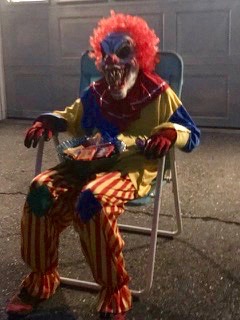
The body of an evil clown is flopped lifelessly in a chair, its immense, angry eyes and garish teeth belying its intent. A full bowl of candy sits on the ground between the clown’s feet.
SCENE 1: Two 13-year-old trick-or-treaters approach the driveway
“What’s that?”
“I don’t know. It looks like a clown!”
“Is it real? I don’t want to go near it.”
“Nah, it’s not real. See?” Lifts one gloved hand, which flops back down onto the armrest
“Did it move? I think it’s real.”
“No way!” Stares hard into clown’s face which is solid and still; lifts the hand, which flops again
“Wait, stay there. I want to get your picture with it!”
Trick-or-treater puts arm around back of clown’s chair and smiles; second trick-or-treater takes a quick photo with cell phone
“Hey! Look at this candy! There are huge bars in here!”
“I don’t want to go near it; it’s creepy. Get me a couple.”
Trick-or-treater squats down to reach into bowl, grabs a handful of full-sized candy bars; the clown’s head shifts slowly toward the squatter by the bowl
“TAKE ONE”
Trick-or-treater leaps to his feet, screaming, dropping candy bars
“Wait, maybe that was, like, a recorded message or something!” Stares at clown’s face again, still unmoving
A huge gust of wind blows, causing hundreds of leaves to fly at the trick-or-treaters; the clown’s body flops and rolls out of its chair and into the yard next to the driveway
“See? I told you! It’s not even real! What kind do you want?” Starts to pick up dropped candy bars from driveway
“I SAID TAKE ONE!” The clown suddenly rises from the grass and starts walking toward the trick-or-treaters, who throw the excess candy back into the bowl and run screaming up the sidewalk; one boldly snaps a photo from a safe distance.
SCENE 2: A large group of children, teenagers and adults approach the clown, who has now flopped lifelessly into his chair again
“Oh. My. God. Look at that!” Two teenagers approach the clown; a terrified youngster grabs a mother’s hand
“Don’t touch it!”
“Why not? It’s not even real!” Takes a tentative step toward the candy bowl
“There’s a banana in here!” Three kids step a little closer
“And there’s candy, too!” A teenager looks closely at the clown’s face, and reaches out a hand to touch his arm
“Seriously! Don’t touch it!” Takes two steps backward
“Well they want us to take the candy or it wouldn’t be here.”
“Yeah but I don’t want to go near it.”
“I just touched the arm. It’s not even real!” Five kids encircle the clown; the adults and younger children stay near the street; one adult films on his cell phone
“Well it looks real. Grab the banana and see what happens.” Tiptoes to the bowl, grabs a banana, then nearly dances backward, away from the clown, holding a banana above his head.
“Grab me a candy bar!”
“Yeah, get me one!”
“No! You grab it!”
“I’ll just take the whole bowl!” Steps forward and reaches down toward the bowl
The clown stands up.
Entire group erupts in high-pitched screeching; cell phone filming stops; children race for the sidewalk; kids look at each other, scream, run, jump around; the clown stands still in the driveway
“OH MY GOD IT’S REAL IT’S REAL!”
Trying to be brave, two tiptoe back to see test their bravery; one speaks breathlessly:
“Excuse me, Mr. Clown? Could I have a candy bar?”
The clown takes a step toward the teen, who screams again and runs. Another dashes behind the clown and stretches, reaching into the bowl, grabbing a handful of candy, then runs for the sidewalk. The clown takes another step toward the crowd, and they flee, screaming, cavorting, laughing.
The clown sits back down in the chair. Within moments, another group rounds the corner … with no idea what awaits.
EPILOGUE: From inside the garage door, I clutch my gut with almost painful, silent laughter. Whereas I once dreaded Halloween, Shane now makes this night an absolute delight.
In my research about OCD, I discovered a concerning connection between OCD and hoarding.
I thought about Shane’s bedroom. I thought about the way things pile and pile and pile up, never to be disturbed. I thought about his inability to part with even the smallest of toys, no matter how impractical.
I thought about the multitude of times that I walked into his room and said, “Shane, I just can’t stand it anymore. You’ve got to clean up the floor, at least, so I can walk in without falling on my face.”
I also thought about the photo book.
When Shane was a baby, we created a photo book for him, so he could learn the names of people in his family. We used a pre-made, all-cloth book – something soft, so it would be comfortable for those tiny baby hands. We slid real photos into the slots, showing Shane with various friends and family.
“And who’s this?” we would say, in that high-pitched baby squeal.
“Din,” he would say, meaning “Dylan” – and he would be right, so we would continue to squeal with delight.
Shane was about four when I suggested that we change the photos in the book.
He wailed. Shane was not much of a crier, so this reaction was quite unexpected.
After much questioning, it seemed that Shane was sad because he’d already grown up so much that he couldn’t bear to look at the book anymore – let alone change it.
“I am too old!” he choked, sobbing uncontrollably.
At the tender age of four, he was upset because he would never be young again. And he realized, even at that age, that changing the book in any way would be taking away something that was rightfully his – a baby book filled with his memories, the people he loved.
So he put the book away on his bookshelf, and he never wanted to look at it again.
“I am too sad,” he said, his giant blue eyes welling with tears.
That book is still on his bookshelf. In eleven years, he hasn’t changed his mind. He doesn’t want to look at it – or get rid of it.
And while he has definitely gotten rid of most of his “little kid” books, there are still a number of toys and things in his room that he will never use again, but that he’s not willing to give away.
So the piles keep piling and the room keeps getting worse, and I really didn’t think too much about it – until I read about the connection between hoarding and OCD.
We will have to see if there’s a connection in Shane’s brain – or if he’s able to tackle the hurricane clean-up on his own.
On Saturday night, I got a (highly unusual) phone call from Dylan – on our home phone.
“Oh you’re there!” he said, sounding exasperated. “I have a predicament.”
“You do?” I asked. “What’s going on?”
“Well, David came to see me.” David is Dylan’s friend from home, 700 miles away. “He just showed up and surprised me! And I’m supposed to go to work in like two hours.”
Ah yes, Dylan is still working at the Halloween haunt. It’s only on weekends, and Dylan makes very little money, but he really wanted to work there.
As I knew it would be, it’s been a problem nearly every weekend since the Halloween season began. But this was a big deal. Dylan really, really, really wanted to spend his evening with David.
“I texted my boss,” Dylan continued. “And I told him what was going on and asked if I could have the night off. But my boss said, ‘We’re understaffed tonight and could really use your help.”
Dylan has a good boss. He doesn’t get angry, and he likes Dylan. He knew exactly how to phrase his request so that Dylan would consider the consequences of his actions.
Meanwhile, I knew exactly what Dylan wanted from me.
“I’m not going to give you permission to skip work,” I said. “It sounds like he really needs you, and you did make a commitment to do this job.” I also reminded him of a night, not long ago, when David couldn’t go to a concert with Dylan because David had to work.
“But David had a full-time job,” Dylan said. “This is just a Halloween haunt.”
After much discussion, I suggested that Dylan have David work with him. (They’d worked together the previous year at a different haunt.) My suggestion would solve both the understaffing problem and Dylan’s ability to spend the evening with David.
“Tell your boss you’ll work for free,” I said. “But say that you are leaving at 10:30. Then you can spend the rest of the evening with David, but you’ll still be there for most of the crowd.”
Dylan thought that was a pretty good idea.
“I knew there was a reason I called you,” Dylan said – making my night.
About three hours went by. David didn’t want to work with Dylan. But Dylan went into work, resigned to, and prepared for, his slightly altered shift.
omg you’re an adult, I texted.
Surprisingly, a short while later, I got another phone call from Dylan.
“Mom! You won’t believe what happened! I went in to work all ready for my shift…? And my boss came up to me and said, ‘We’ve got enough people now; you can take the night off.’ He even shook my hand!”
Dylan was nearly ecstatic.
“Oh, that’s great!” I said. Now he could spend the entire evening hanging out with his best friend from home – guilt-free, doing whatever they wanted to do.
Dylan could hardly contain himself. “Being mature and doing the right thing really paid off!”
It sure did, Son.
(And thanks, God.)
One morning, as usual, I was browsing the parents’ page for Dylan’s college, trying desperately to stay connected without being clingy. Another parent mentioned that she was sending cookies to her son, and I thought: “Gee, Dylan loves cookies.”
So I ordered a dozen and a half cookies to be delivered that very day. And then I went back to my own life.
I was on a break at work when I got a text from Dylan. He was panicked about a grade in Speech class. I spent a few minutes reassuring him that he could talk to the professor and figure out the problem. He texted back:
I suddenly feel like I have so much to do but I can’t for the life of me think of what it is that I have to do
oh that’s just general anxiety…. really, the best thing you can do when you feel like this is to think about what is right in front of you…. concentrate on the moment you’re in.
in the moment I’m in I am anxious
(I started blathering on at this point about getting enough sleep, eating right, blah blah blah.) I was saying:
And stay away from processed sugar…
someone just ordered me a cookie
oh well THAT kind of sugar is okay
cookie
I’m so excited for my cookie
Who ordered me a cookie I’m confused
I love cookies mom
(Suddenly and happily remembering that I’d ordered cookies for him hours before, I quietly soaked it in.)
Dylan sent me a screen shot of the announcement, with a link for him to select his delivery time.
also this isn’t a scam trust me it’s a thing a lot of people do around here apparently
Did you schedule your delivery?
I did
for 1 pm
I will get my cookie at 1 pm
Another screen shot announced: YOU ARE GETTING A GIFT!
see see
someones sending me a gift!!!
idk who’s sending me a gift but I’m excited!!!
Good! I love cookies, too.
this is so exciting mom
I might be failing speech but at least I’m getting a cookie
wow I really am in college
Reading his texts, while sitting at work 700 miles away, made me possibly happier than I’ve ever been. Dylan was so excited, and he was sharing that excitement with me.
I nearly cried with joy.
After work, I texted Dylan again. The cookies were late, but the delivery person had texted that his gift was “on its way.”
Meanwhile, Dylan had done some thinking about who might have sent him a gift.
are you sure u didn’t get me this cookie
I didn’t answer his question. Instead, I pulled my car over to the side of the road and called Tiff’s Treats to make sure those cookies were going to arrive in a timely fashion. Dylan had Bible class at 2 p.m. and it was after 1:30. While I was calling, the cookies arrived.
you diD
thank you mom !!!!!!!!!!
He sent me a photo of the box on his desk, with its little card.
IM SO HAPPY WITH THIS AND I HAVENT OPENED IT YET
He sent me heart icons. I sent him cookie icons. He took a bite and sent me a picture of himself with a cookie.
THEYRE SO GOOD
Dylan had possibly never been happier in his life.
I may not have done a lot right as a parent, but sending cookies was quite possibly the best thing I ever did. And, safely out of work, I finally cried those tears of joy.
I’m considering buying stock in the company.
Shane and I took a special one-day college road trip throughout the Washington, D.C. area. It was a good excuse to spend some quality time together, and we managed to tick off a lot of the nearby colleges while we were at it.
At one point, we were traveling over a bridge. There was a sign that said, Prepare to Stop: Drawbridge Ahead.
We were going over a river that led into the Chesapeake Bay. We were on a long, concrete structure that, apparently, could be lifted for passing barges.
It occurred to me that Shane probably hadn’t been over a lot of drawbridges in his lifetime. Heck, even I haven’t been over a lot of drawbridges, and I’m a few decades older than Shane.
In fact, I wasn’t sure if Shane would even know the word.
“There’s a drawbridge ahead!” I said. “Do you know what that is, Shane?”
“Sure,” he said. “It’s a bridge that goes up in the air.”
I started to compliment him. “Yeah, and….”
“And there’s a castle and alligators and a boat,” Shane said.
With that comment, I realized that the only drawbridge Shane had ever seen was less than five inches long – and it was attached to our vintage Fisher Price Little People castle.
I nearly wrecked the car, laughing so hard.
Shane walked out of his weekly therapy appointment one day – with his therapist – mid-way through the session.
The therapist glanced in my direction. “We’re just going to McDonald’s,” he said. “We’ll be right back.”
Shane was nearly giddy with laughter, but he barely cracked a smile.
Then they left.
I laughed quietly, thinking they were joking. I wondered where they were actually going. But they didn’t come back. And they didn’t come back. And they didn’t come back.
I started to believe they’d actually gone to McDonald’s.
Finally, they came back. Shane was slurping soda from a McDonald’s cup. Sure enough, they’d gone to McDonald’s. Apparently there is a McDonald’s within walking distance of therapy.
I have no idea what they did there, but they both seemed happy upon their return.
Shane’s OCD has almost been unnoticeable since he started with this new therapist. He’s doing exposures directly related to his type of OCD, and it seems to be doing some good. Shane hasn’t been visibly upset at home, and he seems to be able to get through his reading – even for AP Government – substantially easier than he could even last month.
The following week, after McDonald’s, Shane and his therapist didn’t use the whole hour for therapy. Shane was allowed to leave early, with a homework assignment – but the therapist made a suggestion as we were leaving.
“After next week,” he said, “we can look at doing therapy every other week, and starting to phase him out.”
“He’s almost done?” I asked, incredulous. It had only been about a month.
“I think he’s doing really well,” he said. “Shane? Do you think you’re doing well?”
Shane nodded. “I think so.”
I agreed. “He does seem to be doing a lot better.”
“So yeah, I think we can start phasing him out pretty soon,” said the therapist.
And we left.
On the way home, it was quiet in the car. Eventually I said to Shane, “Hey Shane?”
“Yeah?”
“If you’re okay with your OCD, what am I going to worry about?”
“Something will come up,” Shane said. Sadly, he was probably serious.
Shane is pretty close to perfect. I mean, for a teenager, he does everything pretty much right. He keeps himself clean, tries not to overdo the video games, does his homework on time, turns in his classwork, gets good grades, and isn’t addicted to drugs.
But Shane has a hard time doing a few simple things. For example, he auditioned for the school play and got in. Hooray! But…
Shane couldn’t find the cast list. To be fair, the drama team is new this year – but I would think that would just make him want to ask around, figure out where the cast list was posted.
But no. He didn’t know where it was hanging, He never knew it was posted, even though other people were finding out about their parts. In fact, Dylan texted us a copy of the cast list from his college 10 hours away.
“Congratulations!’ Dylan texted.
“Huh?” Shane responded.
“You’re in the fall play!” Dylan said, 500 miles away. Shane had no idea.
The next day, Shane was required to initial the cast list to let the team know that he accepted his part. First thing in the morning, he went to the room where it was supposed to be, but he didn’t see the list hanging there. It turned out that it was on the other side of the door – the inside – and he just didn’t see it.
Meanwhile, we were going on with our lives. I made an appointment for Shane to see his therapist, which meant he could miss rehearsal, and we had a plan to go out of town after school the following day.
But I couldn’t make a follow-up appointment for therapy because I had no idea when Shane had play practice. Even after initialing the list, he hadn’t been able to secure a copy of the rehearsal schedule.
“Did you at least talk to your teacher, and tell her what was going on?” Shane had already missed the first two rehearsals.
“I couldn’t find her,” he said. I’d have figured out a way to find her – or someone – but Shane? It never occurred to him to do any more than to wander the halls and look around.
Our plans included a trip out of town – and we had the car packed. But Shane still didn’t have a copy of the rehearsal schedule, so we didn’t know if he would be attending rehearsal, or not.
“You’re not going to rehearsal – if there is a rehearsal,” I told him, wanting to get on the road as soon as possible. “You are going to miss the entire first week of rehearsal and probably at least one day next week because you couldn’t figure out how to get a copy of the schedule!”
“I tried everything I could think of,” Shane said.
“Don’t you know a whole bunch of people in the play? Couldn’t you have asked one of those people to see their schedules? You could have taken a picture of the schedule sometime in the past seven hours?”
I was flabbergasted. He really couldn’t come up with an alternative solution when the teacher wasn’t standing in her doorway waiting?
Shane – with a sudden recognition of the obvious – started texting people he knew.
I just sat back, shaking my head, having no clue how something so small could become something so huge.