I’m old; I was born years before Martin Luther King, Jr.’s dream speech. I was born ten years after desegregation became law, but long before anyone decided to change anything.
My young adulthood occurred in Pittsburgh which, as a city, should have been substantially more desegregated even then.
When I moved to D.C. in my late twenties, I had no idea how different things would be. I moved into a melting pot. I moved into an area of the world that was not segregated.
The D.C. area is hugely overpopulated with people from every corner of the world. After my lily-white formative years, D.C. is a rainbow.
While it takes awhile to get used to the phoneme differences, it takes no time at all to realize that people are the same inside, no matter what they look like on the outside.
As if that were ever a question.
In my kids’ schools, whites were a minority – and we live in the suburbs. Three miles closer to D.C., it’s rare to see a white face in the classroom. Less than half the population of my kids’ elementary school is white; besides Blacks, Hispanics and Asians make up much of the balance.
My kids grew up with members of every race, color and creed. Their friends’ ancestors came from everywhere. No one ever told them “white is better.” It’s simply not true; they could see that with their own eyes.
They didn’t see color unless it was purposefully noted, like when they did West Side Story on stage and had to figure out who fit into the Sharks and who fit into the Jets. They laughed because it was so crazy, trying to figure out who was “white enough” and who was “Hispanic enough.”
Frequent travels have reminded me that racism is rampant in the U.S. Living in a racially diverse area provides a magnifying glass, of sorts, to show what happens when people stay segregated.
The ignorance is overwhelming. And I don’t mean stupidity; I mean lack of knowledge. People who haven’t lived in this kind of melting pot simply don’t know what it’s like. I don’t mean everyone elsewhere is racist; it’s just easier to stay stuck if you’re living in a segregated society.
It took me a few weeks, maybe months, to get used to the variety of humans here. But now it’s NORMAL. It’s good and right and perfect, just as God intended. But those who haven’t lived it – they just don’t know how combat their own feelings of instant judgement.
Still, I am no expert. I judge people instantly for other things: body language, voice tone, the way they treat their kids. I am constantly guilty of judging based on appearance.
But because I am less ignorant than I used to be, I’d like to say I understand, that I have empathy.
But I don’t know if I can. I haven’t felt the sharp edge of prejudice, unless you count the kind that comes from being a woman.
Come to think of it, I’ve had plenty of that. That sucks.
Still, I feel like nothing I can do will be enough. Living here isn’t enough. Raising my kids right isn’t enough. But what is enough? And what about protesting in the middle of a pandemic – is that smart? Where I live, I think it’s still a bad idea.
So what can I do? For now, I will be aware of my own judgements, and work on eliminating those. It’s a step.
We were dirt poor when I was young, and I moved a lot. But everywhere I lived, the neighborhood was lily-white.
In 7th grade, identical twin boys joined my class. Their names were Rod and Roddy – short for Roderick and Rodney – and they moved into our small town outside of Baltimore.
It’s cool, especially when you’re 12, to see two people who look exactly alike. Rod and Roddy were funny, too. Also, they were black – the only black kids in the school.
Back then, people with dark skin were called “black.”
My late friend, Pete, once said to me, “I didn’t come from Africa; I’m not African-American. I’m black. White people made up that term, and they weren’t talking about me.”
In Pete’s honor, I rarely use the term “African American” unless I’m referring to an American who hails from Africa.
So the 7th grade twins were black. The next time I remember seeing blacks in school was in 12th grade, in a suburb of Pittsburgh.
That was when they demolished a dilapidated inner city school – one that had been 99% black – and forced its occupants to be bussed into various predominantly white schools. No one was happy being bussed out of their own neighborhoods – but I didn’t even think about that until Tyrone, whose locker was next to mine, said, “I don’t want to be here! None of us wants to be here!”
When I left Pittsburgh more than a decade later, I had still been living in a mostly white neighborhood, hanging out with mostly white people. But I met my friend, Pete, in Pittsburgh – and later we both (separately) moved to Washington, D.C. and kept in touch.
Pete taught me a lot about what it’s like to be a black man in American society. While giddily prepping for my vacation, I would announce, “I’m going to Myrtle Beach!” And Pete would say, “I’ll never step foot in South Carolina again. I stay out of the South.”
Pete didn’t have to say much to make his point.
Before that, it never occurred to me that South Carolina was “The South.” In fact, the only thing I knew is that they ate grits in The South, and I didn’t like grits. So when grits appeared on a menu, I knew I was in “The South.”
But no one ever threatened my life for walking into their restaurant.
I will never really know the depth of Pete’s fear, of his pain, of his anger. I will never know because in my life, I lived free. I am still living free.
But now – especially since my awareness has been put on high alert – I don’t feel free.
I feel ashamed. I’m ashamed to have spent my life in ignorance, not knowing what it’s really like to be black in this country. I’m ashamed that I didn’t ask Pete more about that before he died.
And I’m ashamed that I’m one of those white people who gets outraged and then gets quiet.
I don’t want that to happen again; I don’t want to get quiet.
I’ve always taught my kids that they should do what they think is right. Maybe they can’t change the whole world, but they can change their little part of the world. They can be kind and caring and speak up whenever they can. So I want to do that, too.
I just don’t know what to say, or do, to make any of this any better at all.
I found this in my archives – and it hadn’t yet been posted. It makes me remember (1) what life was like before it wasn’t normal and (2) how insignificant my worries usually are. Here’s an example:
—————————————————————————
Dylan is getting great grades. He loves college. He has friends. He’s in a band, and the band had its first gig in Nashville! It’s pretty cool.
But Dylan isn’t doing anything related to getting into the music industry – and by that I mean, he’s doing a lot but nothing related to exploring his career options.
Belmont University is in the heart of Nashville, and there are a ton of resources at his disposal. There are hundreds – literally hundreds – of clubs on campus for people interested in the music industry. There are a few dozen industry clubs that are free to join and encourage students to volunteer at professional events, like the Grammys and the Country Music Awards.
Still others encourage students to help promote various bands, which teaches students about promotion. And there are choral groups galore, none of which “work” for him this semester.
Plus, there are a slew of internship and part-time job opportunities that open up virtually every day – and go straight into Dylan’s e-mailbox.
But Dylan doesn’t open his emails. He doesn’t join those clubs. He doesn’t look for internships or relevant part-time jobs, and he’s taken up Door-Dashing instead.
I know he’s a freshman, which is why I didn’t question his behavior (much) during his first semester. He said he was adjusting to campus life – and he was. He said he had enough to worry about with his classes – and he did.
He adjusted quite nicely, in fact.
So we talked about it over the break, and I suggested that he simply “add in” some things to his schedule, one thing at a time. And I gave him some suggestions of where to find those things, and how to manage doing just one or two things toward finding a solid future in the industry he loves.
I mean, isn’t that why we sent him to this college – the one he loves so much that he gave up a full ride elsewhere?
But six weeks into the second semester, he still hadn’t added anything at all to his life – at least, not anything relevant to his career. No clubs, no internships, no volunteering.
He’s enjoying his band, sure, and that’s a really great thing. But unless his band is the best band in the whole wide world – and first bands are rarely the best band right out of the gate – he’s not going to have a lucrative future starring as the lead singer of Open Casket Wedding.
Really, I am happy for him.
But as a mom, I’d be happier if he’d put at least one foot forward, as if he were taking a step.
For much of my life, I kept my head in the sand with regard to the news. I decided ignorance is bliss. But sometime around January, I started paying attention again.
The world is collapsing around us.
Hundreds of thousands of people have died, and the virus is nowhere near its natural conclusion. Half of our country insists that it’s safe to wander mask-less through the streets; the other half warns of impending doom if we allow ourselves such freedoms.
I am in the latter half. I’ve been studying the countries ravaged by this disease before it hit our country. And everything I learn points to a sharp second wave that will sicken and kill thousands more.
To me, the protests about reopening the country seemed silly. Who’s going to cave to the vocal minority’s demands? And yet…
Here we are. The nation is opening up, even though the case numbers aren’t in the “safe” range for reopening. Even though millions are ignoring precautionary measures and selfishly doing it “their” way.
And then…
Yet another person was killed by a cold-hearted bully in the U.S. And the sociopath “leading” our country offered to defend the victim by shooting anyone who had the audacity to riot.
So our cities went up in flames. Peaceful protests were attempted. Riots erupted everywhere.
The cause is just: we expect all Americans to be treated equally. Like the Constitution says. Like the Bible says. Like common sense says.
White eggs and brown eggs are exactly the same inside, just like us. This is something I know to be true in the deepest part of my soul.
But somehow, crawling out from under countless moldy rocks, thousands of slimy racist creatures are emerging. If they weren’t so repulsive, I’d think them almost comical.
But they are real; they’ve incited riots. Which incited more riots.
While every dark-skinned person has known forever that these creatures not only existed but openly thrived in our country, I had my head in the sand on that. I spent my life believing that an 1865 speech, and another one in 1968, somehow changed the world.
After all, that’s what they taught me in school. I learned that all people living in the United States had the same inalienable rights. And those speeches that they taught us in school weren’t just words to me; they represented a change that had actually taken place.
Why wouldn’t this be true? HOW couldn’t this be true? Up until just a short time ago, I believed wholeheartedly that the color of our skin, the religion we practice, the language we speak, our sexual orientation, and the country of our ancestors’ births were 100% irrelevant factors in deciding whether or not to treat someone with kindness.
I mean, I thought we were all humans. More importantly, I thought everyone thought we were all humans.
But what I see is our country on the verge of another civil war. If our eyes weren’t opened before, they simply must be open now. The slime won’t crawl back under their rocks, and the rest of us are dumbstruck and furious that they’ve done irreparable damage to not only the people who have died, but to the very soul of this country.
And this war is beginning right in the heart of a pandemic that’s killing more than a thousand people every day.
I pray to God that we find a peaceable solution – simple acceptance of our fellow human beings – before more people have to die.
And yet, they are still dying – right now – literally, as I write.
When researching Shane’s synesthesia, I kept seeing things that said it’s likely that synesthesia is genetic. There was even some debate about whether the gene is found on the X chromosome.
I find the whole thing fascinating – probably even more so than Shane does – so I read and read about it.
I was just finishing up my reading when I caught this out of the corner of my eye:
I just have a different kind of synesthesia than Shane does. He has Colored grapheme synesthesia, and I have auditory-tactile synesthesia.
When I was young – as far back as I can remember – I had a tactile response to music. Some songs caused a reaction of actually painful goose bumps on my legs. I was young, and it was odd, but it was how my body reacted. Other than its being painful, I didn’t give it much thought until I got older.
I got more into music when I was 14. In high school, I scoured the earth looking for someone whose legs reacted to music the way mine did. When a song would come on and I would get those bumps, I would look around and ask my friends: “Does this happen to you?”
As a teen, I wanted to be like everyone else. But most people thought I was nuts, so I learned to keep quiet about it. And I never found a single person who got tangible bumps on their legs the way I did.
I grew accustomed to the bumps, and learned that if I didn’t freak out when they appeared, they weren’t painful anymore. In fact, they started to only appear when I heard songs to which I had a positive emotional attachment – and I didn’t mind the bumps anymore.
Other people got “warm fuzzies” when they liked a song, but my body nearly burst with goosebumps whenever my favorite songs played.
Somewhere along the way, I learned that those bumps would be especially prominent when I was in a large group of people, so it was even more obvious in college when I went to parties. Loud music and large groups were my life. As I grew older and went to concerts, even more bumps would appear.
Then one day, well into my forties, I was at a baseball game with my dad. “We Will Rock You” – a crowd favorite at sporting events – came on over the stadium loudspeakers. The whole stadium started stomping along. Naturally, my legs burst into goose bumps.
I looked next to me and there, on my dad’s legs, were the exact same bumps.
“You get them too?” I nearly screamed. How could I never have noticed before? I had asked every friend and colleague I’d ever known – but it never occurred to me that it might be genetic!
“Yeah,” my dad said. “It just happens.” He was almost apologetic. Like me, I doubt he’d ever found anyone else who had that reaction.
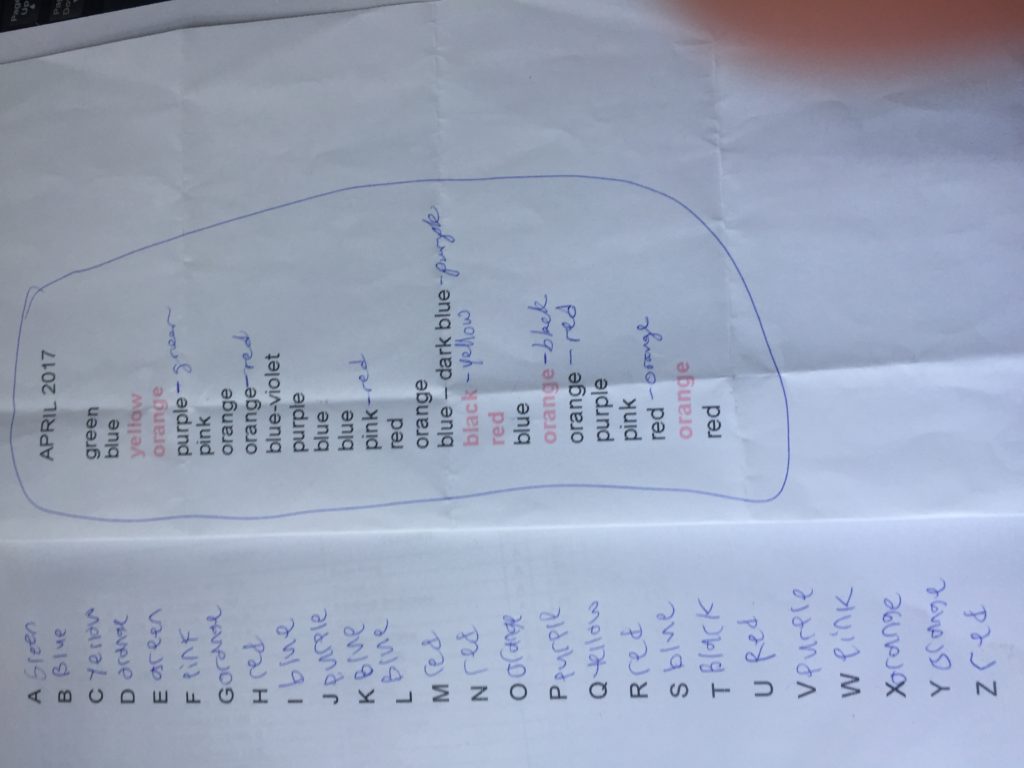
With all the reorganizing and renovating going on at home, I keep finding things I thought I’d lost. One of those things is a list from 2017 – letters and colors.
Back when I was checking to see if Shane had synesthesia – a very rare condition where the senses mingle – I tested him. I made a list of letters and asked him to tell me what color each letter “was” in his mind.
So the paper I found has two lists – one from March and one from April. Of the 26 letters, he listed the same colors on both lists for 21 of them. At the time, I thought it was amazing: he saw the letters “in color” almost exactly the same way for an entire month.
When I found the paper, though, I couldn’t help myself. After three years – 37 months actually – I tested Shane again.
I didn’t show him the original list; I didn’t want him to be swayed in any way. I just printed out the letters of the alphabet and asked him to list the colors that corresponded with each one.
After three years, only three letters had changed color drastically – and two of those had changed color between tests back in 2017. An additional four letters changed among shades of red: pink to red, red to orange, orange to red; a fifth changed from dark blue to purple.
And after three years, 18 of the letters stayed exactly the same color in his mind.
When I originally researched Shane’s synesthesia, I was concerned that he had some form of autism. I was panicked that something was wrong with him, and that this was proof.
But now, as some time has passed and I’ve grown a bit and gotten to know my son better, I don’t wonder “what he has” nearly as much as I think: he’s so interesting!
Shane and I were supposed to take a nice, long college road trip for spring break. I’d been planning it for months.
We were going to drive into upstate New York, cut through Ohio, and pick up Dylan in Tennessee. Then we were going to look at colleges in Alabama and Atlanta, and send Dylan back to college on an airplane from Atlanta. Shane and I were going to drive through South and North Carolina, respectively, stopping at colleges all the way home.
Of course, that didn’t happen. My guess is that we saved a few thousand dollars by not taking that trip.
Not long after we missed that trip, Bill’s conference in Los Angeles got canceled. And with it, our Hollywood/Disneyland trip disappeared. All of us had been looking forward to that vacation, but at least we saved some more money.
Dylan’s Italy trip was canceled, too. We’d budgeted $10,000 for it.
So we had some “extra” money for the first time since the kids were born. Basically, we had budgeted for vacations that simply weren’t happening. And, rather than saving our money for the trips that will surely take place sometime in the future, we decided to finally do something to make our house look less dated.
We got new floors. We got new carpet, too. And then, since we hadn’t painted since we moved in when Shane was born, we hired painters, too.
All of my life, I moved from house to house. I never had “upkeep” to worry about. If the oven gets dirty, I quipped, I’ll just move. It was pretty close to the truth. I never cleaned an oven until I was married.
But we’ve been in the same house since Shane was three months old. The oven has been cleaned countless times. But it took us more than a decade to plant bushes that thrived, and we finally screened in our back porch just a couple of years ago – our first “upgrade.”
So now, in the midst of the painting and flooring, the house is a mess – but it looks like a new house. It’s absolutely breathtakingly gorgeous! We have the same dumb furniture, all of it acquired haphazardly. I’m not exactly an interior decorator. I moved some pictures around and bought new curtains, and it looks pretty great.
I love the new look.
Now I just have to figure out how to pay for our upcoming trips. I’m looking forward to getting back to work and actually making money.
As we were walking into Dutch Wonderland on Monday, you saw
Duke the Dragon, and the Prince (aka ‘The Knight’) and the Princess greeting
people as they walked in. Someone had
told you the day before that you should give the dragon a high-five, so you
raced over to do so.
Duke didn’t see you right away, since he’s a 7-foot-tall
purple dragon and you’re just barely four feet (but finally 48” so you can ride
all the rides!) but you ran up with your hand out to give a high-five. Duke noticed you there and gave you a hug
instead.
The Prince high-fived you, then, and so did the Princess. You were so happy, I saw your eyes light up,
even from 10 feet away. Right then and
there you decided, ‘I like the Knight the best.’
Then you went and rode rides all day – including the most
monstrous of them all, the Kingdom Coaster!
You gave it a try, and loved it.
Today you told Dylan, “That hill looks scarier than it really is,
right?”
It’s something I hope you remember forever: it always looks
scarier than it really is.
Dylan was supposed to go to Italy for the month of May. He was going to be taking classes and exploring Europe for the first time in his life.
Years ago, Dylan decided he wanted to learn Italian. He met some people on a video game when he was a freshman in high school, and they taught him some Italian words. At one point, I thought he might actually teach himself the language.
But then Dylan dropped out of Spanish, and then he gave up on the IBCP program which would have required him to teach himself a new language. And that was the end of that.
Coincidentally, his First Year Seminar class was taught by an Italian professor. She had an accent and used Italian culture as a basis for their seminar studies.
As a freshman, Dylan didn’t have much of a chance to get into any of the coveted Maymester programs – especially not those in Europe. But because of his First Year Seminar professor, he was chosen to take part in the Maymester trip to Italy.
Dylan was thrilled with the opportunity – and also a little scared. He’d just gotten to college, and he didn’t want to leave his friends. But he was still excited and looking forward to exploring Europe. And of course, I was excited for him. I’ve never been to Italy, but at least I could live somewhat vicariously.
And then: the world stopped.
Italy was one of the first places to stop. Obviously, Dylan isn’t in Italy now. To be honest, none of us really wants him in Italy now. But still.
Italy was a dream country. It was a place so many of us dreamed about, wished we could see. And now – what will it be?
The natural beauty, the culture, the glory that once was Italy – none of that has changed. But with the death tolls and the destruction of the population, the certain falling of the economy and the terror felt by so many around the world – what will Italy become in the eyes of the world?
I would love to see Italy in its former glory. Now, I can only hope to still be around if and when that glory returns.
And I hope that Dylan – and maybe even Shane – will get a chance to see that glory, too.
The schools have finally – almost mercifully – decided to stay closed for the remainder of the school year.
While states are cautiously opening up, and teenagers are flocking back to the parks to see who gets coronavirus next, we are staying home. We are glad to stay home. We don’t need to be part of this particular petrie dish.
It’s interesting, watching Shane go through this fourth quarter. While we are still waiting to see what happens with grades, Shane seems perfectly content to do virtually nothing all day, every day.
In fact, Shane seems happier than I’ve seen him in a very long time.
Shane spends his days watching videos and TV, like most teenagers – but he also limits himself. He actually places limits on screen time, because he doesn’t want to overdo.
Even at the very beginning of this social distancing stuff, Shane realized he didn’t want to spend his life just sitting in front of a screen. He was the one who suggested family board games and puzzles. He’s also the one who comes up with interesting things to do – even if we don’t do them.
He makes lists on the computer of his favorite songs, movies and bands. He researches stuff on the computer that interests him. And he teaches himself tricks and things he may never have learned, if it hadn’t been for this “extra” time.
Shane took up drumming again, almost with a vengeance. He hadn’t drummed since 7th grade, and he barely touched his drum kit even when he was in band class. But some days, he drums for hours.
He started lifting weights and started a serious workout routine. While he absolutely adored his P.E. class, Net Sports, he’s added his P.E. regimen to his self-prescribed exercise routine.
Shane also takes the dog for long walks, and goes for bike rides by himself. He spends time with us, and with his brother. They’ve made music together. They even combine different games so that we can all have a little bit of an extra challenge. For example, Shane and Dylan decided that while Apples To Apples and Whoonu were okay by themselves, combining them made for a whole new world of fun.
He makes videos every day and posts them on Instagram, and it’s a sheer delight watching what he’s created, and seeing how his mind works. The videos are almost all short videos that poke fun at some societal norm, or some common term that, in spite of being common, make no literal sense at all.
I know Shane still has issues – as every human does – and that he’s still tackling what he needs to tackle. In fact, he spends more time with his youth minister online than he ever did in person – and he’s exploring some pretty deep, philosophical subjects.
It seemed like Shane was happier without school, so I asked him: “Are you happier now than you were when you had school?”
And he said, “The situation is worse now.”
“Well, that’s true,” I said. “But you seem happier now that you’re not in school every day.”
“I’m about the same,” he said, correcting me. “I miss socializing.” This made me sad – and he must have anticipated that, because he quickly added, “But I’m okay.”
If nothing else, he’s certainly exploring new things. And that, alone, has to be a good thing.