The stories I remember best are those that changed me in some way: took away my innocence, made me feel brave, hurt me beyond repair, frightened me into submission, caused me to rebel, caused irreparable damage, broke my heart, made me lash out, gave me hope, tried to kill me, reminded me I had reasons to live.
But the feelings are what I remember most – the emptiness, the angst, the bottomless pit of sorrow and loss. When trying to accurately describe the depths of my constantly depressed state, I googled the word that came to mind over and over.
The word was “despair.”
de·spair
/dəˈsper/
noun
the complete loss or absence of hope.
Yes, I thought. The complete loss of hope. That’s it.
Coincidentally, Google – not me! – used the word “despair” in a sentence, to show just how desperate a despairing person might be.
Google’s sentence?
“in despair, I hit the bottle”
For the terribly literate, Google was not suggesting that I slap my hand on a bottle of lemonade if I am in despair. Google was suggesting that if one is despairing, one might do something so desperate as to drink alcohol.
And of course, I was drinking alcohol as often as was humanly possible, not relating it to my despair at all. I was drinking alcohol because I was a complete and total drunk. I had crossed over that invisible line without realizing it, and had taken to drinking and doing drugs with all the gusto of a starving man who had just been presented with a buffet.
I did this every single day, without fail, not because I was in despair – but because I was an alcoholic. And being an alcoholic caused me to be in despair every single day. I was 100% stuck in a life that I did not want, and had absolutely no way to get out of it.
I had jumped out a window, landed on my head, and lived. I had survived my one serious suicide attempt and made an instantaneous deal with God that I would go on.
But I didn’t want to go on. I lived with zero gratitude.
I hated my life. I hated waking up with an unbearably dry mouth, squinting to filter any light in the room, wanting to vomit but empty inside. I hated not knowing where I’d been the night before, what I’d done, with whom I’d done it, or where I was now. I hated feeling ostracized by the world for being a drunk, ostracized by my family for being a biker chick, and ostracized by the bikers because I was nothing like them. I hated my life. I hated everything I did. I hated everything I’d become.
And yet I could not fathom for even one moment that there was anything I could do to make the pain stop.
And so I was in a constant state of despair. I had no hope, not for a single moment of any day. I didn’t feel like something good was just around the corner. I didn’t feel like anything would ever change. I couldn’t see a way out of the predicament I’d gotten myself into – but I thought the predicament was Larry, and Pitcairn. I didn’t know yet that the predicament was Alcohol and Me.
So I woke up without hope. I drank and had sex and did drugs. I blacked out then passed out. And then I awoke, again, without hope.
I was in constant, agonizing despair.
And I tried to numb the despair with alcohol, a sadly temporary solution to a permanent problem.
I am still an addict, even though I am sober. I don’t think about drinking all the time; life isn’t like that anymore. In fact, the obsession with drinking is completely gone, which is one of the great rewards of being sober.
But addiction is a huge part of who I am. I have an “addictive personality,” which never really changes.
I am obsessive to the point of insanity. I am drawn to the emotional, rather than the logical. I worry incessantly. I isolate. I am especially sensitive and not especially resilient. I focus on prior, traumatic events instead of taking steps toward a happy future. I vacillate between anxiety and depression, never going far from either. And I have a very negative outlook, no matter how good a situation may be.
Some of this is just me; some of it is addict behavior. I have no idea how to discern which is which, since I have always been like this, and a whole lot of addicts are like this, too.
When I drank, every day looked like this:
Wake up: Oh no. What time is it what did I do where am I where do I need to be?
Lunchtime: How much longer do I have to do this stupid stuff before I can drink?
Evening: Finally. I can drink without anyone bothering me.
Night: Why am I here? I don’t want to be here. This is not where I want to be. I just wanted to drink!
I would survive whatever situation I’d gotten myself into, and then start over the next day. I would hope that the next day would be different, that I would be able to drink the way I wanted to drink without ending up in the wrong place.
This never, ever, ever happened. I never just sat around and drank by myself, which is what I really wanted to do. Every time I picked up a drink or a drug, I ended up somewhere I didn’t want to be. Sometimes I ended up in the wrong place for years.
When I was drinking, the only thing I knew is that I would do absolutely anything to stay drunk – and that I might have to sacrifice my morals to complete my mission.
The thing about being sober is: I now have control over where I end up. I have control over my attitude and my actions. It’s a glorious thing to be able to decide what I want to do, and then just do it. It’s like a gift from God, honestly.
Now that I no longer drink, given my addict mentality, my days go something like this:
Wake up: Oh no. What time is it? I don’t want to get up. I have to get up.
Lunchtime: What can I eat? I should have something healthy. I can have anything I want!
Evening: What did I eat today? I should allow myself to have junk. I should not eat any junk!
Night: I should not have eaten the one thing I ate today that I allowed myself to have.
I have mostly just switched “alcohol and drugs” to “chocolate and popcorn.” And yes, I have a weight problem. I have a me problem.
On especially wonderful nights, Larry and I would go out to eat after the bar closed.
I was never awake in the morning so I only got breakfast in the middle of the night. And the one place open late that offered breakfast at 4 a.m. was Denny’s.
Being the only place open after the bars closed meant that Denny’s was always crowded. We would stand in line and wait for “party of two” to be called – or “party of four” if we could get Leo, the bass player, and my best bud Ronnie to come along. Often Larry and I were the only two who were willing to wait in the line.
After an hour or two, we’d waddle home, still sluggish from drinking, full of nutrition-less food, and pass out.
But one night, while we were in line, we met a guy and started chatting with him. Larry enjoyed conversing with him, so we invited him to sit with us.
Gus was a truck driver – the kind who actually drives for a living, using an 18-wheeler as both an apartment and a job.
“I always wanted to be a truck driver!” I announced.
When I was in 8th grade, my friend’s father drove a truck, and her mother drove a Bookmobile. These sounded like thrilling occupations, always traveling, making deliveries.
Listening to Gus talk about his travels, I was fascinated. I wanted to know a million things about driving a truck. Where did he eat? How far did he drive? What did he listen to on the radio? Did he have a CB? Did he have a CB handle? Did he have a dog?
The three of us walked out together and Gus said, “Wanna go for a ride?”
“Now?” I looked at Larry. “Your truck is here?”
Gus laughed. “Where else would it be?” He pointed to a semi parked in the back of the very large lot.
“Yes! Yes I do!” I was jumping up and down with excitement, quite literally. “I wanna go!”
Then I remembered Larry.
“Can I go?”
“Sure, Baby,” he said, kissing me and waving me off. “See ya at home.”
Getting into the truck was the most exciting thing I’d done in eons. I had to climb – literally climb – hanging onto a metal bar and yanking myself into the passenger seat. It was like climbing a tree, but cooler.
I plopped myself down and waited for the ride of a lifetime.
Gus hopped in and started the engine. It was absurdly loud. He pushed a bunch of buttons, grabbed the giant steering wheel, and the truck started moving.
“Where do you live?” he asked.
“Just over that hill!” I said. “Just go straight and I’ll tell you when to turn!”
“10-4,” Gus said, then pulled out onto the very dark road.
It was so loud!
“This is great!” I squealed, unable to contain my excitement.
Gus turned the truck onto the rather steep hill. Technically, it was the side of a mountain.
We inched forward.
The truck groaned and spit.
Rrrrrrrrmmmmffffrrrrrrrrggggg….
Inch by inch, climbing that hill.
Inch.
By inch.
Still climbing.
We’d gone maybe a hundred yards before I was bored beyond belief.
“Is it always this slow?” I guessed.
“On the hills, yeah,” Gus laughed.
It took us a million years to get to my house, right over that hill.
Larry was still awake when I got home. “Still want to be a truck driver?” he asked.
I can’t stress how incredibly alone I felt during the depths of my alcoholism. “Lonely” doesn’t begin to describe it. I was vacant, my body uninhabited, void of all joy. There was nothing left for me. I was empty.
My few “friends” were at work or lived in another state. And while I was somewhat safe in spite of my behavior, we were very poor and couldn’t always afford the excesses I wanted, most notably: cocaine. Larry bought a lot of marijuana and I smoked it, but it wasn’t mellowing me out the way he’d hoped. Smoking pot made my head fuzzy and that made me want cocaine to snap out of it. And since we rarely had cocaine, I drank more beer instead.
I wanted to find the perfect cocktail of drugs to put into my system to make me feel normal.
This was, of course, an impossible task. So I just kept drinking. And Larry just kept feeding me.
Larry was never truly mean to me. I knew he liked me, maybe even loved me as much as he knew how. He only hit me those two times, and they came from a place deep down in his upbringing that had nothing to do with me.
But as fall approached, and Larry started to feel caged in by the weather, and I started to lean into my friends at work for real conversation and disappear as often as possible to bars while Larry stayed home … things shifted a bit. We weren’t just rolling around on the floor or sitting around smoking pot or playing guitar and singing together anymore. Larry shifted out of the role of lover and more into the role of fatherly figure at some point late in 1987.
For my part, I didn’t just feel increasingly alone; I felt deprived. I felt deprived of companionship, of intellectual stimulation, of intimacy, of meaning. So as life went along, I went along with it, just trying to find good stuff, to feel happy.
One day, I was sitting on the back of Larry’s bike at a red light, smoking a cigarette and waiting for the light to change, when I saw something I hadn’t seen before.
It was a gorgeous sports car, white and shiny, sitting just across the intersection, revving its engine and waiting for its own green light. I loved that car.
Excitedly, I tapped Larry on the shoulder with my non-cigarette hand. “What’s that?” I asked, pointing.
“What?”
“That car!” I said. “I love it!”
“Are you serious?”
“Yes!” I said. It was adorable and sporty in just the right way for me. “What is it?”
Larry turned his head to go full throttle on me: “GET OFF THE FUCKIN’ BIKE!” he roared.
“What? Why?”
“THAT’S A PIECE OF JAP SHIT!” he said. “FUCKIN’ JAP SHIT!”
I was stunned. We’d been having such a lovely day. The light changed, but Larry didn’t move. “GET OFF THE FUCKIN’ BIKE!” he said again. “YOU CAN WALK HOME!”
As I realized he was serious and climbed off the Harley, Larry was still muttering about “Jap shit” under the roar of the engine. He peeled off so fast, his front tire flew up in the air for a second.
I stood there, wondering how long it would take to walk home from the next town over. And I realized: I wasn’t just deprived of friends, intimacy, intellect and sufficient drugs to kill myself. I was also deprived of the right to have my own opinion.
As the knocking got more persistent, I glanced toward the door. Light streamed through the glass block, indicating that the sun had come up.
I’d been at Paul’s Place since early evening the night before, showing up barefoot and irritable. I drank nearly non-stop; it hadn’t occurred to me to sleep. The cocaine kept me going, and I’d been busy paying for it downstairs.
Now I sat at the bar flanked by Paul, Rich, and two very old men who, I suddenly realized, probably lived at Paul’s Place. Maybe underground. Those men were always at Paul’s.
I wanted to be one of them. I wanted to go into a dark corner, crawl up, and die with a can of beer by my side.
Someone yelled outside, like a kid on a distant playground. It had never occurred to me that Larry would care what I was doing. But now he was banging on the door as hard as his biker fist would allow.
From inside the bar, the sounds were distant and muffled, no more threatening than a fly buzzing in my ear. If I hadn’t recognized the rumble of the Harley, I wouldn’t have even guessed it was Larry.
The building was a concrete jungle; Larry couldn’t have gotten in if he’d come with a sledgehammer.
From a long, long way away, I heard distinctly-Larry’s voice say: “I know she’s in there! The fuckin’ car is out here!”
I’d forgotten about the car. With its racing stripes, it was hard to miss. In the empty lot. At this tiny bar in Wall, Pennsylvania.
Paul spoke first, not even looking up from where he was mixing himself a drink behind the bar: “Just ignore him. He’ll go away.”
I considered this. It sounded like a good plan. “He has to go to work,” I said.
I didn’t move.
The banging got louder. Larry had apparently found a large stick and was whacking the sides of the establishment with all the force he could muster.
Again: like a fly. What he needed was a brick.
Suddenly it occurred to me that he might find one. Or maybe he’d pulled out his knife and was brandishing it like a movie villain. Maybe he’d borrowed somebody’s gun.
I started to panic. My heart started to beat a little too fast, my head started swimming. It was probably time to go.
Larry turned off his motorcycle. The familiar rumbling stopped.
We sipped our drinks. I wished I’d done more cocaine, then I wished I’d done less. I reached over the bar, refilled my beer, and chugged it.
We waited. The sounds got louder, though still not loud. It went on for five minutes, ten, maybe twenty.
Finally the banging stopped. It was deathly silent. I breathed.
Then Larry’s grumbly voice came through, loud and clear, as though a microphone had been set in front of him. It was coming from the front door, directly through the keyhole: “Just tell her to come out so I can see her. I just want to know she’s fuckin’ okay.”
I glanced at Paul, still silent, who nodded.
I grabbed my cigarettes and walked to the door. I opened it and there was Larry, old and pathetic, standing lamely outside. He reached in and grabbed me, pulled me outside, hugged me tighter than I liked.
Larry held me away from him, staring. “Let’s go home,” he said. “You can’t fuckin’ drive.”
“Okay.” I hopped on the back of the bike, still in bare feet.
Larry dropped me at home, then went to work. I went to bed.
In my quest to get away from Larry without actually leaving him, I started fights with him and then disappeared to bars. I walked to the Sharwood, then drank with whatever guy bought me drinks.
But one night I wanted to go to my favorite bar, Paul’s Place, across the bridge, so I took the car. I settled in with the dinner crowd, and I was still drinking when the bar closed.
I was smashed.
Owner Paul was the bartender. A man in his mid-forties, Paul never struck me as being particularly interesting or attractive. But on this night, with Larry nowhere around, Paul suddenly showed great interest in me. I drank for free all night long and at the end of the night, Paul had a surprise.
“Wanna do a line?” he asked.
I had never known him to do cocaine so I was very enthusiastic. When would I not want to do a line? “Sure!” I said.
“We’ve gotta go downstairs,” he said. “I don’t want to share with just anybody.” I looked around at the smattering of people – all old, wasted men – and I nodded. I didn’t want to share with them, either.
So Paul and I went downstairs.
We walked into a bedroom – a bed, a dresser, even a bathroom in the basement under a cinder block building. No windows, no light.
Paul turned on a tiny lamp and pulled out a vial of cocaine. He laid out two lines on a mirror and snorted one immediately. He held the mirror for me carefully, and I snorted my line obediently. Paul took the mirror and straw – a rolled bill – and put them down.
Then he kissed me. Hard.
Oh, I thought. I guess we’re doing this now.
Paul and I were on the bed before I knew what was happening. I wanted more cocaine, but it wasn’t my cocaine to dole out, so I just had the sex instead.
At some point, when I was having sex with the bartender I did not like, there was a knock on the door.
Paul yelled, “Come in!” as though it were a party.
In walked Rich, a man I really didn’t like.
“Hey,” Paul said. He hopped up, naked, and laid out three lines of cocaine.
We each did one, two of us naked.
Paul tossed himself back down on the bed. “C’mere, Sweetheart,” he beckoned.
I sat down on the edge of the bed. Rich was still standing there, staring.
I started to get up and walk away, back to upstairs, back to the safety of the bar, but Rich blocked my exit with his whole self.
Paul laughed. Then Rich laughed.
I was happy about the new cocaine. But I did not laugh.
“Just join in whenever,” Paul said, and he started kissing me again, both of us falling together onto the bed in the tiny room.
As though my payment for the cocaine was to do whatever Paul wanted me to do. And I guess it was.
I’d been drinking for eight hours, at least. I’d had two lines of cocaine and four million beers. My head was fuzzy and spinning, and there was nothing in me that deemed this little game “okay” but I figured it made more sense to go through with it than to try and fight these two old men.
When it was over I begged for another line, and they laughed.
They laughed a lot.
I got another line. I’d paid for it.
Upstairs, I ordered another beer and drank until the knocking started.
One night at the bar, I asked Ronnie if we’d still be friends after Larry and I broke up.
“Are you breaking up?” he asked.
“No,” I said. “But if we did, would I still be able to find you?”
“Yeah,” Ronnie said. “I guess. My last name is the only one in the phone book that starts with B-Z.”
“What’s your last name?” I asked.
“Doesn’t matter,” Ronnie said. “Just remember B-Z and you’ll find me.”
“OK, B-Z,” I said. “If Larry and I break up, I’ll check the phone book. And I’ll always think of you when I hear Driver 8.”
Ronnie worked in the steel mill. He once told me that the R.E.M. lyric “we’ve been on this shift too long” repeated in his head every day.
“And I’ll think of you when I hear The Catch,” Ronnie said.
“The Catch?” I was curious. This Cure song wasn’t one of their most popular, but I loved it. “Why does that remind you of me?”
“I don’t know,” Ronnie said. “It just does.” I got the feeling he didn’t want to tell me, so we went back to drinking.
Later I listened to The Catch on my boombox, carefully discerning the lyrics and questioning their meaning to Ronnie. I listened to the song over and over again.
The part that stood out was this:
Sometimes we would spend the night Just rolling about on the floor And I remember even though it felt soft at the time I always used to wake up sore
After repeating the song 2,000 times, I determined that my one sexual romp with Ronnie must have resulted in pain somehow. I started to feel bad for him, bad for myself, worried that I’d hurt him.
I wanted to apologize for my behavior, however it happened. I wanted Ronnie to be happy. And I wanted him to like me again.
At the bar the next week, I blurted: “I’m really sorry,” without so much as a greeting.
Ronnie looked up from his drink. “Sorry?”
“I’m sorry for hurting you,” I said. “If I did something that made you sore.”
“What are you talking about?” Ronnie asked, genuinely perplexed.
“I listened to The Catch, and I am afraid I hurt you.”
Ronnie thought about it for a second. A minute went by. Another minute. Finally he said, “I have no fucking idea what you’re talking about.”
“You told me The Catch – you know, The Cure song …?”
“Yeah,” he nodded. “I know The Cure song.”
“You said it reminded you of me. I spent the whole week trying to figure out why.”
“Oh,” he said. “Yeah. You just fall down all the time.”
I considered this. I was drunk all the time, especially around Ronnie. I woke up bruised and battered with no idea why. I probably did fall down all the time; I just didn’t remember it.
“Oh,” I said. So basically, I thought, I’m just a lush.
I had enjoyed the song so much more when I thought it was a secret message from my best buddy.
I went home and I listened to The Catch more carefully, hearing the more simplistic message more clearly. Unlike the soft-and-sore part, the falling-down lyrics repeated twice.
And I remember she used to fall down a lot That girl was always falling again and again And I used to sometimes try to catch her But never even caught her name.
I tried not to wonder whether or not Ronnie would try to catch me as I fell.
Some things I learned from Larry were important. Having grown up sheltered and well-protected, I knew very little about the adult world. Larry knew a lot.
Larry knew how to ride a motorcycle without crashing, and how to get off the bike without burning a leg. Larry knew when police were important for safety, and when they might arrest us. Larry knew how to find drugs and still pay the rent, and to carry but never use his credit card. He knew how to be a loyal friend, a die-hard biker and a consummate performer on stage.
While I tried to self-destruct, Larry made sure I didn’t implode. Sometimes, even now, I realize that I owe him my life.
But I knew from the moment I met Larry that he wasn’t smart – or at least, not as smart as I’d have liked. Larry was street smart – a street genius, even. But after college, I understood that I wouldn’t be enjoying a lot of intellectually stimulating conversation.
I did not know until late in 1987, however, that Larry was a complete moron who believed his own lies in spite of mountains of evidence to the contrary. “Evidence” did not concern Larry.
Firmly convinced that really stupid things were true, Larry also believed he was the smartest person in any room. And his conviction about his intelligence was enough to make other people believe it, too.
He was nothing if not confident.
Larry believed he was right even when his declarations made no sense at all. He invented his own world view. He believed that his theories were truths, and then he sought out people to agree with his proclamations.
Larry believed, for example, that hot dogs weren’t made of meat, so he wouldn’t eat them. Andy Capp’s Hot Fries, however, were “made with real fuckin’ cheddar!” and therefore healthy.
Larry believed that the government was watching him – and everyone – through street lights, even in Pitcairn. He was quite serious. Sometimes we had to run from one lamp post to the next for “safety,” our heads down.
Larry believed that the Japanese had infiltrated every American company except GE and Harley Davidson. Anything new or different was labeled “Jap shit,” then mentally – and often physically – discarded.
For me, though, the most ludicrous was Larry’s explanation about why he smoked cigarettes.
“I was addicted to cigarettes since I was fuckin’ born,” Larry said, a cigarette hanging from his lips. “My mother smoked cigarettes when she was pregnant with me so I’ve been addicted since the womb.” He shook his index finger once, sternly, for emphasis. “And that’s a fact!”
Larry adamantly spouted “facts.” When he stated a “fact,” it could never be denied.
I didn’t say a word in disagreement; my youth and my gender meant to Larry that I knew literally nothing.
I didn’t mention the likely possibility that Larry hadn’t been breast-fed on tobacco juice, or given chewing tobacco as a toddler. He probably wasn’t smoking Winstons in elementary school. The first 12 years of Larry’s life didn’t play any part in his theory of addiction.
But this “fact” was the final straw. In spite of my constant inebriation, I awoke to my reality that day. I finally recognized that Larry was, in many ways, the most moronic person I’d ever known.
This made me think about my parents’ ideas – the ones I’d shunned since moving in with Larry. My parents suddenly seemed smarter somehow.
And that started me thinking about leaving Larry for good. I just couldn’t fathom how to leave Larry and still be a drunk.
Since seeing the Camaro in its dark home under the bridge way back in the fall of ’86, I’d been in love with that car. I knew it wasn’t in great shape with its rotting floor boards and faulty heat, but I loved it.
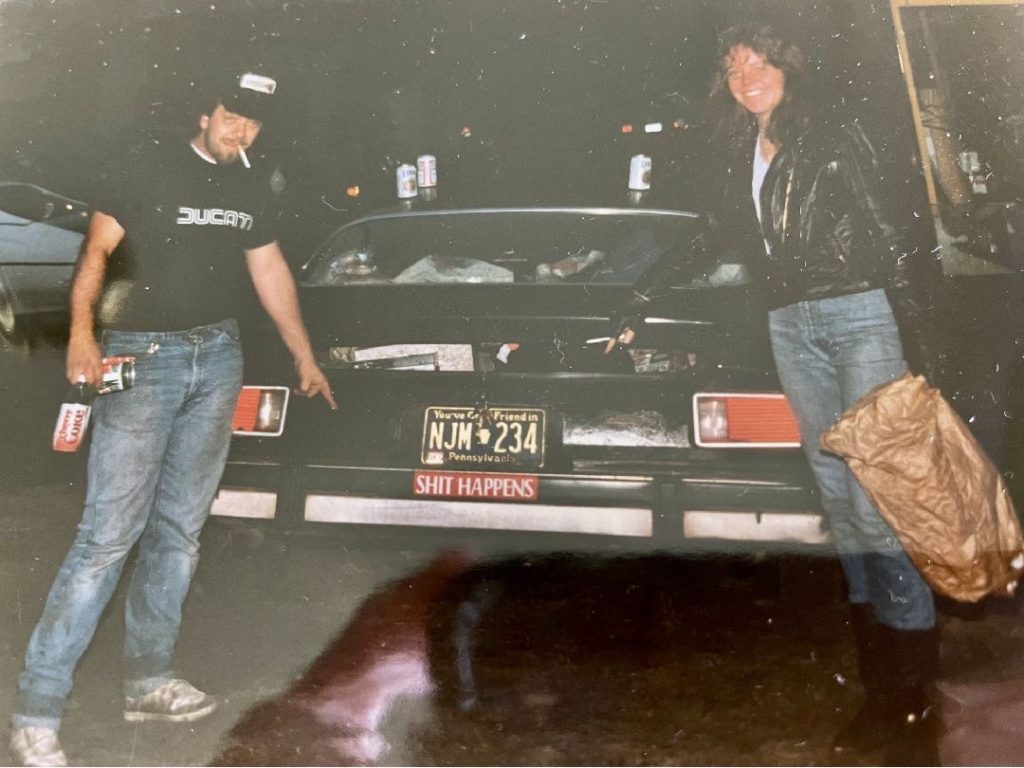
When Larry’s brother, Danny, found a SHIT HAPPENS bumper sticker for us, the car was finally perfect.
While I never loved the Camaro quite as much as I loved our old Ford pickup truck, and I never paid a dime toward the purchase of either vehicle, I always assumed that Camaro was mine.
But one day, I discovered: it wasn’t.
Larry said he had a surprise for me. “It’s outside!” he said. “C’mon!”
I walked outside. I saw nothing.
“The fuckin’ car!” he squealed. “Look at the fuckin’ car!”
I didn’t know what car he was talking about. I didn’t see our car anywhere.
And then, suddenly, I did.
It was white. My beautiful black Camaro was now an ugly, colorless white. I hated it. “It’s fuckin’ white!” I yelled. “Why is it white?!”
“It’s fuckin’ beautiful!” Larry said, ignoring my distaste. “The guys in the shop fixed it up!”
“I hate it,” I said. “Can you paint it black again?”
“Nope.” Larry shrugged and went inside. I followed him.
What else could I do?
A week went by, then two. Then Larry came home with our ugly white car … changed again.
This time, there were bright red stripes running all the way from the hood on the front of the car, over the top, and down to the spoiler in the back of the car.
BRIGHT. RED. STRIPES.
Larry never asked me before painting the car, which made it even worse for me. I was never a fan of change, but I really loved our PLAIN BLACK car.
“What did you do!” I shrieked. “You made it worse!”
“They’re racing stripes!” Larry said, as though we were both suddenly huge NASCAR fans.
I hated the stripes. I hated the red. I hated the white underneath. And I now officially hated the car.
Larry absolutely ignored my displeasure. “It’s fuckin’ great!” he said. “We’ve got a race car now!” He put his big arm around me and squeezed, believing I would like it more if he told me how much he liked it.
I did not.
“Can we get the truck back?” I asked meekly.
“Fuck no!” Larry said. “That truck was a piece of shit! This car runs great, and now it looks great, too.”
He laughed as though I’d been joking, shook his head in disbelief, and headed inside, leaving me outside with the ugliest Camaro I’d ever seen.
I considered jumping on the car, denting it, ruining the already ruined vehicle. But I couldn’t think of any way to actually get what I wanted.
And when I didn’t get what I wanted, Larry simply ignored me. He just laughed at me and walked away.
In Larry’s world, there was no reason to ask me for my opinion about things like painting the car and/or adding racing stripes. Really it was his car, his apartment, his life – and I was just along for the ride.
So I gave up and walked inside, too. It’s impossible to complain when no one cares about your opinion. From then on, we had a white car with red racing stripes. I never said another word about it.
The longer I stayed with Larry, the longer I continued to drink, the harder I sunk into a despair that was unlike anything I have experienced since. Every day was a waste of time, a pit of agony in a world that didn’t suit me.
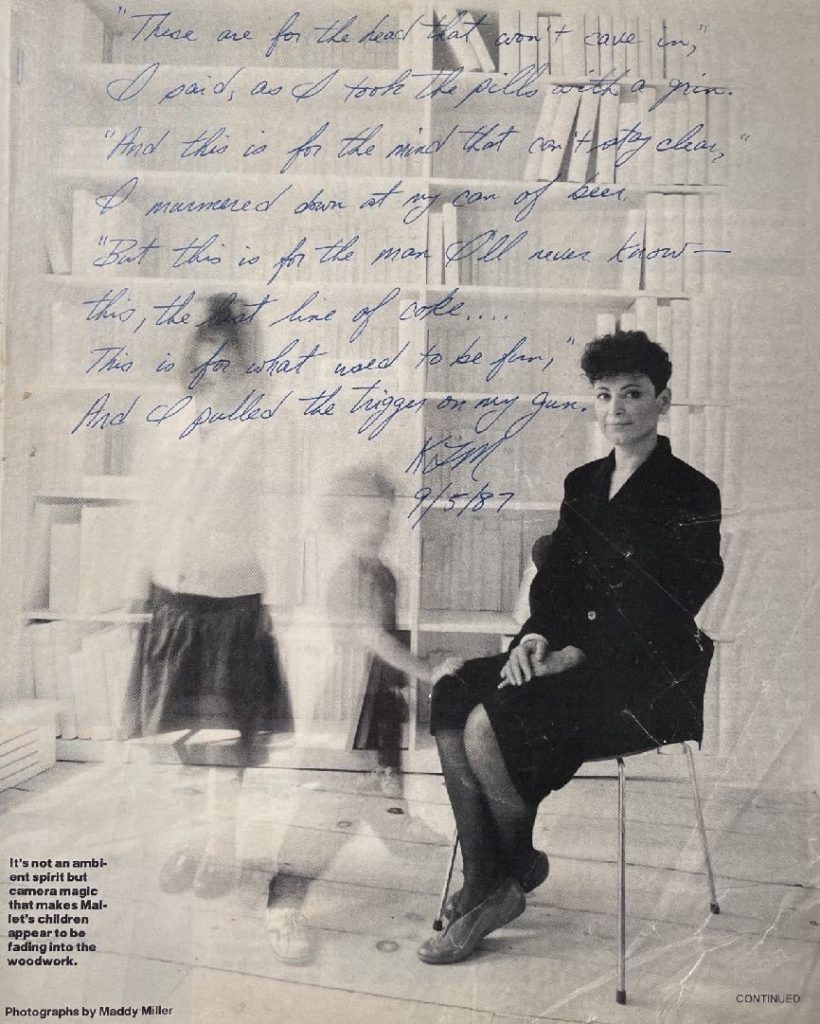
This poem, scrawled inside a magazine I don’t recognize, describes how I felt every single day.
Today I have 32 years clean and sober.
If I didn’t, I would still feel the way I did in 1987. Or I would be dead, which is far more likely.