Shane and I had “special time” together one evening. I gave him choices of things to do, and he picked dinner and dessert (at separate restaurants) and two half-hour videos at home. It was a wild evening.
On our way home after dessert, Shane said, “I want to go to King’s Dominion.”
After all the fun we’d just had – although technically, it wasn’t amusement-park standard fun – I felt a bit … kicked. As if what we’d done wasn’t enough, and he was already projecting himself into a future, more-fun place.
It was an innocent comment, really. But I claimed that it was a federal offense.
“We just had a nice time, and you picked both the restaurants. We’ve done whatever you wanted to do. And when you said that about King’s Dominion, it made me feel like what we did just wasn’t enough.”
Even as I said it, I remembered.
For years and years and years, I did exactly the same thing to my parents. We would be coming home from a particularly delightful time – sled riding, perhaps, or coming home from a week at the beach. And I would pipe up from the backseat – something like, “I wish we could go to Australia.”
I don’t know if my parents remember this. But I remember thinking, this good thing is over and now I have nothing in the world left to excite me.
I have always had a tendency to depend on WAY TOO MUCH – externally – to “excite me.” I’ve always deemed something “out there” to be the answer – something far away, something just out of my reach – that would finally “make me” happy.
This was a particular problem with vacations. I loved vacations so much, I never wanted to leave. I always wanted to live wherever I went on vacation – so I would occasionally run away the night before we left. When I got older, I started fights with my vacation partner(s) the night before we were planning to leave, so as to “ruin” the vacation and (I thought) not be as sad to leave.
I nearly lost my boyfriend (now husband) after an especially good trip to Jamaica. We got into a fight so vicious, over something I can no longer recall, that I thought we might not even fly home on the same plane.
Then, one day about 35 years after it started, it stopped. I came home from a vacation and said the oddest thing.
I said, “I’m happy to be home.”
I can’t remember which vacation inspired this – but it wasn’t a bad one. I was just happier to be back home than I was to be on vacation. I think I was finally happy enough with my own real life that I prefered it to a temporary fantasy world. I know that I was at least in my thirties by then.
So I apologized to Shane since – once again – my issues caused an inappropriate reaction to his comment.
And then I said a little prayer that Shane would look inside himself more often, where true happiness is found.
We took away Dylan’s electronics for the rest of the school year – all of them, even his phone. This time, since we can’t trust him anymore, we are going to be certain that he has no access at all.
The day after the discovery, I didn’t know what to say to Dylan, who had kept his electronics hidden and still in use, and lied to me for so long. So I decided to say nothing at all. The ride to school the next morning – the long, agonizing 45-minute ride – drowned in the silence.
After 34 minutes, I finally spoke. “You have a choice,” I told him. “This can be a mistake that you made, or this can be who you are. And it is entirely your decision.”
“Won’t you want to kill me, either way?” Dylan said quietly.
“I don’t want to kill you,” I said. “You are my son, and I love you no matter what you do. I would prefer that you make good choices. But I don’t enjoy being around people who lie. I did too much of that when I was young.”
There was a pause.
Dylan almost whispered. “And now I’m young.”
I wanted to cry, scream, pull out my hair. I wanted to tell him, to show him – YOU DON’T HAVE TO SUFFER! You don’t have to CHOOSE the painful route!
But I said nothing at all. I’ve talked too much, over the past 14 years. He knows everything I have to say. I am in his head, becoming a part of his conscience, whether I said the right things or not. It’s too late now for talking. It’s too late now for fixing anything.
It’s time to just ride the waves, and see where we are when we hit the shore.
Meanwhile, there’s a pretty good chance that I’ve sunk myself into a real depression. I don’t want to talk about what’s going on with Dylan. I don’t want to write about it. I don’t want to admit that the glory days are really over, and that this is the life I will be leading from now on.
I don’t want to admit that Dylan is a typical teenager. I don’t want to admit that I couldn’t stop it from happening. In fact, I am fairly certain that it’s all my fault.
Or maybe it’s not. And maybe Dylan will choose to pull himself up, out of the gutter, start doing the right things.
So far, all he’s done is play on the trampoline with Shane. He’s lost contact with all of his friends because the electronics are no longer available to him. Parents are useless to him. Shane is all he’s got.
What this will do to Shane is anybody’s guess.
 Once, when Dylan was a toddler, he wandered off. I was getting dressed in the bedroom, chatting on the phone with my mom about all the cute things he did, when I realized Dylan was gone.
We lived in a tiny ranch style house, and I searched it very quickly – Dylan was nowhere to be found. I screamed something at my mom and threw the phone across the room. I looked out the windows – no Dylan. I was in an absolute panic when I saw a tiny red-headed dot in the distance – across the alley way and well past the neighbor’s house. I raced outside, screaming.
“DYLAN!” I screeched, running hysterically to catch him. “DYLAN!”
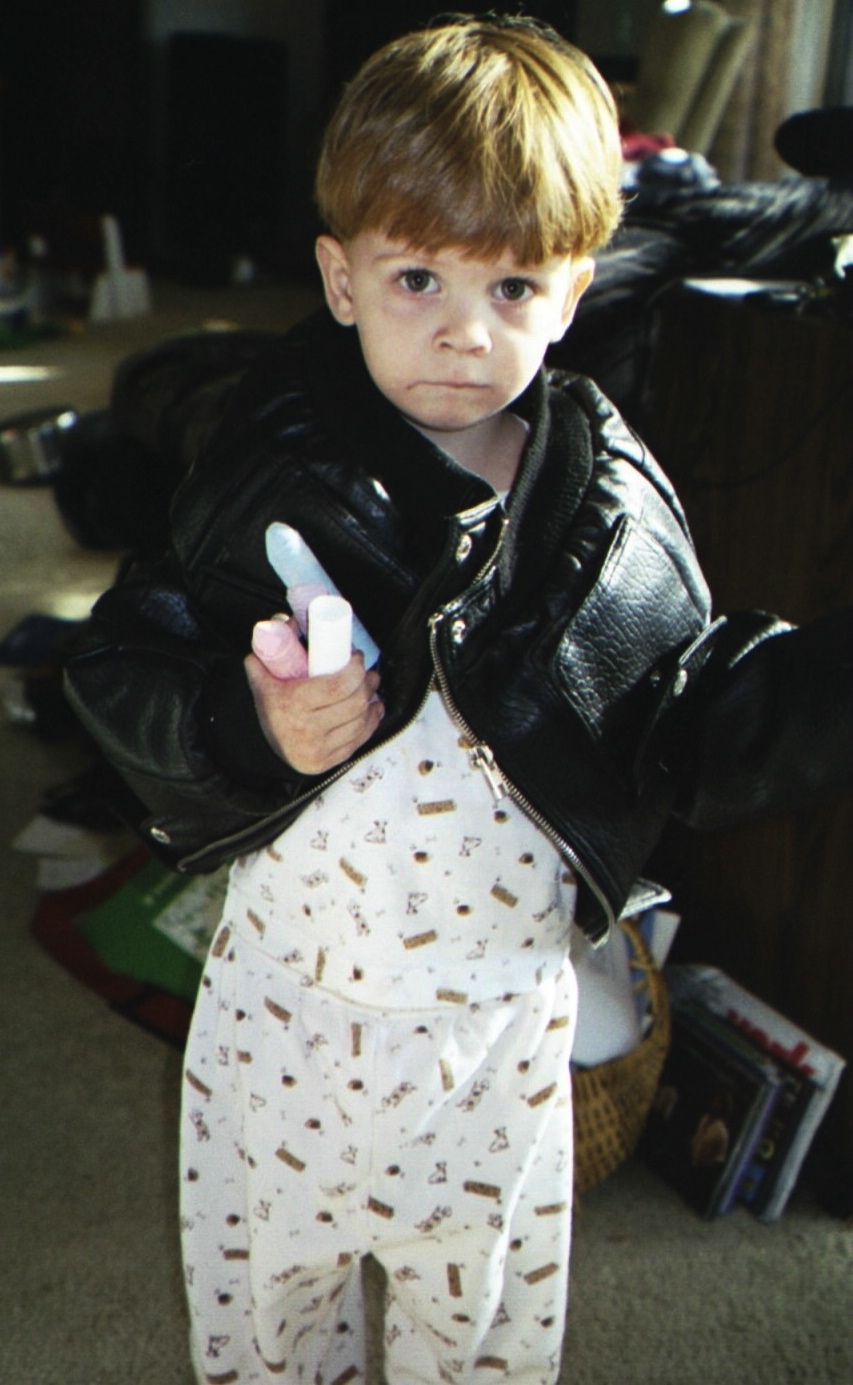
He turned around and looked at me, as I raced hysterically across the neighbor’s yard. Dylan had put on his black leather jacket over his pajamas – upside down. He was barefoot and carrying a large load of pastel sidewalk chalk.
I scooped him up and headed for home. “What were you doing?” I asked, trying to control my hysteria.
“I wanted to color,” he said.
“You need Mommy to go with you if you leave, okay?” I pleaded. “And you need to stay in our yard. Why didn’t you draw on our sidewalk?”
“There were too many leaves,” he said. Indeed, it was autumn – and our sidewalk was completely covered in leaves. Dylan had wandered off searching for a sidewalk to color.
Before my heart had even stopped racing, I took a picture of him, upside-down coat and all. I knew this day was going to stick with me – and I was immeasurably glad to have him home safely.
Twelve years passed.
During those years, Dylan hid from me in clothing racks. He ate cookies he had been forbidden to eat. He was reprimanded countless times in school for rambunctious behavior. He went for long walks with his cell phone, not bothering to answer my texts or phone calls. And he kicked a kid in the groin and got suspended.
He’s actually a good kid. I know he’s a good kid. He’s just trying to do his own thing – same as always – just like when he was a kid with an armload of sidewalk chalk.
I try desperately to believe he’ll do the right thing. His heart has always been in the right place. He’s doing so much right – and trying so hard – that typical teenage behavior feels deeper, somehow, and more painful than it should feel.
Maybe it’s me – my past catching up with me, the issues with which I need to deal, slapping me in the face.
For now, I’m concentrating on today only – and I’m glad he’s safe, and healthy. And hopefully, soon, he will also be happy.
Dylan was doing pretty well, all things considered. He wasn’t getting in trouble at school (except for that minor suspension). He was pulling his grades out of the gutter (except that he kept forgetting to turn in his Spanish homework) and he was acting responsibily at home – so much so, in fact, that we had started to depend on him for important things.
And he was coming through. He was doing all the right stuff.
So Dylan was only a few days away from getting his electronics privileges back… when I discovered that he’d been using electronics for the entire two weeks of electronics prohibition. He’s been sneaking onto his iPad at night, whenever he assumed we wouldn’t find out – and he’s been getting away with it.
It’s an interesting thing, discovering that I’ve been duped by the love of my life.
For example, it immediately and without discrepancy brings back all the times in my past that I’ve been duped. All the liars who have betrayed me… My best friend in 9th grade who had sex with my boyfriend. The guy I adored in 11th grade who cheated on me. The pathological liar with whom I lived in my early 20’s – and who taught me that nearly everything can be a lie. Or the woman who called herself my friend, who maliciously spat upon me, ending nearly 30 years of a perceived “deep” friendship – for absolutely no reason.
All of those earlier pains come swimming to the surface, somehow setting the groundwork for this fatal kick in the gut.
But this is not my past, haunting me with its betrayals. This liar is my son.
This liar is the son I adored from the moment he appeared on this earth. He’s the baby I fed from my own breasts, who toddled down the hall as fast as he could, just to dive into my arms. He’s the giggling preschooler who came running out to greet me, waving fingerpaintings and crafts made out of popsicle sticks. He’s the angel who absolutely shreds my heart every, single time he opens his mouth to sing – even when he’s just goofing around in the kitchen.
And now that child lies to me. He hides from me. He breaks the rules, defies me. He knows right from wrong, yet chooses wrong.
I physically removed all of the electronics from his room. He won’t have any online access, even a cell phone, until the end of the school year. And even then, his grades have to improve tremendously if he wants to get them back. And if he’s caught using any device before then, he will lose them all for the rest of the summer. And he’s grounded indefinitely.
Because Dylan can no longer be trusted.
Dylan called, shortly after noon.
“Mom,” he said, “something happened.”
The land line started to ring.
“Hold on,” I said. “The other line is ringing.”
“Oh NO,” he wailed. “Mom, that’s going to be the school calling and they’re going to tell you something that happened that I don’t even remember doing…”
“What happened?” I said, a bit wary. The other phone was reaching its hang-up point. “Hold on, Dylan,” I said.
Dylan did not hang on. He hung up.
“There’s been an incident,” said his teacher, a calm and kind man who has never done harm to anyone. He speaks very slowly. “I just found this out today. Yesterday, apparently Dylan kicked another boy in the groin area.”
I was stone silent. Dylan is the single least violent person I’ve ever known, except for Shane.
The teacher continued. “Then he took the boy’s papers and threw them around in the hall.”
Dylan sounds like a bully, I thought. Why would he DO this?
“It was physical contact,” said the teacher, “so we have to suspend him from school for the rest of the day.”
“I can’t believe this is my son,” I said, knowing full well that it was, indeed, my son. At the same time, I wanted to say, But that’s it? One day? Shouldn’t there be more of a punishment?
Dylan sat in the office while I drove 45 minutes to pick him up.
Only yesterday, I had mentioned that his behavior could get him expelled – and that he might have to completely re-do 8th grade.
“You’ve been asking to go back to public middle school,” I’d said. “This could be your chance.”
“I’m not going to get expelled,” Dylan had spat, as if he had a crystal ball.
He seemed to be genuinely surprised by the suspension. I must admit, I wasn’t terribly surprised. He’s gotten in trouble for so many impulsive, physical things, it was just a matter of time before something he did really hurt someone.
Today, on the way home, he said, “I guess I really could get expelled.”
DUH. I wanted to say. You’d think you’d listen to your mom once in awhile! Your parents COULD be right, you know! You might just want to start doing what we say instead of doing everything the way YOU think it should be done!
Instead, I said, “Yep, I guess you could.”
He says he was just “playing around” with the boy. He always says he was just “playing around.” Dylan isn’t malicious. He doesn’t like to hurt people. He seems sincerely remorseful when someone gets hurt, whether or not it’s related to something he did.
I can’t help but think back to third grade, when he was tapping his pencil maniacally on his desk, and it flew out of his hand and hit a little girl in the back of the head.
“You could have hit her in the eye,” I told him. “She could have really gotten hurt.” He seemed to understand.
He always seems to understand. He always feels awful about what’s happened.
But until he learns to control himself – because I can’t do it for him – there’s nothing anyone else can do. Except, of course, to suspend him from school.
Dylan had a bad day at school.
First, he had a cold. He didn’t get enough sleep and went to school anyway. He had a strike against him going into the building.
He was supposed to have a test in first period, but for some reason it was delayed. Instead, he was supposed to write an essay – which he didn’t finish. In second period, he didn’t finish his algebra test and in third period, he didn’t finish his physics test.
By the end of the day, he had already been in the office once, though I’m not sure why. He had passed out post-it notes to other kids, and texted me to tell me he’d be late because he had to go around the school finding and removing all the post-its.
When I found him, he was standing by the outside door. There was a post-it on the exit sign above his head.
“What about that one?” I said, pointing. He jumped like an NBA player and got it down.
“I didn’t even put that one there,” he said.
We argued all the way home. I was trying to be helpful – again. My mistake.
“I don’t need you to tell me what I did wrong,” he said – repeatedly.
“What do you expect me to do?” I wailed, at a complete loss.
After much useless discussion about goals and screaming and other assorted irrelevants, he said, “I don’t know why you can’t stop telling me what to do!”
I screeched the car to a literal halt in the middle of the road. Luckily, it was a side road.
“I AM NOT TELLING YOU WHAT TO DO!” I screeched, completely out of control. “I AM TELLING YOU WHAT YOU CAN DO TO HELP YOURSELF! BUT I AM FINISHED! DO WHATEVER YOU WANT!”
I started driving again, with meticulous calm.
Four minutes passed. Then I said, “Every morning, I get up and make you a high protein breakfast. I make sure you have a water bottle and something special to drink for the car ride. I make sure you have the right vitamins. I give you fruit so that you can get some nutrients with your meal. Then I make your lunch. I pack it full of high protein snacks and today, because you were sick, I put in extra pineapple juice and organic strawberries, because I thought it would help you, and make you happy, because you are sick.”
Dylan said nothing. Of course.
“Tomorrow, I am not doing any of that. I am going to get up and go downstairs and get in the car at 7:10. If you are not ready to go at 7:10, you will not go to school.”
“That makes me happy,” he said, oblivious to the fact that we tried this before and he was not only incapable of being ready on time, but he also had nothing but crap for breakfast and in his lunchbox.
In other words, here we go again.
After discovering that Dylan was failing all of his academic classes, we took away the privilege of using electronics.
Dylan’s behavior at home – for a week – had been phenomenal. He’d been kind and pleasant and polite. He wasn’t spinning like a wild top all the time. He’d been paying attention to his diet, taking his “brain vitamins” (no medication) every day, and really trying to respond like an adult when people talked to him. Almost as important, he hadn’t been getting in trouble at school.
So it was an incredibly difficult decision to give him any consequences for his actions.
I called Bill beforehand. “We can’t just keep allowing him to spend all night playing video games and chatting with people all over the country,” I said. “He has C’s, D’s and F’s in every subject.”
“Well, here’s what we need to do,” Bill said. “We need to present it in such a way that we recognize all of his good behavior. Point out what he’s done, how well he’s done, and then just ask him to apply those behaviors to school work.”
Bill had an after-work meeting, so I was on my own with this conversation.
But I was determined for it to go well. I pulled out the list of responsible behaviors I’d itemized for Dylan. I highlighted the many, many positive behaviors he’d already been exhibiting. And when we sat down, I explained that he’d been doing wonderfully – that he had almost all of the behaviors showing that he could be a full-blown responsible adult.
And then I dropped the hammer.
“Until you apply those behaviors to school work, and get your grades up, we can’t allow you the privilege of using electronics. You can keep your phone, because we’re not trying to cut you off from your friends. But you need to show some real improvement at school before you can use the computer or the iPad again.”
Dylan started to cry. It was horrible.
“So basically what you’re saying is that even though I’ve done everything right, you’re punishing me.”
I remained calm. Thank you, Kirk Martin. “No,” I said. “I’m saying that because you’ve done everything right, we know you can apply those behaviors to your school work and we want you to have the opportunity to do that.”
It didn’t go well after that. There was an hour-long discussion that, on my end, made no sense at all. Dylan seemed to be talking around in circles, while I spoke jibberish back to him. We were both trying to make a point – but the points didn’t seem to be related to one another.
Finally we gave up on talking, and Dylan went outside to jump on the trampoline with Shane.
When Dylan came back in, he was like a new person. He ate dinner, laughed with everyone, and went to bed at a reasonable hour.
The next day, he woke up like an adult. He did everything right again. He had a horrific milk-box-explosion in his backpack at school – and cleaned it up by himself. When he got into the car with his backpack in one hand and his “stuff” in the other hand, he was still doing well.
“I have my work all figured out,” he said in the car – for the first time ever. “I’m going to fix one paper from social studies, which will bring my grade up from an F to an A. Then I’m going to do my physics homework and my algebra. And I’ll read the chapters for English before I go to sleep,” he said.
And that’s what he did.
So, Dylan is no longer failing.
Sometimes I go a whole day without spending any time with Shane until bedtime.
It never occurred to me, when selecting a private school for Dylan 45 minutes from home, that Shane would somehow suffer. And I’m not sure, really, that he is suffering. But he does spend a lot of his day with other people.
His grandparents have been unbelievable – picking him up at school nearly every day, so that he doesn’t have to ride a bus. The bus that would have been Shane’s bus is always the last to arrive – and Dylan and I would have ended up waiting 30 minutes for Shane, every day, who didn’t enjoy the bus ride at all.
Shane’s friends’ parents have also come through for us – many, many times. Shane gets to have playdates with some of his very best friends quite frequently now. And their parents take him not only willingly, but happily. It’s awesome to know that other people like Shane, too.
But for me, I miss him. Sometimes I miss him all day long.
I am thrilled to have the time in the car with Dylan. He’s growing into such a nice young man, and it’s a pleasure talking to him, finding out about his day, whatever. I will sincerely miss the car time with him next year – although I won’t miss the equally long rides alone.
Meanwhile, Shane doesn’t care at all. Last night, I crawled into bed with him and read him a story. Then it was time for his “show.” (The stuffed animals briefly come to life and perform.) Apparently, Bill does better “shows” than I do, because once again, Shane asked for his dad to do the show.
“I haven’t seen you all day,” I whined. That morning, I had been late getting back from Dylan’s school because of rainy day traffic, and we only had five minutes to play with Fisher Price little people – our morning routine.
“You didn’t?” Shane asked.
“Not since the little people did five minutes of bungee jumping this morning,” I said. “You went to school, then you played chess with Grandad, then you worked on your book, then you planted tomato plants with Daddy and then you jumped on the trampoline and watched a video with Dylan!”
“You can do a show if you want to,” he said. He always tries to be accomodating.
“That’s okay,” I said, leaning in for a big hug. “I just miss you.”
“Okay,” he said. There was no dramatic pause. “You can get Daddy now.”
Sometimes I think we did so well making sure Shane was happy, that he’s a little bit happier without me.
I checked Dylan’s grades on the computer.
I probably shouldn’t have done it, but I wanted to know if he was still failing Spanish. (He is. I’ve been trying to get Dylan out of Spanish since before he ever started.)
Dylan is getting C’s, D’s and F’s in every academic course.
Everyone says I need to let him fail. I’ve backed off and stopped telling him what to do. And every day, he comes home from school declaring that he has nothing to do. And so he does nothing.
And so he is failing. And I am standing by, watching.
Meanwhile, I discovered that he didn’t have a book to read for English. He’s supposed to have read 23 chapters – but he hasn’t had a book.
“The teacher said he didn’t have any more,” he told me. (The teacher did not verify this statement.) I thought it was important that he figure out a way to get a book, and then actually read the thing.
Surprisingly, he was able to bring a book home when threatened with losing his weekend fun time.
In the midst of all this, Dylan wanted to go for a walk. He hadn’t done his algebra (again) and he had read only the last two chapters of the book he finally brought home – but not the first 21 chapters.
“No,” I said. It was almost a reflex.
“Why not?” he whined. “I just want to go for a walk. I’ve done everything I can do already! There’s nothing else I can do today!”
It was raining and cold outside, and getting dark, too.
“No,” I said, digging in deeper. I knew I was supposed to let him fail, but I was furious. We argued for awhile (my mistake) and he fumed away, believing me to be the core of evil.
He came down later and said, “Mom, I would really appreciate it if you just wouldn’t say anything at all to me about school. I was all like, I’m going to do this! and was going to do my work. And then when you said that stuff to me I just felt like, What’s the point? And now I don’t feel like doing anything at all.”
Somehow, his apathy was my fault.
I got sucked in, of course. I went into a full-blown lecture about how this was all his choice – the grades, the book, the things he chose to do instead of school work. I talked about how I’d given him all the tools he needed, and he was just dancing around the tool box while it sat on the floor.
I knew I was in trouble when I said, “You don’t dance because someone tells you to dance. You dance because you enjoy the music.”
I understood it. But I’m not sure anyone else did, so I just stopped, then and there. I turned around and disengaged.
Again.
In Algebra, Dylan has done quite well on most things. But when he took the Chapter 7 test, he flunked it. He got 20 out of 40 right.
Against my advice, his teacher gave him the test to take home and correct during spring break. And he did something with it over spring break, but I don’t know what.
She emailed me the day after spring break ended, and told me he was getting another chance.
I told her to stop giving him chances, but thanked her for her concern. Then I talked to Dylan when he got home.
“You are really lucky to get this chance,” I said. “She’s giving you another day – so I suggest you actually use that time to do the work.”
“I know,” he said. He got out his algebra book and some papers and went to his room. Ten minutes later he said, “I’m done” and put the book and papers in his backpack.
Two days went by, and I got another email from the teacher. “Dylan needs to show his work,” she said. “I’ve given back the test for him to do that. I’m concerned that he doesn’t understand the material.”
When Dylan came home that day – a full month after he’d taken the test originally – we had another talk.
He got out his book and his paper and went to his room. Ten minutes later, he came downstairs.
“I don’t really understand how to do it,” he said. “I have to ask her.”
“Can’t you look it up on the internet?” I asked. “Or better yet, use your algebra book. That’s what the book is for.”
“It’s just easier if I ask her,” he said. “It’s just one simple question and then it’ll only take, like, five minutes to do.”
“You’re sure you’re going to ask her tomorrow?” I said. “Because I do not want to see this test at home again tomorrow. It’s already been three weeks.”
“I’m sure,” he said.
The next day Dylan said, “Um, she wasn’t there. But I’ll look it up on the internet this weekend.”
On Monday, I got another email from the teacher.
“I asked Dylan for the test this morning and he told me that he really did not understand it. I am going to walk him through a few of the problems on the test during his lunch today and then he is supposed to finish it tonight for homework. And if he does not have it fully completed by tomorrow then his grade will stay as it is.”
I emailed her back (four long paragraphs). I told her that Dylan had really had enough chances, and that the next time he fails a test, he needs to just fail the test. I explained that we have been encouraging this behavior by allowing him to continue not doing his work – and not studying for tests – and having no consequences for his actions. I assured her that not only did I want her to leave this grade as it is (20/40) but to leave the rest of them, too.
“There are no do-overs in high school, or in life,” I told her.
Then I called Bill, to decide what the consequences would be at home. Consider the ipads, video games and computers gone until the grades come up.
And if they don’t come up? Well, that’s okay, too. It’s no longer my job to fix him.
But it is my job to give him realistic consequences.